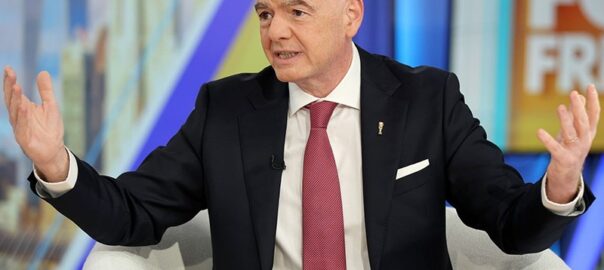
FIFA president Gianni Infantino has confirmed that the governing body will evaluate the possibility of expanding the men’s World Cup to 64 teams once the 2026 tournament has concluded. The idea emerged last year, and Infantino believes the first edition featuring 48 nations has demonstrated that larger competitions deserve further consideration.
Speaking to Swiss broadcaster Blue Sport, Infantino said any future decisions would be examined after the upcoming World Cup. He stressed that the competition should represent the entire football community rather than being focused primarily on Europe and South America, arguing that every country should have the opportunity to dream of reaching the finals.
According to Infantino, football standards continue to improve across the globe. He suggested that increasing access to the World Cup would encourage developing nations to keep progressing, while limiting places could reduce motivation for countries still striving to compete at the highest level.
Expanded competition praised after 48-team introduction
Infantino described the upcoming 48-team World Cup as a major success before it has even concluded, pointing to the performances of African nations. He highlighted that nine of the 10 African representatives progressed to the knockout rounds, contrasting that with previous editions when the continent had only five participants.
He argued that the increase in qualification places has already demonstrated its value by creating more opportunities for countries that were previously underrepresented. In his view, broader participation allows more teams to experience football’s biggest stage while strengthening the global development of the sport.
The decision to increase the World Cup from 32 to 48 teams was approved by the FIFA Council in 2017, with the expanded format taking effect for the 2026 tournament.
Proposal divides football leaders
An official request to enlarge the 2030 World Cup to 64 teams was submitted by South American governing body Conmebol in April 2025, although no final ruling has been made. FIFA has maintained that it is obliged to consider proposals presented by members of its council and will continue discussions with relevant stakeholders before reaching any conclusion.
The 2030 tournament is scheduled to be jointly staged by Spain, Portugal, and Morocco, while Argentina, Uruguay, and Paraguay will host the opening fixtures as part of celebrations marking 100 years since the first World Cup, which was held in Uruguay in 1930.
Not everyone supports further expansion. UEFA president Aleksander Ceferin has labelled the idea a bad one for both the finals and the qualifying campaign. Asian Football Confederation president Sheikh Salman bin Ibrahim Al Khalifa warned that another increase in participating teams could create chaos, while Concacaf president Victor Montagliani said the proposal does not feel appropriate and believes it could negatively affect the wider football landscape.
Meanwhile, Andrew Giuliani, executive director of the White House’s World Cup task force, said the United States could consider bidding to host the 2038 World Cup and would be capable of staging the event even if it featured 64 nations.
A larger tournament would create new challenges
When Infantino first ran for the FIFA presidency in 2016, his manifesto proposed expanding the World Cup from 32 to 40 teams. Within a year, that plan evolved into the 48-team format that will debut in 2026, while speculation over additional growth has continued ever since.
Hosting an increasingly larger competition also presents significant logistical questions. Plans to introduce 48 teams for the 2022 tournament were explored, but Qatar was ultimately unable to stage an event of that scale on its own. The 2026 edition will instead be shared across three countries, while the 2030 finals will stretch across six host nations.
Questions also remain about how Saudi Arabia would manage a 64-team World Cup with 128 matches when it hosts the 2034 tournament. At the same time, a larger field would allow almost one-third of FIFA’s 211 member associations to qualify, while generating additional revenue that could be distributed among those associations.
Although the FIFA Council would make the final decision on any expansion, there is currently no indication that such a move is expected in the immediate future.