Category Archives: 2026 FIFA World Cup

Expansion, politics and innovation: how the 2026 World Cup changed football’s biggest stage

FIFA president Gianni Infantino described the 2026 World Cup as the “biggest event in the history of mankind”, comparing the tournament hosted by the United States, Mexico, and Canada to 104 Super Bowls taking place in a single month. With 48 teams involved for the first time, the competition promised more matches, more nations, and more unforgettable moments. But the expanded format also raised questions about whether the increase in size came at the expense of quality.

The arrival of debutants such as Curaçao, Cape Verde, Jordan, and Uzbekistan added a fresh sense of discovery to the tournament. The group stage produced some memorable stories, especially from smaller nations who made their first appearance on football’s biggest stage. Cape Verde, a country with a population of around 530,000, impressed by securing draws against Spain and Uruguay, as well as Saudi Arabia, to finish second in their group.

Curacao also provided one of the tournament’s surprise moments by recovering from a heavy 7-1 defeat by Germany to earn a point against Ecuador. DR Congo reached the knockout rounds after drawing with Portugal, adding another unexpected chapter to the competition. Without the expanded format, these teams would not have had the opportunity to create those stories.

However, the new structure was not without criticism. The group phase featured 72 matches — more than an entire World Cup used to contain — but only 16 teams were eliminated. The use of head-to-head results as the first tie-breaker also created unusual situations, with teams such as Australia and Paraguay, as well as Austria and Algeria, knowing that a draw would send both sides through.

The real drama arrived once the knockout rounds began. Cape Verde pushed Argentina into extra time before eventually losing 3-2, meaning they completed the tournament without a defeat in 90 minutes against either of the eventual finalists. Their run, along with the story of veteran goalkeeper Vozinha, highlighted the value of giving more countries a chance to compete.

New rules, new formats and the impact on the road to the final

The 2026 tournament introduced a different approach to the World Cup draw, with FIFA attempting to prevent the highest-ranked teams from meeting too early. Argentina, England, France, and Spain were placed into separate sections of the bracket, ensuring they could only face each other from the semi-final stage onwards.

In the end, the special seeding system had little effect on the outcome. The four highest-ranked nations still reached the final four, something that had never happened before in World Cup history. However, one important adjustment was made to the draw to guarantee that Argentina and Spain, ranked first and second, could only meet in the final.

To achieve that, FIFA moved Argentina into Group J and France into Group I. Without that change, the semi-final match-ups would have been different, with England expected to face France and Argentina meeting Spain. The alteration changed the possible route to the final, even though the strongest teams still dominated the later stages.

Another major talking point was the introduction of mandatory three-minute hydration breaks in every match. Fifa presented the stoppages as a measure designed to protect players and maintain fairness, but the breaks became a source of frustration among supporters, especially as they were used for advertising opportunities by broadcasters.

Television companies outside the UK were allowed to show commercials during these interruptions, and advertising slots reportedly reached significant prices, particularly during matches involving the United States and during the final stages of the tournament. Coaches also used the breaks as tactical opportunities, with some matches seeing momentum shift after teams received additional instructions.

Despite criticism from fans, the hydration breaks are likely to remain part of future World Cups. However, European competitions have already rejected the idea, making their introduction into domestic leagues unlikely.

Faster football, record crowds and the business behind the tournament

FIFA refereeing chief Pierluigi Collina entered the tournament determined to improve the rhythm of matches. His focus was on reducing delays caused by slow restarts, substitutions, and players appearing to waste time through injuries.

The changes produced a noticeable difference compared with the 2022 World Cup. While matches in Qatar lasted an average of 101 minutes and 22 seconds, with 58 minutes and three seconds of actual playing time, the 2026 tournament reduced the average duration to 96 minutes and 24 seconds while slightly increasing ball-in-play time to 58 minutes and 15 seconds.

The percentage of matches spent with the ball in action also improved, rising from 57.4% in 2022 to 60.4%. The new approach was viewed as a success because games became more fluid, supporters faced fewer delays, and players provided more football within a shorter overall timeframe. The same regulations are expected to continue influencing domestic competitions.

Away from the pitch, concerns about attendance failed to materialise. Despite criticism over expensive tickets, FIFA announced that stadiums were operating at 99.7% capacity after the quarter-finals, with a record attendance figure of 6,527,410 fans.

The organisation also generated additional revenue through its resale platform, which charged a 30% fee on every transaction. Yet controversy remained, with authorities in New York and New Jersey investigating ticket pricing practices and seat information. Supporters also criticised restrictions on bringing water bottles into stadiums, forcing FIFA to reverse the decision, while transportation costs around venues such as New Jersey and Boston also caused complaints before reductions were introduced.

Politics, refereeing debates and the legacy of the tournament

The political atmosphere surrounding the 2026 World Cup was present before the first match was played. Immigration restrictions affected supporters from several countries, while Somali referee Omar Artan was denied entry at Miami Airport before the tournament began. The situation created an uncomfortable moment for Infantino, who responded by telling people to “chill” and “relax”.

Iran’s participation also became a political issue, with the team facing restrictions on how long they could stay in the United States around their matches. After Iran’s elimination, US homeland security official Markwayne Mullin publicly expressed his reaction to their exit.

One of the biggest controversies emerged when US President Donald Trump contacted Infantino regarding Florian Balogun’s suspension. A FIFA disciplinary committee member later made an unprecedented decision by suspending rather than enforcing the forward’s ban, allowing him to play against Belgium. However, the United States suffered a heavy 4-1 defeat, while the decision raised concerns about possible political influence over football matters.

VAR also became a major discussion point as the tournament progressed. The group stage passed with relatively little controversy, but knockout matches produced more debate over refereeing decisions. The Egyptian Football Association requested an investigation after their defeat by Argentina, following a VAR decision that ruled out one of their goals.

Across the tournament, VAR interventions occurred at a similar rate to the 2022 World Cup, but subjective decisions involving referee monitors were more frequent than in the Premier League. Despite complaints, one major difference was the speed of decisions, with most reviews being completed quickly compared with the longer delays often criticised in domestic football.

The 2026 World Cup delivered more matches, more participants, and more debates than any previous edition. While the expanded format created unforgettable stories from emerging nations, it also brought new challenges involving scheduling, commercial interests, politics, and technology. The tournament’s legacy may ultimately depend on whether football can preserve the excitement of a larger World Cup while addressing the concerns that came with its growth.
Lamine Yamal leads Spain to World Cup glory as Messi’s dream ends

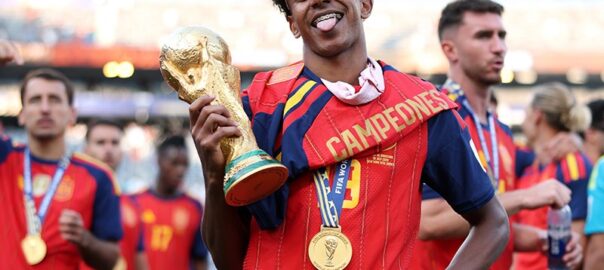
The closing moments of the World Cup final produced one of the tournament’s defining images as Lamine Yamal embraced a tearful Lionel Messi after Spain’s victory. With Argentina’s captain standing before supporters who continued to sing his name inside the New York New Jersey Stadium, the embrace appeared to represent one era fading while another begins.

The scene inevitably recalled the famous photograph from September 2007 showing a young Messi bathing six-month-old Lamine Yamal during a charity calendar event. Nearly two decades later, the two Barcelona number 10s met again under entirely different circumstances, with the teenager celebrating football’s greatest prize while the Argentine reflected on what could prove to be his final appearance on the World Cup stage.

Spain’s young star had entered the competition carrying a hamstring concern but completed the tournament by adding the World Cup to the European Championship he had already won with his country. At 19 years and six days old, he became the youngest player to collect both major international trophies.

Another key theme of the final was the contrast between the two teams. Spain relied on their collective football and technical quality, allowing Lamine Yamal to influence the match, while Argentina’s more confrontational style ultimately failed to produce the outcome they wanted.

Spain’s teenager continues rewriting history

Spain’s triumph completed another successful chapter in a tournament during which the team steadily improved before Ferran Torres settled the final with an extra-time goal in the 106th minute. The victory reinforced the country’s grip on the international game and further elevated Lamine Yamal’s growing reputation.

The statistics surrounding the winger continue to underline his extraordinary start at the international level. He remains unbeaten in 28 competitive appearances for Spain and has started 13 matches at major tournaments, winning every one of them. That sequence represents the longest perfect record for any European player starting matches at major competitions.

Lamine Yamal also entered an exclusive group alongside fellow 19-year-old Pau Cubarsi. The pair became only the fourth and fifth teenagers to start and win a World Cup final, following Pelé in 1958, Giuseppe Bergomi in 1982, and Kylian Mbappé in 2018.

Spain coach Luis de la Fuente praised the teenager after the final, expressing sincere gratitude for his contribution. He highlighted not only the quality of his football but also his willingness to sacrifice for the team, insisting those qualities would help him continue developing into an even greater player.

Composure under pressure earns widespread praise

Argentina attempted to unsettle Lamine Yamal throughout the contest, with Nicolas Tagliafico frequently involved in physical confrontations against the teenager. Despite the constant attention, the Spanish winger never allowed the situation to distract him from his performance.

Former England goalkeeper Joe Hart pointed to the youngster’s maturity, noting that he neither reacted emotionally nor retreated from the challenges. Instead, he stood his ground while maintaining his composure despite repeated attempts to disrupt his rhythm.

Hart described the display as one of the standout performances of the final, remarking that Lamine Yamal had “completed football” at only 19 years of age. With experienced players such as captain Rodri around him, the teenager leaves the tournament with the prospect of adding further honours during the years ahead.

Messi’s farewell hopes fade amid Argentina’s approach

While Spain celebrated, Messi endured a heartbreaking conclusion. The 39-year-old spent several moments after the final whistle looking toward Argentina’s supporters, creating the impression that this might have been his final appearance in football’s biggest tournament.

Coach Lionel Scaloni became emotional when asked whether the match marked Messi’s World Cup farewell, admitting he had not yet discussed the subject with his captain before breaking into tears and leaving his post-match press conference. Scaloni was also facing uncertainty over his own future with his contract due to expire in December.

Argentina’s tactical approach became another major talking point. Rather than allowing Messi to dictate the contest, the team repeatedly became involved in physical confrontations. Slovenia referee Slavko Vincic allowed several robust challenges to pass without severe punishment, including Alexis Mac Allister’s early foul on Dani Olmo, while Lisandro Martinez eventually received the game’s first booking only after 40 minutes.

Messi himself became involved when he appealed for Marc Cucurella to be sent off after speaking with his hand covering his mouth, an action that could result in a red card if used confrontationally under tournament regulations. Shortly before extra time, Enzo Fernandez was dismissed after charging into Pau Cubarsi without attempting to play the ball.

Numbers that reflected the final

The statistics illustrated Spain’s superiority throughout the contest. Argentina became the first side in World Cup history to finish the opening 90 minutes of a final without attempting a single shot, only managing one effort in the 117th minute when Messi fired wide.

Spain finished with 12 shots on target, while Argentina failed to register one across the entire match. During the opening half, Argentina also committed more fouls than completed passes in the attacking third, recording nine fouls compared with eight passes.

Emotions boiled over after the final whistle as players from both teams became involved in another confrontation. Leandro Paredes grabbed Eric Garcia by the throat and was also present during an incident that saw Gavi thrown to the ground, bringing an untidy conclusion to an otherwise memorable World Cup.

Spain may not have produced their finest display in the final, but their progress from an opening draw against Cape Verde to lifting the trophy completed an impressive campaign. For Messi, the defeat may have marked the closing chapter of an unforgettable World Cup story, while Lamine Yamal emerged as the face of tournaments still to come.

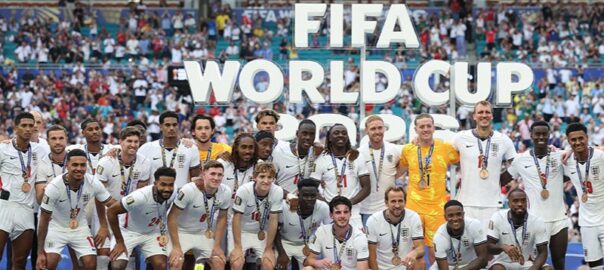
England finish World Cup on a high after remarkable 6-4 success against France

A fixture often viewed as an unwanted finale to a tournament turned into one of the most unforgettable matches of the World Cup. England defeated France 6-4 to claim third place, producing the highest-scoring bronze-medal game in tournament history and recording the nation’s best men’s World Cup finish since lifting the trophy in 1966. It also marked England’s strongest World Cup result outside home soil and their first victory over a higher-ranked nation at the finals since overcoming Argentina in 2002.

Only days after their painful semi-final defeat to Argentina, Thomas Tuchel’s side responded with an explosive first-half display. England raced into a four-goal advantage before the interval, immediately putting France under relentless pressure and silencing any suggestion that the contest would lack intensity or entertainment.

Declan Rice, captaining the side with Harry Kane among the substitutes, opened the scoring after intercepting a misplaced pass from Desire Doue, driving forward and firing beyond Mike Maignan from outside the penalty area. Soon afterwards, Rice delivered a corner that Ezri Konsa glanced home to double England’s advantage.

England continued to exploit the open spaces left by France. Bukayo Saka first converted after Marcus Rashford helped create the opportunity following an initial save from Maignan, before adding another deep into first-half stoppage time by finishing a precise through ball from Eberechi Eze to complete a remarkable opening 45 minutes.

France responds, but England withstand the fightback

France emerged after the break with far greater purpose following what appeared to be a forceful team talk from Didier Deschamps in his final match as national team manager. The turnaround nearly became complete as Les Bleus dramatically reduced the deficit and repeatedly threatened an equaliser.

Kylian Mbappé began the comeback with an early second-half finish before Bradley Barcola struck from a tight angle only minutes later. Mbappe then completed another flowing move to score his second of the evening, reaching 10 goals in the tournament, moving ahead of Lionel Messi in the Golden Boot race and becoming the World Cup’s all-time leading scorer with 22 goals. He also became the first player since Gerd Muller in 1970 to reach double figures at a men’s World Cup.

France continued to create chances as England goalkeeper Dean Henderson denied Rayan Cherki, Mbappé, and Ousmane Dembélé with several important saves, while Michael Olise failed to convert two clear opportunities. Despite France’s pressure, England found the decisive response when Djed Spence was brought down by Malo Gusto, allowing Saka to complete his hat-trick from the penalty spot.

Dembele curled home in stoppage time to reduce the deficit once again, but England had the final word. Jude Bellingham collected possession near halfway, surged through the French defence, beat Maxence Lacroix, and calmly finished with virtually the last kick of the match to seal a memorable 6-4 triumph.

Saka shines as England answer questions after semi-final defeat

Tuchel introduced seven changes following the loss to Argentina, leaving both Harry Kane and Bellingham out of the starting line-up while handing Saka a start despite the winger’s fitness struggles during the tournament. England’s attacking approach stood in sharp contrast to the tactics used in the semi-final and produced one of the team’s most entertaining displays.

Saka’s influence stretched well beyond his three goals. He also had another effort ruled out for offside and consistently troubled France down the right flank, prompting fresh discussion over why he had not been introduced during the defeat to Argentina.

Although England looked less secure after the interval as France mounted their comeback, they ultimately prevailed in a contest featuring 38 shots, including 20 on target. No England World Cup match has ever produced more goals, while the flowing football earned widespread praise from former internationals Stephen Warnock and Danny Murphy.

Bellingham also completed an outstanding individual tournament by finishing with seven goals, the highest tally ever recorded by an England men’s player at a single World Cup.

Deschamps bows out after dramatic farewell

The match marked the conclusion of Didier Deschamps’ time in charge of France after his 187th appearance as head coach and a record-extending 27th World Cup finals match. The 2018 World Cup-winning manager ended his reign with a thrilling defeat despite seeing his team produce a vastly improved second-half performance.

France entered the contest with tournament top scorer Mbappe and leading assist provider Michael Olise in the starting eleven, but their first-half display left them facing a historic setback. They had never previously trailed by four goals at half-time since April 1930, and they also conceded six goals in a World Cup match for the first time.

Even though Les Bleus dominated large spells after the interval and repeatedly threatened to rescue the contest, England’s clinical finishing proved decisive. The encounter finished level with France’s 7-3 victory over Paraguay in 1958 as the joint fifth highest-scoring World Cup match and became the tournament’s highest-scoring game since Hungary defeated El Salvador 10-1 in 1982.

Match preview: Spain vs Argentina

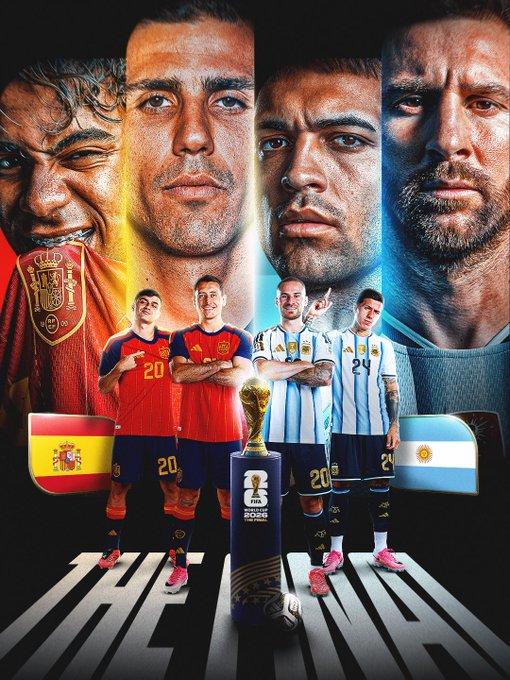
The 2026 FIFA World Cup reaches its conclusion with Spain and Argentina meeting in the tournament’s 102nd and final fixture. The winners will leave with football’s biggest honour after a campaign that has brought together the world’s strongest national teams.

Argentina arrive as the reigning world champions after lifting the trophy in 2022 and now have the opportunity to defend their title successfully. Only Italy, with triumphs in 1934 and 1938, and Brazil, with consecutive victories in 1958 and 1962, have previously retained the World Cup.

Spain entered the contest carrying the status of European champions and are chasing a second world title after their success in 2010. The final also creates a unique occasion, as the current Copa América holders face the reigning UEFA European champions in a World Cup final for the first time.

Adding further significance, it is also the first World Cup meeting at any stage between the teams occupying the top two places in the FIFA World Rankings, with Argentina ranked first and Spain second.

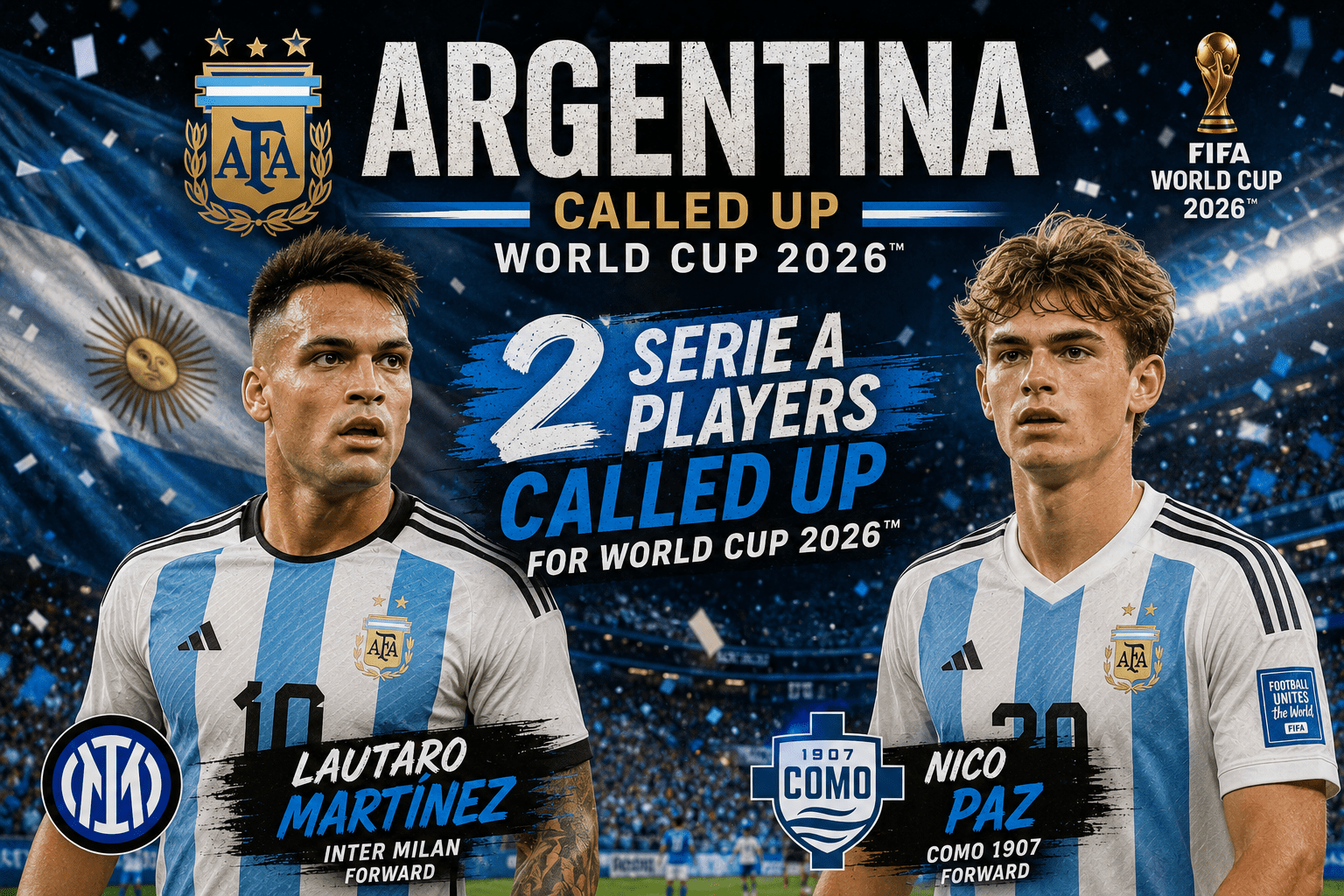
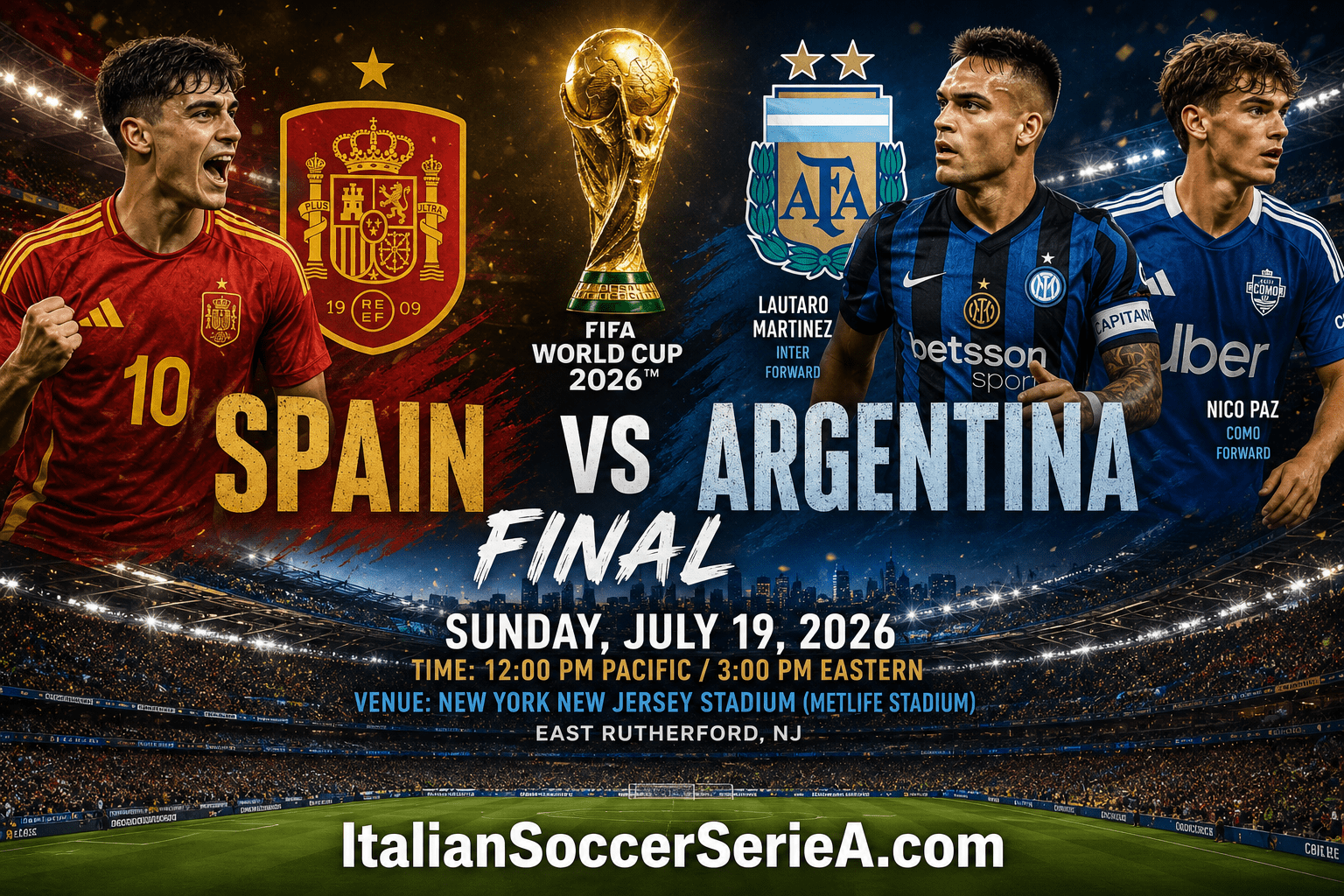
👉   Serie A players called up for  🇦🇷    the Argentina National team:
  • Inter forward Lautaro Martinez.
  • Como forward Nico Paz.


Date: Sunday, July 19, 2026
Kick-off Time: 15:00 New York local time (UTC-4)
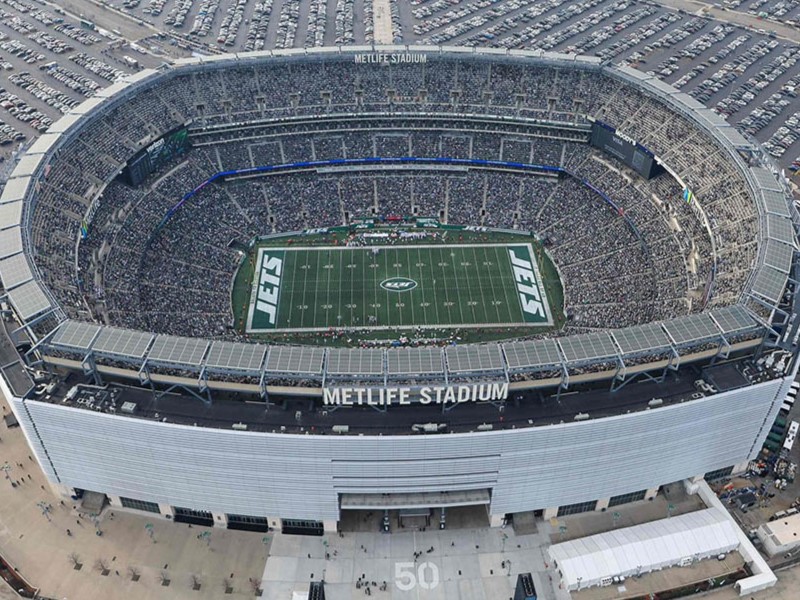
Venue: New York New Jersey Stadium, East Rutherford, New Jersey
Venue Capacity: 82,500
Opponents: Spain vs. Argentina (Final)
This is the World Cup final, a clash between the reigning European champions (Spain) and the defending world champions (Argentina)

Spain rely on consistency and defensive strength

Spain are preparing for only the second World Cup final in the nation’s history after winning the competition in 2010. Across all major tournaments, they have celebrated victory in five of their six finals, including four successes from five appearances in European Championship finals.

One of Spain’s biggest strengths throughout the competition has been their defensive control. Opponents have generated only 0.31 expected goals per match, the best figure recorded at this tournament and a mark matched only by Uruguay’s performance at the 1990 World Cup since records dating back to 1966.

That defensive dominance has produced six clean sheets, already the highest total achieved by any team during a single World Cup. Their overall consistency is reflected in an unbeaten sequence of 37 matches in all competitions since a 1-0 defeat to Colombia in March 2024.

If Spain avoids defeat in the final, they will establish the longest unbeaten run ever recorded by a European national side. Those numbers are among the reasons they are considered favourites by many, including the Opta supercomputer.

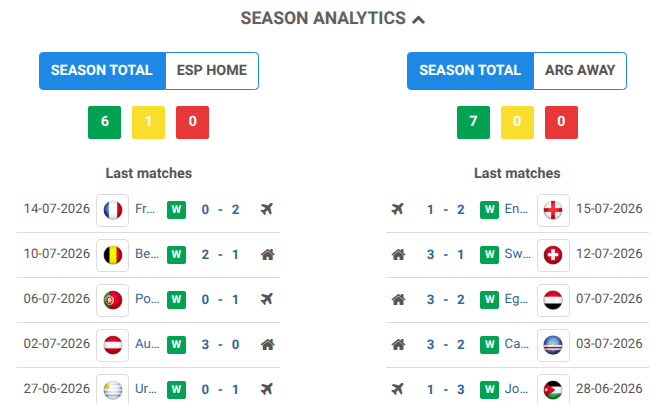
Last 5 Spain matches stats

FIFA World Cup

FIFA World Cup

FIFA World Cup

FIFA World Cup

FIFA World Cup

France 0 – 2 Spain

Spain 2 – 1 Belgium

Portugal 0 – 1 Spain

Spain 3 – 0 Austria

Uruguay 0 – 1 Spain

2026/07/14

2026/07/10

2026/07/06

2026/07/02

2026/06/27

Argentina pursue another place in history

Argentina will contest the seventh World Cup final in their history, with only Germany having appeared in more. Their previous record includes titles in 1978, 1986, and 2022, alongside runner-up finishes in 1930, 1990, and 2014.

Lionel Scaloni’s side have enjoyed a flawless campaign, winning each of their seven matches in the tournament. Victory in the final would make them the first nation since Brazil in 2002 to finish a World Cup with seven wins from seven games.

Their winning streak stretches even further beyond the competition. Argentina had already claimed seven consecutive victories before arriving at the finals, meaning success against Spain would produce a 15-match winning run and establish a new record for a South American national team.

Despite those perfect results, Argentina have shown moments of vulnerability during the tournament, leaving many observers believing they still face their toughest examination in the final.

Last 5 Argentina matches stats

FIFA World Cup

FIFA World Cup

FIFA World Cup

FIFA World Cup

FIFA World Cup

England 1 – 2 Argentina

Argentina 3 – 1 Switzerland

Argentina 3 – 2 Egypt

Argentina 3 – 2 Cabo Verde

Jordan 1 – 3 Argentina

2026/07/15

2026/07/12

2026/07/07

2026/07/04

2026/06/28

Records, stars and rivalry add extra intrigue

Much of the attention is expected to centre on Lionel Messi and Lamine Yamal. If both are named in the starting line-up, they will become the first opposing starters in a World Cup final separated by more than two decades in age. Messi has completed a tournament-leading 25 dribbles, the highest total ever recorded by a player aged over 30 in a single World Cup, while Yamal’s 22 successful dribbles equal the best figure ever achieved by a teenager alongside Kylian Mbappé in 2018.

Messi is also set to make history by becoming only the second player to feature in three World Cup finals after Cafu. At 39 years and 25 days, he would additionally become the oldest outfield player to appear in the showpiece. Yamal, meanwhile, would become the third-youngest player ever to play in a World Cup final at 19 years and six days.

Rodri is another major figure to watch after completing 655 passes during the tournament, already the highest total recorded in a single World Cup edition. His performances have placed him among the contenders for the Golden Ball should Spain claim the title.

The nations have rarely met at the World Cup, with Argentina winning their only previous tournament encounter 2-1 in the 1966 group stage. Since the beginning of this century, Spain has won three of their four meetings with Argentina, while the latest clash between the sides ended in a 6-1 Spanish victory in a friendly played in March 2018.

Past H2H Results

International friendlies

International friendlies

International friendlies

Spain 6 – 1 Argentina

Argentina 4 – 1 Spain

Spain 2 – 1 Argentina

2018/03/27

2010/09/07

2009/11/14

Prediction and expected outcome

Spain and Argentina arrive in the World Cup final with outstanding records, making this one of the most evenly matched championship games in recent history. Argentina have won all seven of their matches in the tournament and are chasing back-to-back world titles, while Spain combines an exceptional unbeaten run with the tournament’s strongest defensive record, having conceded very few chances and kept six clean sheets. The battle between Lionel Messi’s experience and Lamine Yamal’s youthful brilliance could prove decisive, but Spain’s ability to dictate possession and control matches may give them a slight tactical advantage. Argentina, however, possess the confidence and resilience of reigning champions and have consistently found ways to win throughout the competition. The most likely outcome is a tense, tactical contest decided by fine margins, with extra time or even penalties remaining a realistic possibility.

Prediction: Spain 2-1 Argentina

Expected outcome: A closely contested final in which Spain’s defensive organisation and control of possession ultimately prove decisive against Argentina’s determined challenge. The margins between the teams are extremely small, making every moment significant, but Spain appear slightly better equipped to edge the contest and lift their second FIFA World Cup trophy.

Spain vs Argentina Official Lineups, Sunday, 19 July 2026, World Cup Final

Spain vs Argentina Official Lineups, Sunday, 19 July 2026, World Cup Final

Here are the official starting lineups for Spain and Argentina in the 2026 FIFA World Cup Final, taking place on Sunday, July 19, 2026. This eagerly awaited match is set to begin at 12:00 PM local time at the New York New Jersey Stadium (MetLife Stadium) in East Rutherford, New Jersey.

The match includes two Serie A players from Argentina: Inter forward Lautaro Martinez and Como forward Nico Paz.

19-07-2026 19:00
Final


How they reached the World Cup Final

Spain made it to the final with a commanding 2-0 win against France in the semi-finals. La Roja has showcased the best defense in the tournament, allowing just one goal in seven games and focusing on maintaining possession in midfield.

Argentina, the reigning champions, navigated through a series of thrilling knockout matches, highlighted by a 2-1 comeback against England in stoppage time during the semi-finals. Their success is largely attributed to the vast experience of Lionel Messi and the late-game brilliance of players like Inter forward Lautaro Martinez.

Image


Head to Head

In their history, the two nations have faced each other evenly, with a record of 6 wins, 2 draws, and 6 losses for each side. This match marks their inaugural encounter in a World Cup knockout stage, and it’s also their first World Cup clash since the group stage in 1966.


👉   Serie A players called up for  🇦🇷    the Argentina National team:
  • Inter forward Lautaro Martinez.
  • Como forward Nico Paz.


Spain starting lineup: Unai Simón, Pedro Porro, Pau Cubarsí, Aymeric Laporte, Marc Cucurella, Rodri, Fabián Ruiz, Lamine Yamal, Dani Olmo, Álex Baena, Mikel Oyarzabal

Substitutes: David Raya, Marc Pubill, Alejandro Grimaldo, Eric García, Marcos Llorente, Mikel Merino, Ferran Torres, Gavi, Yéremy Pino, Joan García, Nico Williams, Martín Zubimendi, Pedri, Víctor Muñoz, Borja Iglesias

Argentina starting lineup: Emiliano Martínez, Gonzalo Montiel, Cristian Romero, Lisandro Martínez, Nicolás Tagliafico, Rodrigo De Paul, Alexis Mac Allister, Enzo Fernández, Nico González, Lionel Messi, Julián Alvarez

Substitutes: Juan Musso, Marcos Senesi, Leandro Paredes, Valentín Barco, Giovani Lo Celso, Gerónimo Rulli, Exequiel Palacios, Thiago Almada, Giuliano Simeone, Nico Paz, Nicolás Otamendi, José Manuel López, Lautaro Martínez, Facundo Medina, Nahuel Molina

Spain
Argentina

Starting lineups

23
Unai Simón
Goalkeeper
14
Aymeric Laporte
Defender
99'
24
Marc Cucurella
Defender
22
Pau Cubarsí
Defender
12
Pedro Porro
Defender
15
Álex Baena
Midfielder
75'
8
Fabián Ruiz
Midfielder
62'
16
Rodri
Midfielder
99'
10
Dani Olmo
Attacker
75'
19
Lamine Yamal
Attacker
21
Mikel Oyarzabal
Attacker
62'
23
Emiliano Martínez
Goalkeeper
13
Cristian Romero
Defender
71'
4
Gonzalo Montiel
Defender
58'
6
Lisandro Martínez
44'
3
Nicolás Tagliafico
20
Alexis Mac Allister
Midfielder
24
Enzo Fernández
Midfielder
7
Rodrigo de Paul
Midfielder
71'
9
Julián Álvarez
Attacker
102'
10
Lionel Messi
Attacker
15
Nico González
Attacker
46'

Substitutes

1
David Raya
Goalkeeper
9
Gavi
Midfielder
5
Marcos Llorente
Midfielder
3
Alejandro Grimaldo
13
Joan García
Goalkeeper
2
Marc Pubill
Defender
26
Borja Iglesias
Attacker
11
Yéremy Pino
Attacker
25
Víctor Muñoz
Attacker
7
Ferran Torres
Attacker
62'
20
Pedri
Midfielder
62'
6
Mikel Merino
Midfielder
75'
17
Nico Williams
Attacker
75'
4
Eric García
Defender
99'
18
Martín Zubimendi
Midfielder
99'
1
Juan Musso
Goalkeeper
22
Lautaro Martínez
18
Nico Paz
Midfielder
11
Giovani Lo Celso
Midfielder
14
Exequiel Palacios
Midfielder
16
Thiago Almada
Midfielder
12
Gerónimo Rulli
Goalkeeper
8
Valentín Barco
Defender
21
José Manuel López
2
Marcos Senesi
Defender
102'
19
Nicolás Otamendi
44'
5
Leandro Paredes
Midfielder
46'
26
Nahuel Molina
Defender
58'
17
Giuliano Simeone
Attacker
71'
25
Facundo Medina
Defender
71'


Spain   Spain World Cup Squad:
  • Goalkeepers: Unai Simon (Athletic Bilbao), David Raya (Arsenal), Joan Garcia (Barcelona).
  • Defenders: Marc Cucurella (Chelsea), Alejandro Grimaldo (Bayer Leverkusen), Pau Cubarsi (Barcelona), Aymeric Laporte (Athletic Bilbao), Marc Pubill (Atletico Madrid), Eric Garcia (Barcelona), Marcos Llorente (Atletico Madrid), Pedro Porro (Tottenham Hotspur).
  • Midfielders: Pedri (Barcelona), Fabian Ruiz (PSG), Martin Zubimendi (Arsenal), Gavi (Barcelona), Rodri (Manchester City), Alex Baena (Atletico Madrid), Mikel Merino (Spain).
  • Forwards: Mikel Oyarzabal (Real Sociedad), Dani Olmo (Barcelona), Nico Williams (Athletic Bilbao), Yeremy Pino (Crystal Palace), Ferran Torres (Barcelona), Borja Iglesias (Celta de Vigo), Víctor Muñoz (Osasuna), Lamine Yamal (Barcelona)
Argentina   Argentina World Cup 2026 Squad:
  • Goalkeepers: Juan Musso (Atletico Madrid), Geronimo Rulli (Marseille), Emiliano Martinez (Aston Villa).
  • Defenders: Leonardo Balerdi (Marseille), Nicolas Tagliafico (Lyon), Gonzalo Montiel (River Plate), Lisandro Martinez (Manchester United), Cristian Romero (Tottenham), Nicolas Otamendi (Benfica), Facundo Medina (Marseille), Nahuel Molina (Atletico Madrid).
  • Midfielders: Leandro Paredes (Boca Juniors), Rodrigo de Paul (Inter Miami), Valentin Barco (Strasbourg), Giovani lo Celso (Real Betis), Ezequiel Palacios (Bayer Leverkusen), Alexis Mac Allister (Liverpool), Enzo Fernandez (Chelsea).
  • Forwards: Julian Alvarez (Atletico Madrid), Lionel Messi (Inter Miami), Nicolas Gonzalez (Atletico Madrid), Thiago Almada (Atletico Madrid), Giuliano Simeone (Atletico Madrid), Nico Paz (Como), Jose Manuel Lopez (Palmeiras), Lautaro Martinez (Inter)


The New York / New Jersey Stadium is ready for Spain vs England


Image


Image


Buy FIFA World Cup Tickets
Sports, Football, Soccer, FIFA World Cup Tickets

Sports Events 365World Cup Final

🇪🇸  Spain – Argentina   🇦🇷

Date: Sunday, July 19, 2026Time: 12:00 PM Pacific / 3:00 PM Eastern
Venue: New York New Jersey Stadium (MetLife Stadium)
East Rutherford, NJ

Referee: Slavko Vinčić SVN
Assistant Referee 1: Tomaž Klančnik SVN
Assistant Referee 2: Andraž Kovačič SVN
Fourth Official: Adham Makhadmeh JOR
Reserve AR: Mohammad Alkalaf JOR
Video Assistant Referee: Bastian Dankert GER
Assistant Video Assistant Referee 1 : Nicolas Gallo COL
Assistant Video Assistant Referee 2 : Khamis Al Marri QAT
Standby Video Assistant Referee: : Tatiana Guzman NCA
Standby Assistant Video Assistant Referee: Guillermo Pacheco MEX