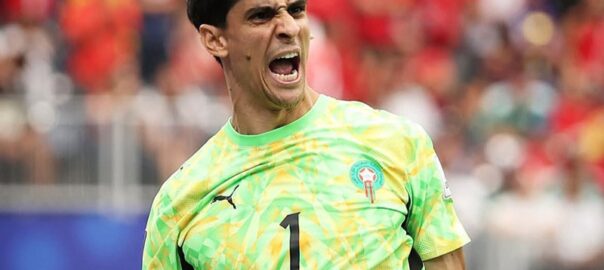
France booked their place in the World Cup semi-finals with a 2-0 victory over Morocco, but one of the game’s biggest talking points came long before the final whistle. Kylian Mbappe failed to convert from the penalty spot after his trademark delayed approach ended with a comfortable save by Yassine Bounou.
The opportunity arrived in a scoreless match after Noussair Mazraoui brought down the France captain. Mbappe slowed his run before striking, hoping to force the goalkeeper into an early decision, but Bounou remained patient and denied the effort with ease.
The miss did not define Mbappe’s evening. Shortly after the hour mark he produced a superb curling finish to finally break Morocco’s resistance, while Ousmane Dembele added a second goal six minutes later to secure France’s passage.
Even so, the failed penalty reignited discussion about whether the increasingly common stuttering run-up is still an effective technique.
A tactic that divides opinion
Many traditional football supporters have never embraced the delayed approach from the penalty spot, placing it alongside other modern aspects of the game they dislike, including VAR, diving, and players wearing gloves despite short-sleeved shirts.
FIFA regulations allow players to pause or feint during their approach provided they do not perform that movement immediately before striking the ball. The method has existed for decades, having previously been used by John Aldridge, Hugo Sánchez, and Pelé.
The approach is designed to persuade goalkeepers to move first, but it becomes far less effective when the goalkeeper holds position and refuses to commit early.
During this World Cup, Mbappe joined Bruno Guimarães, Jorgen Strand Larsen, Lionel Messi, and Harry Kane among players who failed to score after using a stuttering approach. Kane later converted his retaken penalty against Croatia after abandoning that technique.
Numbers suggest a changing balance
Statistics from the tournament indicate that delayed run-ups have not been especially productive. Across 26 penalties using that method, including shootouts, only 15 found the net, producing a conversion rate of 57%.
Players such as Marko Arnautovic, Raul Jimenez, Neymar, Cristiano Ronaldo, Yoane Wissa, and Kai Havertz were among those who successfully used the technique.
By comparison, players taking penalties without a stutter converted 24 of 35 attempts, giving a success rate of 68%.
Overall, penalty takers have endured a difficult World Cup. Thirty percent of penalties taken during normal play have been missed, making it the second-highest miss rate at a World Cup since records began in 1966. When shootout kicks are included, unsuccessful attempts rise to 35%, the highest figure recorded in that period.
Experts point to goalkeepers and preparation
Speaking on ITV, Ian Wright suggested that goalkeepers now appear better equipped to deal with stuttering penalties, saying they have gained the upper hand against the technique.
Pat Nevin argued that modern goalkeepers are taller, quicker, and better prepared, making penalties increasingly difficult to score. He explained that players use delayed run-ups in an attempt to force keepers into diving the wrong way, but detailed analysis means goalkeepers are now familiar with individual preferences, creating an ongoing battle between both sides.
Mbappe’s overall record from the penalty spot remains strong. The miss against Morocco was only his second in a France shirt, leaving him with 14 successful penalties from 16 attempts. At the club level, he has converted 50 of his 62 penalties.
His opponent also deserves significant credit. Bounou has conceded only two of the nine penalties he has faced during the World Cup, including shootouts, recording four saves while three other attempts missed the target.
The delay before the kick becomes another talking point
The penalty was not taken immediately after it was awarded. A VAR review meant three minutes and 12 seconds passed before Mbappe eventually stepped up, creating another debate over whether long interruptions benefit goalkeepers.
French football journalist Julien Laurens felt the lengthy pause disrupted Mbappe’s usual preparation. He described the effort as a poor penalty, adding that the forward normally relies heavily on his established routine when placing the ball before shooting.
Laurens also praised Bounou’s ability from the penalty spot but believed the weak strike made the save straightforward. He suggested Mbappe rush once he was finally given permission to continue.
Roy Keane, speaking on ITV, questioned why players should have to wait so long before taking penalties, arguing that time works against the taker and shifts the balance towards the goalkeeper. Ian Wright agreed, saying prolonged delays give players more opportunity to second-guess their decision before striking the ball.