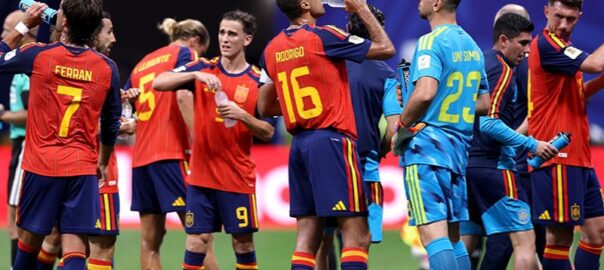
A familiar pattern has emerged at World Cup matches, where referees halt play roughly 22 minutes into each half for a three-minute drinks interval. The measure has been made compulsory across all 104 games, designed to help players cope with intense heat and humidity across co-host nations Mexico, Canada, and the United States.
Despite its stated purpose, the intervention has not been universally welcomed. Some critics have suggested the pauses resemble commercial interruptions intended to suit US broadcasters. Even venues with retractable roofs and climate control are still applying the same stoppages.
The USA head coach Mauricio Pochettino was among those questioning the necessity of the rule. He said: “I don’t like it. I only like it when the conditions are extreme. But when the conditions are good, it is unnecessary.”
Momentum shifts and coaching advantages
One of the clearest debates around the breaks is their influence on game rhythm. In Brazil’s opening match against Morocco, the South Americans were trailing 1-0 and underperforming before the first-half pause. Shortly after play resumed, they equalised, with Vinícius Júnior scoring a standout goal after cutting inside and finishing powerfully.
Brazil coach Carlo Ancelotti later acknowledged the interruption allowed him to adjust instructions and refine tactics during the pause. He noted that such moments can be used to explain problems and implement tactical changes that influence performance.
US women’s coach Emma Hayes described the stoppages as disrupting momentum for the side in control. She said: “It’s advantageous for the team losing momentum – that’s why I call them momentum breaks.” She added that while sometimes players simply hydrate and reset, the pause can still function as coaching time.
Teams gaining or losing rhythm after breaks
Several early matches have shown swings in momentum following the mandatory interruptions. Canada, for example, equalised shortly after a second-half hydration break when substitute Cyle Larin scored against Bosnia-Herzegovina.
Elsewhere, Scotland found a decisive goal soon after a stoppage in their win over Haiti, while Australia also scored shortly after a break during their 2-0 victory against Turkey. These sequences have strengthened the view that the pauses can coincide with shifts in control, even if they are not the direct cause.
Former Spain midfielder Juan Mata said he would have disliked such interruptions as a player, arguing that they break attacking rhythm. He explained that teams either want to chase a goal or maintain possession depending on the scoreline, and stoppages interrupt that flow.
Controversy over purpose and broadcasting influence
Criticism has also focused on whether the breaks serve commercial interests. Former England forward Ian Wright suggested they function as a way of inserting advertising into the game, saying: “I just think it’s another way of getting adverts into it from an American point of view.”
He also noted that broadcasts had already used the pauses for advertising transitions during opening matches, reinforcing scepticism about their intent. Some observers argue this undermines the idea that the breaks are solely for player welfare.
Differing views on player welfare and extreme conditions
Not all reactions have been negative, with some coaches defending the measure as necessary in extreme environments. Spain coach Luis de la Fuente supported the initiative ahead of his team’s opener, highlighting the difficulty of playing in high temperatures.
He said it is important for players to hydrate, breathe, and receive brief instructions during pauses. However, he also noted that conditions vary by venue, pointing out that some stadiums are temperature-controlled, including those with retractable roofs.