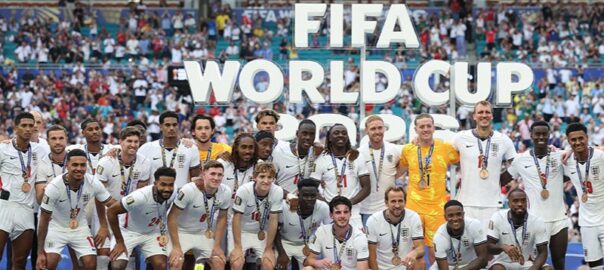
A fixture often viewed as an unwanted finale to a tournament turned into one of the most unforgettable matches of the World Cup. England defeated France 6-4 to claim third place, producing the highest-scoring bronze-medal game in tournament history and recording the nation’s best men’s World Cup finish since lifting the trophy in 1966. It also marked England’s strongest World Cup result outside home soil and their first victory over a higher-ranked nation at the finals since overcoming Argentina in 2002.
Only days after their painful semi-final defeat to Argentina, Thomas Tuchel’s side responded with an explosive first-half display. England raced into a four-goal advantage before the interval, immediately putting France under relentless pressure and silencing any suggestion that the contest would lack intensity or entertainment.
Declan Rice, captaining the side with Harry Kane among the substitutes, opened the scoring after intercepting a misplaced pass from Desire Doue, driving forward and firing beyond Mike Maignan from outside the penalty area. Soon afterwards, Rice delivered a corner that Ezri Konsa glanced home to double England’s advantage.
England continued to exploit the open spaces left by France. Bukayo Saka first converted after Marcus Rashford helped create the opportunity following an initial save from Maignan, before adding another deep into first-half stoppage time by finishing a precise through ball from Eberechi Eze to complete a remarkable opening 45 minutes.
France responds, but England withstand the fightback
France emerged after the break with far greater purpose following what appeared to be a forceful team talk from Didier Deschamps in his final match as national team manager. The turnaround nearly became complete as Les Bleus dramatically reduced the deficit and repeatedly threatened an equaliser.
Kylian Mbappé began the comeback with an early second-half finish before Bradley Barcola struck from a tight angle only minutes later. Mbappe then completed another flowing move to score his second of the evening, reaching 10 goals in the tournament, moving ahead of Lionel Messi in the Golden Boot race and becoming the World Cup’s all-time leading scorer with 22 goals. He also became the first player since Gerd Muller in 1970 to reach double figures at a men’s World Cup.
France continued to create chances as England goalkeeper Dean Henderson denied Rayan Cherki, Mbappé, and Ousmane Dembélé with several important saves, while Michael Olise failed to convert two clear opportunities. Despite France’s pressure, England found the decisive response when Djed Spence was brought down by Malo Gusto, allowing Saka to complete his hat-trick from the penalty spot.
Dembele curled home in stoppage time to reduce the deficit once again, but England had the final word. Jude Bellingham collected possession near halfway, surged through the French defence, beat Maxence Lacroix, and calmly finished with virtually the last kick of the match to seal a memorable 6-4 triumph.
Saka shines as England answer questions after semi-final defeat
Tuchel introduced seven changes following the loss to Argentina, leaving both Harry Kane and Bellingham out of the starting line-up while handing Saka a start despite the winger’s fitness struggles during the tournament. England’s attacking approach stood in sharp contrast to the tactics used in the semi-final and produced one of the team’s most entertaining displays.
Saka’s influence stretched well beyond his three goals. He also had another effort ruled out for offside and consistently troubled France down the right flank, prompting fresh discussion over why he had not been introduced during the defeat to Argentina.
Although England looked less secure after the interval as France mounted their comeback, they ultimately prevailed in a contest featuring 38 shots, including 20 on target. No England World Cup match has ever produced more goals, while the flowing football earned widespread praise from former internationals Stephen Warnock and Danny Murphy.
Bellingham also completed an outstanding individual tournament by finishing with seven goals, the highest tally ever recorded by an England men’s player at a single World Cup.
Deschamps bows out after dramatic farewell
The match marked the conclusion of Didier Deschamps’ time in charge of France after his 187th appearance as head coach and a record-extending 27th World Cup finals match. The 2018 World Cup-winning manager ended his reign with a thrilling defeat despite seeing his team produce a vastly improved second-half performance.
France entered the contest with tournament top scorer Mbappe and leading assist provider Michael Olise in the starting eleven, but their first-half display left them facing a historic setback. They had never previously trailed by four goals at half-time since April 1930, and they also conceded six goals in a World Cup match for the first time.
Even though Les Bleus dominated large spells after the interval and repeatedly threatened to rescue the contest, England’s clinical finishing proved decisive. The encounter finished level with France’s 7-3 victory over Paraguay in 1958 as the joint fifth highest-scoring World Cup match and became the tournament’s highest-scoring game since Hungary defeated El Salvador 10-1 in 1982.