Category Archives: 2026 FIFA World Cup

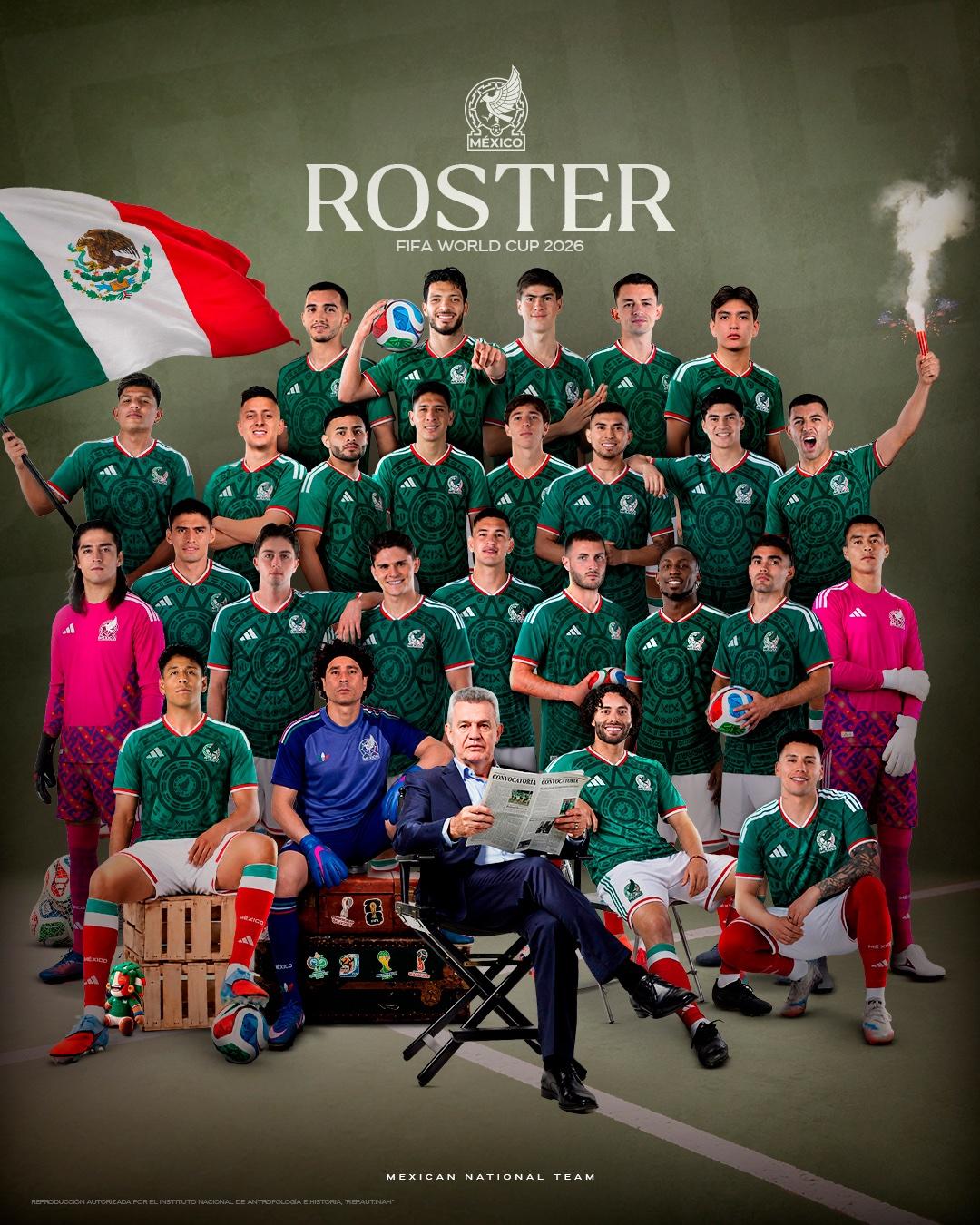
Mexico’s FIFA World Cup 2026 Squad

Mexico’s FIFA World Cup 2026 Squad

Mexico head coach, Javier Aguirre, has revealed the 26 players who will represent co-hosts Mexico at the FIFA World Cup 2026.  Veteran goalkeeper Guillermo Ochoa, a former player for Salernitana*,  will make his sixth World Cup appearance.  Rising star Gilberto Mora will make history as the youngest Mexican to participate in the tournament at just 17 years old.

✅   Two Serie A players included: AC Milan forward Santiago Gimenez and
Genoa defender Johan Vasquez.

The Mexico national team is in Group A.  Mexico will start the 2026 World Cup tournament by facing a CAF representative, South Africa.   Group A also features a familiar face from Asia, the Korea Republic, along with a UEFA participant, Czech Republic.

  • * On December 23, 2022, Guillermo Ochoa joined the Italian Serie A team Salernitana, signing a contract that runs until June 30, 2023, with an option for a one-year extension. After playing a crucial role in keeping the club from being relegated, Ochoa was honored with the Player of the Season award by Salernitana. He departed from Salernitana by mutual agreement at the conclusion of the 2023–24 season following the club’s relegation to Serie B.

👉   Click here for  Full 2026 World Cup Squad Lists – Confirmed rosters for all 48 teams

👉  Click here for  2026 World Cup Group Stage Standings

Buy FIFA World Cup Tickets.
Sports, Football, Soccer, FIFA World Cup Tickets

Sports Events 365


Mexico    Mexico National team:
  • Goalkeepers: Raul Rangel (Guadalajara), Guillermo Ochoa (AEL Limassol), Carlos Acevedo (Santos Laguna).
  • Defenders: Jorge Sanchez (PAOK), Israel Reyes (Club America), Cesar Montes (Lokomotiv Moscow), Johan Vasquez (Genoa), Jesus Gallardo (Toluca), Mateo Chavez (AZ).
  • Midfielders: Erik Lira (Cruz Azul), Orbelin Pineda (AEK Athens), Alvaro Fidalgo (Real Betis), Roberto Alvarado, Brian Gutierrez, Luis Romo (Guadalajara), Edson Alvarez (West Ham), Obed Vargas (Atletico Madrid), Gilberto Mora (Tijuana), Luis Chavez (Dynamo Moscow).
  • Forwards: Cesar Huerta (Anderlecht), Alexis Vega (Toluca), Julian Quinones (Al-Qadsiah), Guillermo Martinez (UNAM), Armando Gonzalez (Guadalajara), Santiago Gimenez (AC Milan), Raul Jimenez (Fulham).


Knockout
 
Possible knockout


World Cup 2026 Group E: Squad announcements

Germany

Manuel Neuer has been recalled from international retirement and is set to start as Germany’s first-choice goalkeeper at the 2026 World Cup under Julian Nagelsmann. The 40-year-old Bayern Munich player last featured for his country at Euro 2024, when Germany was eliminated by Spain in the quarter-finals, and had earlier stepped away from national duty after that tournament. He was part of Germany’s 2014 World Cup-winning side and has earned 124 international appearances while continuing to feature strongly for Bayern this season, including a Bundesliga title and a Champions League semi-final run. Nagelsmann highlighted his experience and influence, confirming that the team is built around him for the tournament in North America.

Goalkeepers: Oliver Baumann (Hoffenheim), Manuel Neuer (Bayern Munich), Alexander Nubel (Stuttgart)
Defenders: Waldemar Anton (Borussia Dortmund), Nathaniel Brown (Eintracht Frankfurt), Joshua Kimmich (Bayern Munich), David Raum (RB Leipzig), Antonio Rudiger (Real Madrid), Nico Schlotterbeck (Borussia Dortmund), Jonathan Tah (Bayern Munich), Malick Thiaw (Newcastle United)
Midfielders: Nadiem Amiri (Mainz), Leon Goretzka (Bayern Munich), Pascal Gross (Brighton and Hove Albion), Jamie Leweling (Stuttgart), Jamal Musiala (Bayern Munich), Felix Nmecha (Borussia Dortmund), Aleksandar Pavlovic (Bayern Munich), Angelo Stiller (Stuttgart), Florian Wirtz (Liverpool)
Forwards: Maximilian Beier (Borussia Dortmund), Kai Havertz (Arsenal), Lennart Karl (Bayern Munich), Leroy Sane (Galatasaray), Deniz Undav (Stuttgart), Nick Woltemade (Newcastle United)

Curacao

Curaçao, making their first World Cup appearance, has selected a 26-player squad for the tournament. The Caribbean nation, with a population of just over 150,000, became the smallest country ever to reach the finals. Dick Advocaat has returned as head coach shortly after his previous departure, and at 78 he is set to become the oldest manager in World Cup history.

Goalkeepers: Tyrick Bodak (SC Telstar), Trevor Doornbusch (VVV-Venlo), Eloy Room (Miami FC)
Defenders: Riechedly Bazoer (Konyaspor), Joshua Brenet (Kayserispor), Roshon Van Eijma (RKC Waalwijk), Sherel Floranus (PEC Zwolle), Deveron Fonville (NEC Nijmegen), Jurien Gaari (Abha Club), Armando Obispo (PSV Eindhoven), Shurandy Sambo (Sparta Rotterdam)
Midfielders: Juninho Bacuna (FC Volendam), Leandro Bacuna (Igdır), Livano Comenencia (FC Zurich), Kevin Felida (FC Den Bosch), Ar’Jany Martha (Rotherham United), Tyrese Noslin (SC Telstar), Godfried Roemeratoe (RKC Waalwijk)
Forwards: Jeremy Antonisse (AE Kifisia), Tahith Chong (Sheffield United), Kenji Gorré (Maccabi Haifa), Sontje Hansen (Middlesbrough), Gervane Kastaneer (Terengganu FC), Brandley Kuwas (FC Volendam), Jurgen Locadia (Miami FC), Jearl Margaritha (SK Beveren)

Ivory coast

Ivory Coast have announced their 26-man squad for the tournament, with four players currently active in the Premier League included, while Wilfried Zaha has not been selected. The squad is led by coach Emerse Fae and features several Europe-based players across top leagues. Ange-Yoan Bonny, who recently changed national eligibility after playing for France youth sides, is among the forwards included. Sebastien Haller and Willy Boly are notable absentees, although Haller remains on a standby list as the team prepares for Group E matches.

Goalkeepers: Yahia Fofana (Rizespor), Mohamed Kone (Charleroi), Alban Lafont (Panathinaikos)
Defenders: Emmanuel Agbadou (Wolverhampton Wanderers), Christopher Operi (Istanbul Basaksehir), Ousmane Diomande (Sporting), Guela Doue (Racing Strasbourg), Ghislain Konan (Gil Vicente), Odilon Kossonou (Atalanta), Evan Ndicka (AS Roma), Wilfried Singo (Galatasaray)
Midfielders: Seko Fofana (Stade Rennais), Parfait Guiagon (Charleroi), Franck Kessie (Al Ahli), Christ Oulai (Trabzonspor), Ibrahim Sangare (Nottingham Forest), Jean-Michael Seri (NK Maribor)
Forwards: Simon Adingra (AS Monaco), Ange-Yoan Bonny (Inter Milan), Amad Diallo (Manchester United), Oumar Diakite (Cercle Brugge), Yan Diomande (RB Leipzig), Evann Guessand (Aston Villa), Nicolas Pepe (Villarreal), Bazoumana Toure (Hoffenheim), Elye Wahi (Nice)

Ecuador

Ecuador have named Sunderland forward Nilson Angulo in their squad for the World Cup, which will be his first appearance at the tournament. The 22-year-old joins a group that also includes key players such as Moises Caicedo and Piero Hincapie, both returning for another World Cup campaign. Enner Valencia, the national captain and record goal scorer with 49 goals in 105 matches, is set for his third appearance at the finals. The team also includes former Brighton defender Pervis Estupinan and Chelsea-linked teenager Kendry Paez, currently on loan at River Plate.

Goalkeepers: Hernan Galindez (Huracan), Moises Ramirez (Kifisia), Gonzalo Valle (LDU Quito)
Defenders: Piero Hincapie (Arsenal), Willian Pacho (Paris St-Germain), Pervis Estupinan (AC Milan), Felix Torres (Internacional), Joel Ordonez (Club Brugge), Jackson Porozo (Tijuana), Angelo Preciado (Atletico Mineiro)
Midfielders: Moises Caicedo (Chelsea), Alan Franco (Atletico Mineiro), Kendry Paez (River Plate, on loan from Chelsea), Pedro Vite (UNAM), Jordy Alcivar (Independiente del Valle), Denil Castillo (Midtjylland), Yaimar Medina (Genk)
Forwards: Enner Valencia (Pachuca), Kevin Rodriguez (Union Saint-Gilloise), Jordy Caicedo (Huracan), Nilson Angulo (Sunderland), Anthony Valencia (Antwerp), Jeremy Arevalo (Stuttgart)

World Cup 2026 Group A: Squad announcements

Mexico

Mexico has announced their squad for the upcoming tournament as they prepare to co-host the competition with the United States and Canada. Guillermo Ochoa is set to be part of a sixth World Cup selection, placing him alongside Lionel Messi and Cristiano Ronaldo, who have also been picked for a sixth finals appearance. Head coach Javier Aguirre, taking charge of his third World Cup after previous editions in 2002 and 2010, leads a group featuring both experienced and emerging players. The team will open against South Africa, followed by matches against South Korea and the Czech Republic.

Goalkeepers: Raul Rangel (Guadalajara), Guillermo Ochoa (AEL Limassol), Carlos Acevedo (Santos Laguna).
Defenders: Jorge Sanchez (PAOK), Israel Reyes (Club America), Cesar Montes (Lokomotiv Moscow), Johan Vasquez (Genoa), Jesus Gallardo (Toluca), and Mateo Chavez (AZ).
Midfielders: Erik Lira (Cruz Azul), Orbelin Pineda (AEK Athens), Alvaro Fidalgo (Real Betis), Roberto Alvarado, Brian Gutierrez, Luis Romo (Guadalajara), Edson Alvarez (West Ham), Obed Vargas (Atletico Madrid), Gilberto Mora (Tijuana), and Luis Chavez (Dynamo Moscow).
Forwards: Cesar Huerta (Anderlecht), Alexis Vega (Toluca), Julian Quiñones (Al-Qadsiah), Guillermo Martinez (UNAM), Armando Gonzalez (Guadalajara), Santiago Gimenez (AC Milan), and Raul Jimenez (Fulham).

Buy FIFA World Cup Tickets.
Sports, Football, Soccer, FIFA World Cup Tickets

Sports Events 365

South Africa

South Africa returned to the World Cup finals for the first time since 2010, when they were hosts, and are now led by Belgian coach Hugo Broos, who will retire after the tournament. Burnley striker Lyle Foster is the only British-based player in the squad, while most of the group competes in the domestic league. The squad includes several uncapped players as well as Broos, who previously featured at the 1986 World Cup as a player for Belgium. South Africa begins their campaign against Mexico and then faces the Czech Republic and South Korea.

Goalkeepers: Ronwen Williams (Mamelodi Sundowns), Ricardo Goss (Siwelele), Sipho Chaine (Orlando Pirates).
Defenders: Khuliso Mudau, Aubrey Modiba, and Khulumani Ndamane (all Mamelodi Sundowns), Olwethu Makhanya (Philadelphia Union), Bradley Cross (Kaizer Chiefs), Thabang Matuludi (Polokwane City), Nkosinathi Sibisi and Kamogelo Sebelebele (both Orlando Pirates), Ime Okon (Hannover), Samukele Kabini (Molde FK), Mbekezeli Mbokazi (Chicago Fire).
Midfielders: Teboho Mokoena and Jayden Adams (both Mamelodi Sundowns), Thalente Mbatha (Orlando Pirates), Sphephelo Sithole (Tondela).
Forwards: Oswin Appollis, Tshepang Moremi, Evidence Makgopa, and Relebohile Mofokeng (all Orlando Pirates), Lyle Foster (Burnley), Iqraam Rayners and Themba Zwane (both Mamelodi Sundowns), Thapelo Maseko (AEL Limassol).

South Korea

South Korea has named a squad featuring captain Son Heung-min, who is set for his fourth World Cup appearance, alongside experienced Europe-based players such as Kim Min-jae and Hwang Hee-chan. The group also includes several British-based midfielders and Paris St. Germain’s Lee Kang-in, while Jens Castrop becomes the first player of dual heritage to be included after switching allegiance from Germany. Coach Hong Myung-bo has selected an experienced blend with players competing across Europe, Asia, and the United States.

Goalkeepers: Jo Hyeon-woo (Ulsan), Kim Seung-gyu (FC Tokyo), Song Bum-keun (Jeonbuk).
Defenders: Kim Moon-hwan (Daejeon), Kim Min-jae (Bayern Munich), Kim Tae-hyon (Kashima Antlers), Park Jin-seob (Zhejiang), Seol Young-woo (Red Star Belgrade), Jens Castrop (Borussia Mönchengladbach), Lee Ki-hyuk (Gangwon), Lee Tae-seok (Austria Wien), Lee Han-beom (Midtjylland), and Cho Wi-je (Jeonbuk).
Midfielders: Kim Jin-gyu (Jeonbuk), Bae Jun-ho (Stoke City), Paik Seung-ho (Birmingham), Yang Hyun-jun (Celtic), Eom Ji-sung (Swansea), Lee Kang-in (Paris St-Germain), Lee Dong-gyeong (Ulsan), Lee Jae-sung (Mainz), Hwang In-beom (Feyenoord), and Hwang Hee-chan (Wolves).
Forwards: Son Heung-min (LAFC), Oh Hyeon-gyu (Besitkas), Cho Gue-sung (Midtjylland).

Czech Republic

The Czech Republic returned to the World Cup for their first appearance since 2006, with Tomáš Souček the most experienced member of the squad on 89 caps. Head coach Miroslav Koubek has selected a group heavily influenced by reigning domestic champions Slavia Prague, alongside several players based in Germany, England, and other European leagues. The team begins its campaign against South Korea before facing South Africa and co-hosts Mexico. At 17, Hugo Sochurek is the youngest player in the squad.

Goalkeepers: Lukas Hornicek (Braga), Matej Kovar (PSV Eindhoven), and Jindrich Stanek (Slavia Prague).
Defenders: Vladimir Coufal (Hoffenheim), David Doudera (Slavia Prague), Tomas Holes (Slavia Prague), Robin Hranac (Hoffenheim), Stepan Chaloupek (Slavia Prague), David Jurasek (Slavia Prague), Ladislav Krejci (Wolverhampton), Jaroslav Zeleny (Sparta Prague), David Zima (Slavia Prague).
Midfielders: Lukas Cerv (Viktoria Plzen), Vladimir Darida (Hradec Kralove), Lukas Provod (Slavia Prague), Michal Sadilek (Slavia Prague), Hugo Sochurek (Sparta Prague), Alexandr Sojka (Viktoria Plzen), Tomas Soucek (West Ham), Pavel Sulc (Olympique Lyonnais), and Denis Visinsky (Viktoria Plzen).
Forwards: Adam Hlozek (Hoffenheim), Tomas Chory (Slavia Prague), Mojmir Chytil (Slavia Prague), Jan Kuchta (Sparta Prague), Patrik Schick (Bayer Leverkusen).
World Cup 2026 stadiums and places: BMO Field, Ontario

Country: Canada
City: Toronto, Ontario
Address: 170 Princes’ Boulevard
Capacity: 45,736 after expansion (40,100 actual seating capacity for World Cup)
Opened: 2007
Last Renovation: 2026
Surface: Hybrid grass
Construction cost: CA$62.9 million
Record attendance: 44,828, Toronto FC vs. Inter Miami CF, May 9, 2026
Interesting fact: Protective Canopy: The east, west, and south seating stands are covered by a long-span roof canopy, providing weather protection for fans and helping to contain crowd noise

BMO Field is an open-air venue situated at Exhibition Place in Toronto, Ontario. Built on the grounds formerly occupied by Exhibition Stadium, the arena officially opened in 2007 as the home of Toronto FC in Major League Soccer. The site itself has a long sporting history, as Exhibition Stadium previously hosted both the Toronto Argonauts and the Toronto Blue Jays before the opening of SkyDome, now known as Rogers Centre, in 1989. Exhibition Stadium was eventually demolished in 1999.

The stadium belongs to the City of Toronto and is operated by Maple Leaf Sports & Entertainment, the company that owns Toronto FC and the Argonauts. Naming rights belong to the Bank of Montreal, widely recognized through the “BMO” brand. The venue will also play an international role during the 2026 FIFA World Cup, becoming one of two Canadian stadiums selected to host tournament matches. During the competition, FIFA sponsorship rules will require the facility to operate under the temporary name “Toronto Stadium.”

Originally designed as a soccer-specific facility, BMO Field was built in preparation for the 2007 FIFA U-20 World Cup and became Toronto FC’s first permanent home ground. The venue later welcomed additional international competitions, including the 2014 FIFA U-20 Women’s World Cup.

Renovations and sporting events

Between 2014 and 2016, the stadium underwent extensive modernization work that significantly changed its appearance and functionality. The project included the construction of an upper level on the east side, installation of a roof covering the seating sections, and expansion of the playing surface to accommodate Canadian football.

These upgrades allowed the Toronto Argonauts to relocate to BMO Field for the 2016 CFL season. In the same year, the stadium hosted the 104th Grey Cup, one of the Canadian Football League’s showcase events.

The ground has also become an important location for championship soccer. While the 2010 MLS Cup was staged there as a neutral-site final, BMO Field later hosted the 2016 and 2017 championship matches involving Toronto FC after the league adopted a format rewarding the higher-ranked regular-season team with home-field advantage.

Beyond soccer and Canadian football, the venue has welcomed rugby union competitions, including matches featuring Canada’s national side. Rugby sevens contests during the 2015 Pan-American Games were also staged at the stadium.

Stadium design and features

The playing area measures 74 yards wide by 115 yards long, dimensions that satisfy FIFA requirements. Seating throughout the venue is predominantly red, though several visual elements distinguish the two main stands.

A large maple leaf pattern is displayed across the east grandstand, reflecting a national symbol closely tied to Canada. On the west side, the lower seating section spells out “TORONTO” and incorporates part of the Toronto FC crest into the overall design.

For the 2026 FIFA World Cup, the venue’s capacity will be temporarily increased to 45,736 spectators. The expansion will allow the stadium to accommodate larger international crowds during the tournament.

Main attractions across Ontario

Ontario offers a wide range of destinations, from natural landmarks to major urban centers. Niagara Falls remains one of the province’s most recognizable sights, where massive volumes of water plunge over the curved edge of the river with tremendous force. Mist rises high above the gorge as visitors gather daily to observe the spectacle. The surrounding area also contains riverside trails and historical locations connected to the War of 1812.

Toronto stands as Canada’s largest and most multicultural city, known for its skyline, sports scene, and cultural institutions. The CN Tower dominates the downtown landscape, while Nathan Phillips Square hosts festivals and seasonal skating. Along the waterfront, visitors can enjoy beaches, marinas, and walking paths. The city is also home to major professional sports teams and venues such as Scotiabank Arena and Rogers Centre, alongside museums including the Royal Ontario Museum and the Art Gallery of Ontario.

Algonquin Provincial Park is recognized for wilderness experiences centered around lakes, forests, and extensive backcountry routes. Established in 1893 as Ontario’s first provincial park, it contains numerous canoe routes, hiking trails, and campgrounds concentrated near the Highway 60 corridor. The park also forms part of the Muskoka region, an area often associated with seasonal cottage life.

Ottawa, the national capital, combines government institutions with cultural attractions and outdoor recreation. Parliament Hill and several museums highlight the country’s history, while festivals and arts venues contribute to the city’s atmosphere. Seasonal activities include the Canadian Tulip Festival in spring and skating on the Rideau Canal during winter. Although Ottawa is located in Ontario, its proximity to Gatineau offers visitors quick access to francophone Québécois culture.

World Cup 2026 stadiums and places: BC Place, British Columbia

Country: Canada
City: Vancouver, British Columbia
Address: 777 Pacific Boulevard
Capacity: 54,500
Opened: 1983
Last Renovation: 2026
Surface: FieldTurf
Construction cost: CA$356 million
Record attendance: 65,061, Ed Sheeran, September 2, 2023
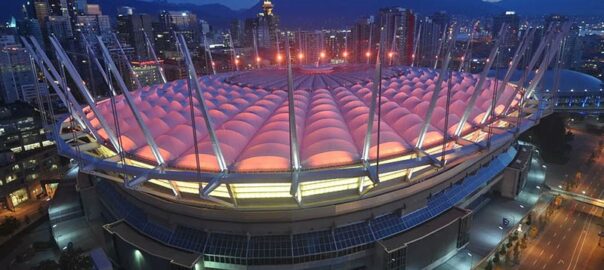
Interesting fact: Northern Lights Display: The stadium’s ETFE façade utilizes thousands of energy-efficient LED lights to create dynamic, colorful animations that illuminate the Vancouver skyline

BC Place is a multi-purpose stadium situated on the northern side of False Creek in Vancouver, British Columbia. The facility belongs to the BC Pavilion Corporation (PavCo), a Crown corporation operated by the province. Since opening on June 19, 1983, the venue has become one of the most recognizable sports and entertainment sites in Canada.

The stadium was constructed as part of preparations for Expo 86, the 1986 World’s Fair held in Vancouver. Structural engineers from Geiger Berger Associates designed the original building with an air-supported roof that was considered the largest of its kind in the world at the time. The design resembled the Hubert H. Humphrey Metrodome in Minneapolis, Minnesota, and remained a landmark feature for decades.

Today, BC Place serves as the home stadium for the BC Lions of the Canadian Football League and Vancouver Whitecaps FC of Major League Soccer. The venue also hosts the annual Canada Sevens tournament and houses the BC Sports Hall of Fame. Over the years, it has welcomed major international sporting events and large crowds for football and soccer matches.

The stadium played a central role during the 2010 Winter Olympics and Paralympics, later hosting the 2012 CONCACAF Women’s Olympic Qualifying Tournament and several matches at the 2015 FIFA Women’s World Cup, including the final. BC Place is also scheduled to stage multiple games during the 2026 FIFA World Cup, among them knockout-round fixtures.

Major renovation and modern upgrades

In May 2008, officials confirmed that BC Place would undergo an extensive modernization project worth more than $150 million. The renovation work was divided into two phases and became one of the largest redevelopment projects ever completed at the stadium.

A key element of the reconstruction was the replacement of the original inflatable roof. Following the 2010 Winter Olympics, the building closed for 16 months so crews could install a retractable roof supported by cables. After completion, the new structure became the largest retractable roof of its kind.

The renewed venue also received a centre-hung high-definition scoreboard that ranks as the second largest in North America behind the display at AT&T Stadium. In addition, a new artificial playing surface produced by Polytan was installed at a reported cost of $1.2 million. The pitch was designed to meet FIFA 2-star certification standards and measures 117 by 75 yards.

After Vancouver Whitecaps FC entered MLS and relocated to the updated stadium, the club initially used only the lower seating bowl for league matches. In 2018, the team attracted 27,683 supporters for a regular season meeting with Seattle Sounders FC without opening the upper level. Several years later, on November 22, 2025, the Whitecaps established a new MLS attendance record for the club when 53,957 fans watched the playoff semifinal against Los Angeles FC.

Stanley Park and Vancouver Island highlights

Among the best-known destinations in British Columbia is Stanley Park, a 1,000-acre green space located beside downtown Vancouver. The park offers views of the city skyline, surrounding mountains, and the Pacific Ocean. Visitors can explore forest paths, cycle or walk the 9-kilometre Seawall, spend time at the Vancouver Aquarium, or relax near the waterfront beaches.

One of the park’s most photographed landmarks is the collection of totem poles at Brockton Point. The area remains a popular stop for travelers wanting to experience nature while staying close to the city centre.

On Vancouver Island, the Inner Harbour in Victoria stands out as one of the province’s most picturesque waterfront areas. Tourists can watch floatplanes depart from the harbour, visit the Royal BC Museum, admire the Fairmont Empress Hotel, or join whale-watching excursions departing from the docks. During summer, the harbour becomes especially lively with musicians, street performers, and outdoor cafés.

Another major attraction on Vancouver Island is Pacific Rim National Park Reserve on the island’s west coast. The park is known for its dramatic shoreline, ancient rainforests, and outdoor activities. Travelers can walk along Long Beach near Tofino, kayak through the Broken Group Islands, or visit the area for surfing and storm watching.

Mountain resorts, gardens and remote islands

Whistler Blackcomb is internationally recognized as one of British Columbia’s leading ski destinations. The resort attracts visitors throughout the year, offering skiing and snowboarding across more than 8,000 acres during winter months. In warmer seasons, guests can explore alpine hiking routes, mountain biking trails, and the Peak 2 Peak Gondola, which provides panoramic mountain views.

Near Victoria, Butchart Gardens remains one of the province’s most celebrated attractions and holds status as a National Historic Site of Canada. Spread across 55 acres, the gardens include floral displays, fountains, themed landscapes, and walking paths.

Among the most visited sections are the Sunken Garden and the Japanese Garden. During summer evenings, the site also features entertainment events and fireworks displays that attract large numbers of visitors.

Farther north, Haida Gwaii offers a more remote experience shaped by Indigenous culture and natural scenery. Previously known as the Queen Charlotte Islands, the archipelago is home to Gwaii Haanas National Park Reserve, where visitors can see historic Haida totem poles and longhouses.

The islands are also known for fishing, hiking opportunities, and wildlife viewing. Their isolated location and cultural significance make Haida Gwaii one of the most distinctive destinations in British Columbia.