Category Archives: History and facts 2026

Almiron becomes first player sent off under new mouth-covering rule at World Cup

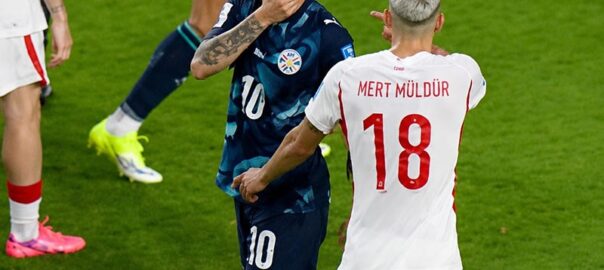
Paraguay midfielder Miguel Almiron became the first footballer to receive a red card under the World Cup’s newly introduced rule regarding players covering their mouths while speaking on the pitch. The incident occurred during Paraguay’s group-stage meeting with Turkey in San Francisco.

Shortly before the interval, the 32-year-old covered his mouth with his hand while talking to Turkish defender Mert Muldur. Muldur immediately alerted a nearby match official, prompting further scrutiny of the exchange.

After consulting with the video assistant referee, referee Ivan Barton of El Salvador informed spectators of his decision and dismissed the former Newcastle United player. At the time of the incident, Paraguay were leading the match 1-0.

New regulation makes World Cup debut

The rule is being enforced at a World Cup for the first time. Its introduction was approved during a special meeting of the International Football Association Board (IFAB) held in Vancouver in April.

FIFA president Gianni Infantino had previously expressed support for such a measure. He stated that officials should operate with the assumption that a player may have said “something they shouldn’t have” when attempting to conceal their words.

Although the regulation allows for a dismissal, the final decision remains entirely with the referee. Match officials are expected to assess all relevant circumstances before determining whether a red card is warranted.

Reaction and Paraguay’s response

Former Republic of Ireland forward Clinton Morrison said the officials had correctly applied the law. While acknowledging that some observers might disagree with the outcome, he stressed that players must abide by the regulations once they are in place.

Despite being reduced to 10 men for more than half of the contest, Paraguay successfully protected their advantage and secured a 1-0 victory over Turkey.

The result leaves Paraguay in a strong position in Group C. Victory against Australia in their final group fixture on Friday would secure a place in the last 32 of the tournament.

Previous incidents linked to the rule

The debate surrounding players concealing their mouths gained prominence in February during a Champions League match involving Benfica and Real Madrid. Benfica winger Gianluca Prestianni used his shirt to cover his mouth while speaking to Vinicius Jr.

Prestianni was initially accused of racist abuse, an allegation he denied. He was provisionally suspended for one match before a UEFA investigation concluded that he had committed homophobic conduct instead. The player subsequently received a six-game ban, with three matches suspended.

Almiron had already been involved in another notable application of a new law during Paraguay’s opening World Cup match against the United States. In that game, referee Tim Ream was initially booked for a challenge on the Paraguayan attacker, but a VAR review determined that Almiron had simulated the foul, resulting in a yellow card being shown to him instead.

Can Renard rescue Tunisia’s World Cup hopes?

Tunisia have turned to Herve Renard in an effort to revive their 2026 World Cup campaign after a crushing 5-1 defeat against Sweden in their opening Group F match. The heavy loss prompted the Tunisian Football Federation to dismiss Sabri Lamouchi immediately, making the Carthage Eagles the first team in World Cup history to replace a coach after just one game at the tournament.

Despite the setback, the expanded 48-team format means Tunisia still has an opportunity to reach the knockout stage. However, Renard faces immediate pressure, with little room for further mistakes as he prepares for Sunday’s meeting with Japan.

The Frenchman accepted the challenge without hesitation after being contacted by the federation. Renard described the situation as difficult but motivating, embracing the opportunity to guide Tunisia through a complicated moment.

His appointment also places him among a small group of coaches who have managed different nations at three consecutive World Cups. After leading Morocco in 2018 and Saudi Arabia in 2022, he now takes charge of Tunisia at the 2026 finals.

From overnight cleaner to international coach

Renard’s route into management was far from conventional. After ending his playing career at SC Draguignan at the age of 29, he began coaching while simultaneously working as a cleaner to support himself.

For eight years, his daily routine involved waking up during the night, carrying out cleaning duties in residential buildings until midday, and then leading training sessions later in the day. He balanced those responsibilities while studying for coaching qualifications.

Looking back, Renard has often described that period as one of the most valuable experiences of his life. The physically demanding work helped shape his character and taught him the importance of perseverance through difficult circumstances.

Those challenging years eventually laid the foundation for a coaching career that would take him across clubs and national teams on several continents.

Building a reputation across Africa and beyond

Renard’s first major opportunity arrived in 2002 when he became an assistant to fellow French coach Claude Le Roy at Shanghai Cosco. He later followed Le Roy to Cambridge United before establishing himself as a head coach.

His greatest achievements came in African football. Renard remains the only coach to win the Africa Cup of Nations with two different countries. He guided Zambia to a memorable title in 2012 before lifting the trophy again with Ivory Coast three years later.

According to Zambian journalist Nkweto Tembwe, Renard earned a reputation as a dedicated worker and meticulous strategist. Tembwe described him as someone who studies opponents thoroughly and constantly seeks to keep pace with developments in the game.

Although he enjoyed continental success, Renard was unable to capture an African title with Morocco, whose campaigns ended in the quarter-finals in 2017 and the last 16 in 2019. He later coached France’s women’s national team, reaching the quarter-finals at both the 2023 Women’s World Cup and the 2024 Olympic Games.

A coach always in demand

Renard has regularly attracted interest whenever African federations have searched for a new manager. Yet his availability and salary expectations have often complicated negotiations.

During the 2023 Africa Cup of Nations, Ivory Coast attempted to bring him back after dismissing Jean-Louis Gasset during the competition. However, the French Football Federation declined to release him from his contract with the women’s national team.

Nigeria also explored the possibility of hiring Renard in 2024, but a football official later described his financial requirements as excessively high.

Tunisia becomes the fifth African national team he has managed. His previous experience on the continent includes spells with Zambia, Ivory Coast, Morocco, and Angola, while he also worked as an assistant with Ghana.

The task facing Tunisia

Renard’s first priority will be improving Tunisia’s defensive performances. The defeat against Sweden followed another heavy loss, a 5-0 setback against Belgium in the team’s final preparation match before the tournament.

After the Sweden game, Lamouchi admitted that Tunisia had committed too many errors. Renard, known for demanding discipline from his squads, has already urged the players to move on from the defeat and focus on representing their country with pride.

Tembwe believes the French coach’s motivational abilities have often made the difference. He recalled Renard’s team talk before Zambia’s Africa Cup of Nations semi-final victory over Ghana, arguing that the match was effectively won before the players stepped onto the field.

Renard’s previous encounters with Japan during World Cup qualifying campaigns with Saudi Arabia may also prove useful. Tunisia’s hopes of reaching the knockout rounds for the first time now rest largely on whether he can inspire another turnaround and add a new accomplishment to an already remarkable managerial career.

Hydration breaks – who benefits and who suffers from the stoppages

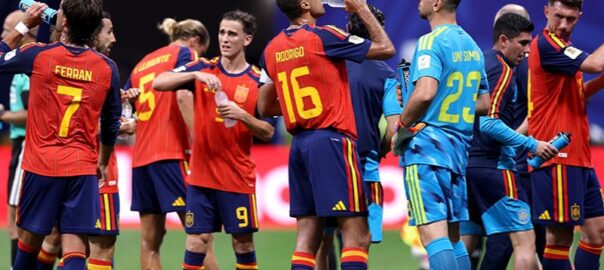
A familiar pattern has emerged at World Cup matches, where referees halt play roughly 22 minutes into each half for a three-minute drinks interval. The measure has been made compulsory across all 104 games, designed to help players cope with intense heat and humidity across co-host nations Mexico, Canada, and the United States.

Despite its stated purpose, the intervention has not been universally welcomed. Some critics have suggested the pauses resemble commercial interruptions intended to suit US broadcasters. Even venues with retractable roofs and climate control are still applying the same stoppages.

The USA head coach Mauricio Pochettino was among those questioning the necessity of the rule. He said: “I don’t like it. I only like it when the conditions are extreme. But when the conditions are good, it is unnecessary.”

Momentum shifts and coaching advantages

One of the clearest debates around the breaks is their influence on game rhythm. In Brazil’s opening match against Morocco, the South Americans were trailing 1-0 and underperforming before the first-half pause. Shortly after play resumed, they equalised, with Vinícius Júnior scoring a standout goal after cutting inside and finishing powerfully.

Brazil coach Carlo Ancelotti later acknowledged the interruption allowed him to adjust instructions and refine tactics during the pause. He noted that such moments can be used to explain problems and implement tactical changes that influence performance.

US women’s coach Emma Hayes described the stoppages as disrupting momentum for the side in control. She said: “It’s advantageous for the team losing momentum – that’s why I call them momentum breaks.” She added that while sometimes players simply hydrate and reset, the pause can still function as coaching time.

Teams gaining or losing rhythm after breaks

Several early matches have shown swings in momentum following the mandatory interruptions. Canada, for example, equalised shortly after a second-half hydration break when substitute Cyle Larin scored against Bosnia-Herzegovina.

Elsewhere, Scotland found a decisive goal soon after a stoppage in their win over Haiti, while Australia also scored shortly after a break during their 2-0 victory against Turkey. These sequences have strengthened the view that the pauses can coincide with shifts in control, even if they are not the direct cause.

Former Spain midfielder Juan Mata said he would have disliked such interruptions as a player, arguing that they break attacking rhythm. He explained that teams either want to chase a goal or maintain possession depending on the scoreline, and stoppages interrupt that flow.

Controversy over purpose and broadcasting influence

Criticism has also focused on whether the breaks serve commercial interests. Former England forward Ian Wright suggested they function as a way of inserting advertising into the game, saying: “I just think it’s another way of getting adverts into it from an American point of view.”

He also noted that broadcasts had already used the pauses for advertising transitions during opening matches, reinforcing scepticism about their intent. Some observers argue this undermines the idea that the breaks are solely for player welfare.

Differing views on player welfare and extreme conditions

Not all reactions have been negative, with some coaches defending the measure as necessary in extreme environments. Spain coach Luis de la Fuente supported the initiative ahead of his team’s opener, highlighting the difficulty of playing in high temperatures.

He said it is important for players to hydrate, breathe, and receive brief instructions during pauses. However, he also noted that conditions vary by venue, pointing out that some stadiums are temperature-controlled, including those with retractable roofs.

No arena too large – Haaland makes a stylish debut

There is still no evidence that any occasion is too demanding for Erling Haaland, who marked his first World Cup appearance with two goals as Norway defeated Iraq 4–1.

The Norwegian forward, who has previously scored a hat-trick on his Champions League debut for Red Bull Salzburg, another hat-trick on his Bundesliga debut for Borussia Dortmund, and a double on his Premier League debut for Manchester City, added a new milestone at international football’s biggest tournament.

His brace helped secure Norway’s victory, while the team also ended a long wait for a World Cup finals goal stretching back to 1998, a span of 10,220 days before his first strike in the match.

Earlier on the same day, Kylian Mbappe had also made an impact, scoring twice in France’s 3–1 win over Senegal and becoming his country’s all-time leading scorer, setting the tone for the evening before Norway’s fixture.

First half impact and opening breakthrough

Haaland had a quiet start in terms of involvement, registering only 11 touches in the first half, yet his presence quickly became decisive.

Just before the half-hour mark, he reacted to a low cross from David Møller Wolfe, sliding in to convert Norway’s opening goal with a close-range finish.

Speaking on television commentary, Stephen Warnock described the move as typical of Haaland’s instincts, noting that his anticipation ensured he was in the right place to finish a simple opportunity.

The goal also briefly put Norway in control after Iraq had been competitive in the opening stages.

Second goal and decisive moments

Iraq responded through a header from Aymen Hussein, briefly drawing level in a moment that carried similarities to Haaland’s own physical style in attack.

Norway regained the lead when Haaland pressed a backpass, forcing goalkeeper Jalal Hassan into hesitation before charging down the clearance and turning it into a goal.

A third goal almost followed late on, but Hassan denied him after another loose defensive moment, and a looping late header from Haaland was eventually forced over the line by Hussein.

Reactions, records and wider impact

After the match, Norway head coach Ståle Solbakken said the forward handled the pressure comfortably and looked prepared throughout the build-up.

Iraq manager Graham Arnold described Haaland as an exceptional striker, praising his strength, speed, and finishing ability, and also suggested Norway could go far in the tournament with their current squad.

Former players and pundits also highlighted his influence, including Ellen White, who pointed to his physicality and quality around the box, and Ashley Williams, who emphasised his work rate and leadership during the match.

Haaland’s international scoring record now stands at 57 goals in 51 appearances, a ratio that places him among the most efficient goalscorers in international football history, second only to Poul Nielsen among players with at least 50 goals.

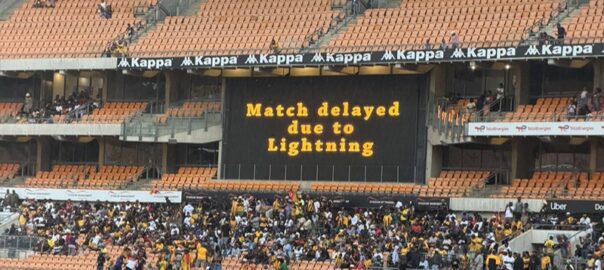
World Cup 2026 weather protocol explained amid lightning concerns

The 2026 World Cup is staged across the United States, Canada, and Mexico, and it is set to take place during the height of storm season in several regions involved in hosting duties. This timing raises the possibility that matches could be affected by severe weather, particularly thunderstorms and electrical activity.

Certain areas, especially within the United States, are already known for strict procedures related to lightning safety, which adds another layer of disruption risk for teams and organisers. Weather-related interruptions have already been observed during preparatory fixtures, highlighting how conditions could impact the tournament itself.

England’s friendly against Costa Rica in Orlando was held up by around an hour due to heavy rain combined with the possibility of lightning activity in the surrounding area. In addition, New York City experienced intense heat reaching the mid-30s Celsius, followed by heavy rainfall, thunder, and lightning less than a day before Brazil was due to meet Morocco in New Jersey.

Lightning safety rules and match suspension protocol

FIFA operates in line with guidance issued by local authorities during the tournament, meaning lightning safety procedures will follow established national standards. In the United States, the National Oceanic and Atmospheric Administration (NOAA) specifies that any detected lightning strike within an eight-mile radius of a stadium requires immediate suspension of play.

Once a strike is identified within that distance, a 30-minute waiting period begins before play can resume. If another strike occurs within that window, the countdown is reset, potentially extending interruptions significantly depending on weather persistence.

These measures are designed to prioritise safety, but they also create conditions where matches could be paused for prolonged periods, especially in regions prone to repeated storm activity.

Real cases of weather interruptions in recent competitions

Similar disruptions have already been witnessed in major tournaments held in the United States. During a previous Club World Cup edition, six matches were temporarily stopped due to electrical storms moving through host cities.

One of the most notable examples involved Chelsea and Benfica in Charlotte, North Carolina, where kick-off began at 4:38 pm local time, but the match was not completed until four hours and 38 minutes later due to repeated weather stoppages.

These incidents demonstrate how quickly storms can interrupt play and how extended delays can develop when lightning activity remains within close proximity of stadium venues.

Scheduling challenges and match completion rules

Stadiums located in the Gulf Coast region and the southeastern United States are considered most vulnerable to thunderstorm disruption. FIFA is expected to assess each affected fixture individually if play is halted, depending on the severity and timing of the weather conditions.

One additional complication involves group-stage scheduling, where final-round matches in each group are played simultaneously to prevent teams gaining an advantage from knowing other results. Extended delays could disrupt this structure and create logistical challenges for organisers.

If a match cannot be completed due to unsafe conditions, tournament regulations state that it would be rescheduled and resumed later from the exact minute it was stopped, rather than restarted in full.