- UEFA preliminary draw for Qatar 2022 takes place on Monday 7 December
- FIFA.com sets the scene by looking back at ten classic European qualifiers
- Part 2 includes a surprise Spanish saviour, a Portuguese “joke” and a crucial free-kick
6) Spain-Denmark, 1993: Danish dreams dashed again by La Roja
“What Spain gave me in club success, it took back with its national team,” Denmark’s Michael Laudrup once told FIFA.com. With good reason too, the Scandinavian side having fallen victim to their bête noire in the Round of 16 at Mexico 1986, two years after losing out in the semi-finals of UEFA EURO 1984. Then, in November 1993, the teams crossed paths again – with Denmark a point clear of Spain in Group 3 ahead of this final qualifier. European champions in 1992, the Danes had already defeated La Roja1-0 in Copenhagen and boasted the greatest generation in their history, so would they finally turn the tables?
17 November 1993, Estadio Ramon Sanchez Pizjuan, Seville, Spain 1-0 Denmark
Goal: Fernando Hierro 63′ (Spain)
It began to look like mission impossible for Javier Clemente’s Spain after just ten minutes, when Andoni Zubizarreta passed a clearance to Michael Laudrup and brought the forward down, trying to limit the damage. The goalkeeper was shown a straight red card and suddenly a young Santiago Canizares, denied the time to warm up, was sent into the fray. Despite the pressure, Canizares pulled off an exceptional performance as Denmark laid siege to his goal for the 80 minutes that remained.
At the other end, ten-man Spain relied exclusively on set-pieces to create danger. And, with just over an hour gone, it was from an Andoni Goikoetxea corner that they broke the deadlock, Fernando Hierro finding the net after Peter Schmeichel’s misjudged attempt to claim the ball. Thanks to a defensive stalwart and a novice keeper, Spain had thwarted Denmark once again, denying them the point they needed to reach USA 1994.
7) Germany-England, 2001: Owen’s hat-trick heroics
In October 2000, Germany triumphed 1-0 in the very last game at the old Wembley Stadium, a result that spelled the end of the road for England manager Kevin Keegan and brought Sven-Goran Eriksson into the hotseat. The return fixture at the Olympiastadion – where Germany remained unbeaten since 1973 – would prove critical to the Three Lions’ chances of reaching Korea/Japan 2002.
1 September 2001, Olympiastadion, Munich, Germany 1-5 England
Goals: Carsten Jancker 6′ (Germany); Michael Owen 12′, 48′, 66′, Steven Gerrard 45+2′, Emile Heskey 74′ (England)
To nobody’s great surprise, Germany kicked off the encounter with confidence, and it did not take long for Carsten Jancker to open the scoring. Just a few minutes later, however, England struck back via Michael Owen. Their tails now up, the visitors were starting to grow in belief when, on the cusp of half-time, Steven Gerrard fired in a powerful effort from distance. England increased their lead two minutes after the restart, Owen pouncing on Heskey’s headed lay-off. The Liverpool striker was at the peak of his powers and completed his hat-trick after latching onto Gerrard’s through-ball. And an eye-catching turnaround became a football lesson when Heskey got his own name on the scoresheet.
“I’ve never seen an England team play better,” said Franz Beckenbauer. “They had pace, aggression, movement and technique. It was fantasy football. When they scored their third goal, they started to play football that would have beaten anyone in the world.” Four days later, England defeated Albania to take top spot in the group on goal difference – and second-placed Germany would ultimately be left facing the play-offs.
8) England-Greece, 2001: Beckham’s redemption
At kick-off, England possessed just a single point advantage over Germany at the head of Group 9. Sven-Goran Eriksson’s men now needed a result at home against Greece to be sure of finishing above their rivals.
6 October 2001, Old Trafford, Manchester, England 2-2 Greece
Goals: Teddy Sheringham 68′, Beckham 90+3′ (England); Angelos Charisteas 36′, Demis Nikolaidis 69′ (Greece)
Boosted by their superb 5-1 success in Germany the previous month and a follow-up win against Albania, England had no intention of losing to a Greece side beaten in their last three away trips. The visitors had other ideas, and everything changed as they went ahead shortly after the half-hour mark. But when Teddy Sheringham levelled the scores ten seconds after coming on, it seemed as if the Three Lions were back on track – not least since they still had over 20 minutes to make the difference.
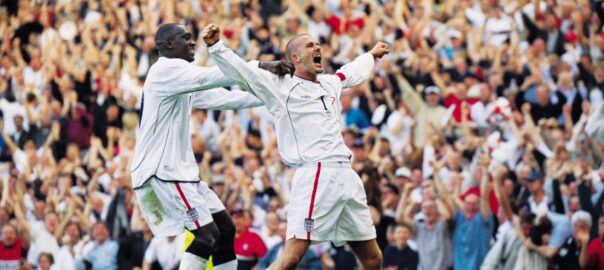
Less than a minute later, however, the England defence was breached again, this time by Demis Nikolaidis. Now trailing 2-1 as the game ebbed into added time, the hosts appeared destined for the play-offs. Instead, David Beckham stepped forward to take his sixth free-kick of the match, the previous five having brought no joy.
The Manchester United midfielder had been criticised by a portion of the fanbase since his sending-off against Argentina at France 1998, but he rescued his team with an unstoppable effort. Better yet, England swiftly learned that Germany had failed to beat Finland, meaning the Three Lions were heading to Korea/Japan 2002 and Germany would have to tackle the play-offs
9) Germany-Ukraine, 2001: Ballack at his best
Next up, that very play-off! Having gone neck and neck with England throughout the group phase, Germany finished second and faced a two-legged showdown with Ukraine, anxious to avoid missing out on a FIFA World Cup™ finals for the first time due to sporting reasons.
14 November 2001, Westfalenstadion, Dortmund, Germany 4-1 Ukraine
Goals: Michael Ballack 4′, 51′, Oliver Neuville 11′, Marko Rehmer 15′ (Germany); Andriy Shevchenko 90′ (Ukraine)
Rudi Voller’s side went into the second leg under pressure, despite having opened the tie with a 1-1 draw in Ukraine. That pressure began to ease as early as the fourth minute, when Michael Ballack headed in from a pinpoint Bernd Schneider cross. Seven minutes later, Oliver Neuville gave the hosts more breathing space from close range. And it was 3-0 after just a quarter of an hour as Marko Rehmer beefed up the scoreline by nodding in from a corner. That pattern of domination only continued after the break, with Neuville collecting an exquisite 40-metre pass from Schneider and crossing for Ballack, who plundered his second goal of the game. Andriy Shevchenko conjured a last-minute riposte, but it was no more than a consolation for the beaten visitors.
Having already struck in the first leg, Ballack was at his very best that night, and his inspirational performance helped Germany stave off disaster and qualify for Korea/Japan 2002. To widespread surprise, they then went on to reach the Final, where – with Ballack suspended – their trophy hopes were ended by Brazil.

10) Liechtenstein-Portugal, 2004: “The joke of Europe”
For Liechtenstein, even taking a point against a traditional European power counts as a historic sporting achievement. So it was that the principality side celebrated their moment of glory on the road to the 2006 World Cup in Germany.
9 October 2004, Rheinpark, Vaduz, Liechtenstein 2-2 Portugal
Goals: Franz Burgmeier 48′, Thomas Beck 76′ (Liechtenstein); Pauleta 23′, Daniel Hasler 39′ og (Portugal)
The outcome in Vaduz seemed inevitable, and the early exchanges merely followed the script, with Portugal camping out in Liechtenstein’s half as the hosts dug deep. Their resistance was broken on 23 minutes when a young Cristiano Ronaldo crossed for Pauleta to head in. Liechtenstein goalkeeper Peter Jehle steadied himself for a long night, and his team’s task only got tougher six minutes before half-time, Daniel Hasler diverting a Simao cross into his own net.
Soon after the restart, however, the locals stunned Luiz Felipe Scolari’s men when Thomas Beck set up Franz Burgmeier to halve the deficit. Then, with 14 minutes to go, the miracle was complete, Beck turning from provider to goalscorer to help the minnows claw back a 2-0 deficit against the EURO 2004 runners-up.
The press reaction in Portugal the next day made for uncomfortable reading for A Seleção das Quinas. The headline in A Bola said it all, the paper lambasting “The joke of Europe” and adding that “Portugal produced one of the worst performances in their history, playing a football that was lifeless, soulless and lacking inspiration”.

FIFA.com
FIFA.com News