Category Archives: 2022 FIFA World Cup

Italy Head Coach Mancini names a 38-man squad for the upcoming World Cup qualifying matches against Northern Ireland, Bulgaria and Lithuania

https://www.italiansoccerseriea.com/wp-content/uploads/2019/07/Anna_Italia_bigger.jpgBy Anna Italia
Follow me in Twitter
,
Facebook:
Anna Italia Page
Instagram:
annaitalia2
Italian Soccer Serie A
Italian Soccer Serie A supports the Italian National Team

Italy Head Coach Roberto Mancini has called up 38 players in his latest squad.  As reported by the Italian Football Federation (FIGC),  the players will meet up at Coverciano in the evening on Sunday 21 March and then train at the Federal Technical Centre until Wednesday 24 March, when they’ll travel to Parma. They’ll remain in the same city the day after their match against Northern Ireland and will then fly from Parma to Sofia on Saturday 27 March. Two days after their showdown with Bulgaria, the Azzurri will depart for Vilnius.

Italy advanced to the final phase of the 2021 Nations League and ahead of Euro 2020, which was postponed for a year due to the pandemic, the National Team are set to play their first matches in World Cup qualifying. The Azzurri, who have been inserted in Group C, will play three matches in quick succession in the latest round of international fixtures as they look to get off to a positive start on the road to Qatar 2022.

  • 👉 On Thursday 25 March, they’ll face Northern Ireland at the Stadio Tardini in Parma,
  • 👉On Sunday 28 March, the away match to Bulgaria  (Vasil Levski National Stadium in Sofia).
  • 👉Wednesday 31 March, Italy will play against Lithuania at the LFF Stadium.  All three fixtures will kick off at 20:45 CET.

The good news is for Atalanta defender Rafael Toloi and Spezia midfielder Matteo Ricci being called up for the first time.  Whether Ricci and Inter players Bastoni, Barella and Sensi can join up with the squad is subject to the approval of the relevant local health authorities.

Former Italy team and AS Roma midfielder Daniele De Rossi, who became a World Champion in 2006 and was part of the Italy team that finished as runners-up at the 2012 European Championship, has joined Mancini’s coaching staff.

STATE OF PLAY – The Azzurri haven’t tasted defeat in 22 matches: in the last two years, they’ve won on 15 occasions and drawn seven times (their last loss came in Lisbon on 18 September 2018). It’s Italy’s third-longest undefeated streak of all time: previously they went 30 games unbeaten under Pozzo between 1935 and 1939 and 25 matches without losing under Lippi between 2004 and 2006. On a global level, Spain hold the record in this regard: no side got the better of the La Furia Roja in 35 matches between 2007 and 2009. Mancini is yet to lose in 14 games at home as the Italy Head Coach and is closing in on Lippi’s record of 17 without defeat.

In total, Mancini’s record reads as follows: 18 wins, seven draws and two defeats. Since he’s been at the helm, Italy have led for 960 minutes in their matches (out of 2430’ – 39.51%), been on level terms for 1265 minutes and behind for 205 minutes. The Azzurri have picked up 61 points, a record after 27 matches for a National Team Head Coach.

Over the course of these 27 games, the average age of the team has been 26.5. 76 players have been called up across 34 months and 64 have taken to the pitch, with Jorginho having played the most (22 appearances, 1493’). There have been 32 debutants under Mancini. Italy’s positive goal difference has continued to grow and now stands at (+48). The Azzurri have scored 62 goals though 27 players, an average of 2.29 per game (the second-best figure in the National Team’s history after Pozzo’s side). Belotti has been Italy’s most prolific player under Mancini (six goals). Since the latter’s reign began, the team have conceded just 14 (the second-best record in the Azzurri’s history after Vicini’s side) and only three in their last twelve matches. Furthermore, Italy have kept 15 clean sheets. The National Team haven’t shipped any goals since Van de Beek’s 25th-minute finish in Italy vs. Netherlands, a run of 292 minutes. Between 2018 and 2019, the Azzurri went 600 minutes without allowing the opposition to score.

==============================
Ticket option for Italy National team games

Italy


==============================

👉 Italy Squad list

Goalkeepers: Alessio Cragno (Cagliari), Gianluigi Donnarumma (Milan), Alex Meret (Napoli), Salvatore Sirigu (Torino);

Defenders: Francesco Acerbi (Lazio), Alessandro Bastoni (Inter)*, Cristiano Biraghi (Fiorentina), Leonardo Bonucci (Juventus), Giorgio Chiellini (Juventus), Giovanni Di Lorenzo (Napoli), Emerson Palmieri (Chelsea), Gian Marco Ferrari (Sassuolo), Alessandro Florenzi (Paris Saint-Germain), Manuel Lazzari (Lazio), Gianluca Mancini (Roma), Leonardo Spinazzola (Roma), Rafael Toloi (Atalanta);

Midfielders: Nicolò Barella (Inter)*, Gaetano Castrovilli (Fiorentina), Bryan Cristante (Roma), Manuel Locatelli (Sassuolo), Rolando Mandragora (Torino), Lorenzo Pellegrini (Roma), Matteo Pessina (Atalanta), Matteo Ricci (Spezia)*, Stefano Sensi (Inter)*, Roberto Soriano (Bologna), Marco Verratti (Paris Saint-Germain);

Forwards: Andrea Belotti (Torino), Domenico Berardi (Sassuolo), Federico Bernardeschi (Juventus), Francesco Caputo (Sassuolo), Federico Chiesa (Juventus), Stephan El Shaarawy (Roma), Vincenzo Grifo (Freiburg), Ciro Immobile (Lazio), Lorenzo Insigne (Napoli), Moise Bioty Kean (Paris Saint-Germain).

*Will join up with the squad should they gain approval from the relevant local health authority

Photo: figc.it

ITALY vs. NORTHERN IRELAND. Italy will take to the field wearing armbands in memory of four Azzurri who have sadly passed away in recent months: Pietro Anastasi, Mauro Bellugi, Pierino Prati and Paolo Rossi, after whom the Federal Council room at the FIGC headquarters in Rome was re-named in recent days. Before the match, there will be a moment of silence; a video in memory of the Azzurri will be shown at the stadium, which will also be displayed in virtual graphics that will be visible to television viewers. The stadium will be fitted with an Italy flag that will be hung up in the Curva Nord. Furthermore, Goal Line Technology will be in use.

There have been nine head-to-head clashes with Northern Ireland, with the Azzurri’s record reading as follows: six wins, two draws and one very significant defeat in Belfast in 1958, a result which meant that the Azzurri failed to qualify for a World Cup for the first time. It’ll be Italy’s eighth match in Parma, where the Azzurri have won six times and suffered one defeat, which came against France in 2012. From their first showdown there under Head Coach Sacchi 25 years ago in a friendly with Finland ahead of USA ’94 through to their 6-0 win over Liechtenstein in March 2019, when Quagliarella bagged a brace and became the oldest goalscorer in the history of the National Team.

Referee: Ali PALABIYIK (Turkey). Assistants: Kerem ERSOY, Serkan OLGUNCAN (Turkey). Fourth Official: Halis OZKHAYA (Turkey).

BULGARIA vs. ITALY. Out of 19 prior meetings, Italy boast a record of ten wins, seven draws, and two defeats. The Azzurri have never managed to win in Bulgaria, however. Out of six games played, all in Sofia, four matches have been drawn and two have ended in defeat. Two important milestones for Azzurri goalkeepers were achieved against Bulgaria: Zoff made his debut in 1968 in Naples and Buffon celebrated his 150th appearance with the National Team in 2015. Italy’s last outing in Sofia was in March 2015: it ended in a 2-2 draw.

Referee: Slavko VINCIC (Slovenia). Assistants: Tomas KLANCIC, Andraz KOVACIC (Slovenia). Fourth Official: Matej JUG (Slovenia).

LITHUANIA vs. ITALY. In terms of games with Lithuania, the balance again clearly favours the Azzurri: four wins and two draws. The only previous meeting in Vilnius was in April 1996: Zola’s goal and a narrow victory.

👉 Italy National Team Schedule

Sunday 21 March
Players to meet up at the Coverciano Federal Technical Centre by midnight and, along with the staff, undergo molecular tests upon arrival

Monday 22 March
14:00 – Press conference – FIGC-RAI (FTC Coverciano Auditorium)
Press conference – Head Coach (Auditorium-CTF Coverciano)
16:30 – Training (behind closed doors)

Tuesday 23 March
13:45 – Press conference – FIGC/Panini (FTC Coverciano Auditorium)
Press conference – player (FTC Coverciano Auditorium)
16:30 – Training (behind closed doors)

Wednesday 24 March
11:00 – Departure from Florence to Parma
17:30  – Press conference – ITALY (Stadio Tardini, Parma)
18:00 – Training – ITALY (first 15 minutes open to the press) (Stadio Tardini, Parma)
19:30 – Press conference – Northern Ireland (Stadio Tardini, Parma)

Thursday 25 March
20:45 – ITALY vs. Northern Ireland (Stadio Tardini, Parma). Post-match press conference

Friday 26 March
11:00 – Training (behind closed doors) (Stadio Tardini, Parma)
12:30 – Press conference – player (Stadio Tardini, Parma)

Saturday 27 March
10:30 – Departure from Parma to Sofia
11:00 – Press conference – Bulgaria (Boyana National Football Center)
11:30 – Training – Bulgaria (first 15 minutes open to the press) (Boyana National Football Center)
18:00 – Press conference – ITALY (Vasil Levski National Stadium, Sofia)
18:30 – Training – ITALY (first 15 minutes open to the press) (Vasil Levski National Stadium, Sofia)

Sunday 28 March
20:45 Bulgaria vs. ITALY (Vasil Levski National Stadium, Sofia). Post-match press conference

Monday 29 March
11:30 – Training (behind closed doors)

Tuesday 30 March
10:45 – Departure from Sofia to Vilnius
16:30 – Press conference – Lithuania (LFF Stadium, Vilnius)
17:00 – Training – Lithuania (first 15 minutes open to the press) (LFF Stadium, Vilnius)
17:30 – Press conference – ITALY (LFF Stadium, Vilnius)
18:00 – Training – ITALY (first 15 minutes open to the press) (LFF Stadium, Vilnius)

Wednesday 31 March
20:45 – Lithuaniua vs. ITALY (LFF Stadium, Vilnius). Post-match press conference followed by return to respective clubs
 

Revived giants ready to right Russian wrong

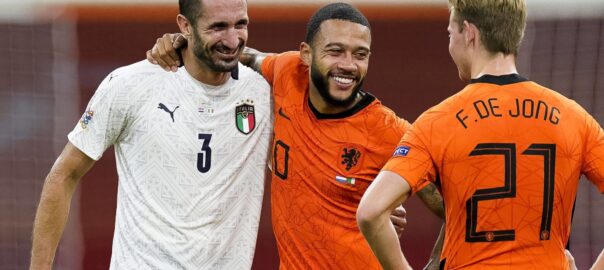
Netherlands player Memphis Depay (M), Italy player Georgio Chiellini (L), Netherlands player Frenkie de Jong (R).

  • Italy and the Netherlands failed to reach Russia 2018
  • Both have bounced back impressively in the years since
  • We look at what’s changed ahead of their Qatar 2022 campaigns

La Gazzetta dello Sport described it as “the apocalypse” and, in football terms, it wasn’t far short. Italy, four-time champions, had failed to qualify for the 2018 FIFA World Cup Russia™.

Staggering in itself, this outcome was made doubly unthinkable by the Netherlands – finalists and bronze-medalists at the previous two editions – also missing out. And it was Sweden –  sturdy, well-drilled but devoid of star players – who had claimed the scalps of these World Cup heavyweights.

For Italy, the enduring the image of their play-off defeat was an inconsolable Gianluigi Buffon leaving the field in tears. For the Dutch, it was Dick Advocaat scoffingly dismissing as “stupid” the suggestion that the Swedes could put eight goals past Luxembourg – and being proved all too wrong.

Changes were inevitable and, for both sides, the significant alterations of recent years have had the desired effect. Now, as a new FIFA World Cup qualifying campaign beckons, the Oranje and Azzurri arrive as altogether more formidable prospects.

Gianluigi Buffon and Leonardo Bonucci #19 of Italy dejected

Italy

Roberto Mancini has spoken of facing “a big problem”. It is, however, the kind that every coach desires: selecting a team, and squad, from scores of players who merit inclusion.

“It was already going to be difficult before, but in the last few months players are coming through and have proved to be excellent,” said Mancini, who blooded a number of youngsters in Italy’s triumphant 2020/21 UEFA Nations League group campaign.

Marcello Lippi has lauded the former Manchester City manager for “recovering the beautiful image of Italy’s football”, while Tite – in an interview with FIFA.com – compared Mancini to Arrigo Sacchi and praised the “beautiful” style he has implemented.

“We have tried to become more offensive with our play,” explained the man himself. “You have to have the right mentality to do so and have a style of play that all the great teams have. In Italy, we never lacked the players. We just had to give them confidence and a chance to play.”

Roberto Mancini acknowledges Federico Chiesa.

Post-2018 achievements

  • Qualified for UEFA EURO 2020 without dropping a single point, scoring 37 goals across ten matches and conceding just four.
  • Set a new national record for games won in a calendar year.
  • Emerged from UEFA Nations League 2020/21 Group A1 as unbeaten section winners.

What’s changed

A 4-3-3 formation has become the norm but it’s the switch to playing on the front foot, attacking and dominating the opposition, that has underpinned the Mancini revolution.

Key player

Federico Chiesa didn’t have his doubters to seek when made the big move to Juventus. But this dynamic and intelligent wide man has silenced those sceptics by emerging as a star man for both club and country. Mancini, who played alongside Enrico Chiesa at Sampdoria, has praised Federico for having “more running” than his father and fellow Azzurri international.

Upcoming qualifiers

  • Northern Ireland (H), 25.03
  • Bulgaria (A), 28.03
  • Lithuania (A), 31.03

The Netherlands

While Italy’s gains have all been posted under Mancini, the Dutch were revived by a coach who is no longer in the post. Ronald Koeman oversaw a spectacular transformation in a team that had failed to qualify for each of the two most recent major tournaments, with Virgil van Dijk, Frenkie de Jong and Memphis Depay among several stars to emerge.

Koeman’s departure for Barcelona threatened, for a time, to derail that progress. Brows certainly became furrowed when his replacement, Frank de Boer, set an unwanted new record by failing to win any of his first four games in charge.

But recent results – draws against Italy and Spain followed by back-to-back wins over Poland and Bosnia-Herzegovina – ensure that the Dutch head into the World Cup qualifiers with a renewed sense of self-confidence.

Jorginho of Italy competes for the ball with Frenkie De Jong of Netherlands during the UEFA Nations League group stage match between Italy and Netherlands at Stadio Atleti Azzurri d'Italia on October 14, 2020 in Bergamo, Italy. 

Post-2018 achievements

  • Advanced to the 2019 UEFA Nations League final, beating France, Germany and England en route.
  • Qualified for their first major tournament in three attempts by reaching UEFA EURO 2020.

What’s changed

The 4-3-3 formation that was once a Dutch trademark has all but been abandoned, with De Boer – like his predecessor – favouring a 4-2-3-1 set-up and a dynamic, counter-pressing style.

Player to Watch

Van Dijk, a classy, composed and commanding captain, remains sorely missed, while Frenkie de Jong has been lauded as “the engine” of this Dutch team. But it is the man who paid De Jong that compliment, Memphis Depay, who brings this new-look Oranje its attacking potency. Once described by De Boer as a player “who has everything”, Depay dazzled in EURO 2020 qualifying, scoring six goals and creating another eight.

Upcoming qualifiers

  • Turkey (A), 24.03
  • Latvia (H), 27.03
  • Gibraltar (H), 30.03

FIFA.com
FIFA.com News

Tadic: Zidane was my hero

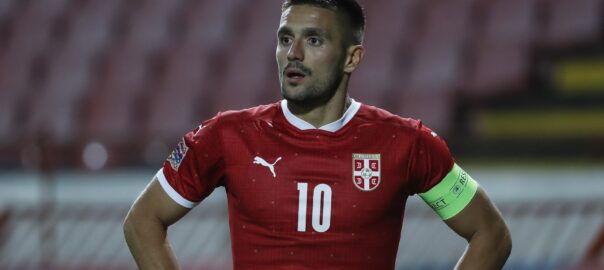
Dusan Tadic of Serbia looks on during the UEFA Nations League group stage match between Serbia and Hungary at Rajko Mitic Stadium on October 11, 2020 in Belgrade

  • Serbia begin their Qatar 2022 qualifying campaign on 24 March
  • Eagles captain Dusan Tadic gives an exclusive interview
  • The attacking midfielder talks about Ajax, Russia 2018 and his childhood heroes

Serbia begin their FIFA World Cup Qatar 2022™ qualification bid next week, taking on their two biggest rivals in Group A in Belgrade: Republic of Ireland on 24 March, followed by Portugal three days later.

If his side are to make a strong start against such formidable opponents, Serbia’s new coach, Dragan Stojkovic, will no doubt need Dusan Tadic to be on song. His country’s captain and most-capped active player, the Ajax man established himself as their playmaker during the qualifiers for Russia 2018. Having come out of Pot 3 in the draw, Serbia finished top of Group D, thanks in no small part to Tadic’s four goals and seven assists.

Though they failed to progress beyond the group phase in Russia, Tadic found some consolation in the shape of Ajax’s thrilling UEFA Champions League run the following season, pulling the strings as the Dutch side reached the semi-finals on the back of some enthralling football.

In conversation with FIFA.com, the 32-year-old attacking midfielder picked out the high points of a career that has been shaped by his passion and love of the game and also spoke of his expectations ahead of what promises to be an exciting new campaign.

Dusan Tadic of Serbia

FIFA.com: You spent four years at Southampton between 2014 and 2018. How would you sum up your Premier League experience?

I’m very proud of my time in England. We finished higher in the Premier League than Southampton had ever done before and I finished in the top five for assists in three seasons. Some big teams came in for me, but the club didn’t want to let me go after my second season, when we finished sixth – a Premier League best for Southampton. We kept on getting good results through to the fourth season, when we had to fight against relegation. I told the directors that I’d do everything I could to keep the club in the top flight but that I wanted to decide which club I’d leave for at the end of the season, which is exactly how things turned out.

You chose to go back to the Netherlands, where you’d played from 2010 to 2014, to sign for Ajax. You said it was the only club you wanted to join. Why was that?

Ajax are a great club that think big and are always reaching for the top. It’s not just about football with them and they pay attention to every little detail. They want to be the best, to beat every opponent. It’s the perfect club for me. They’ve inspired me ever since I was little. They’ve won the Champions League four times and a host of other trophies. So many football legends and incredible players have played for them too. Ajax is the place where ‘total football’ was born with [Rinus] Michels and with Johan Cruyff, who took the philosophy with him to Barcelona.

The team’s run to the last four of the Champions League in your first season showed you’d made the right decision. Did you expect that kind of success?

Yes, because we had a very strong team and we were playing the best football in Europe. Everyone was behind us, even our rivals. I think we took football forward because a lot of people went out and tried to copy what we were doing and to play like us. We beat Bayern Munich, Real Madrid and Juventus by playing some very attractive football. Even against Tottenham in the semis, we won 1-0 away in the first leg and were 2-0 up at half-time in the second. I still don’t understand how we managed to lose. I think we deserved to make the final.

How did you feel when key players like Matthijs de Ligt and Frenkie de Jong left the following season?

Ajax have this philosophy of bringing young players through and then selling them for big money. I was happy for them but obviously I missed them too. As for me, I decided to stay because I love the club and I like the way we play. The team is always hungry and if we lose a game it’s a problem. I like that.

Dusan Tadic of Ajax celebrates after he takes and scores his second penalty 

You’re an unselfish player on the pitch. Is that just part of you or is it something you’ve worked on?

It just comes naturally. It comes from the fact that I’ve always got my head up and I can see everything. When I see a team-mate in a better position than me, I automatically give them the ball.

After doing so well in the qualifiers, Serbia failed to make the knockout rounds at Russia 2018. Do you think the national team has the resources to do better?

It was our dream to qualify for the World Cup. We were so happy when we made it because it was a great achievement for Serbia, something the country had been waiting for for eight years. And we were every bit as disappointed when we didn’t make it to the next round. We knew we were in a strong group, but I think we could have done better.

What does the World Cup mean to you and which players from the competition’s history have made the biggest impact on you?

It’s a childhood dream for me, as it is for most players I guess. When I watched matches as a kid, I pictured myself playing in it one day. Zinedine Zidane was my hero and I loved watching him. Ronaldo was a phenomenal player and made an impact on me too, and so did Ronaldinho. They’re the three I like the most.

What do you make of Serbia’s Qatar 2022 qualifying group, which also features Portugal, Republic of Ireland, Luxembourg and Azerbaijan?

It’s a tight group and only one team qualifies automatically. Portugal are a great side and will be the toughest opponents. We played against Ireland recently and we know they’re a solid side too. Luxembourg and Azerbaijan have got some quality as well, so we’ll need to give our all and be at our best to achieve our goal of qualifying.

FIFA.com
FIFA.com News

Six: The World Cup is the dream of all Guineans

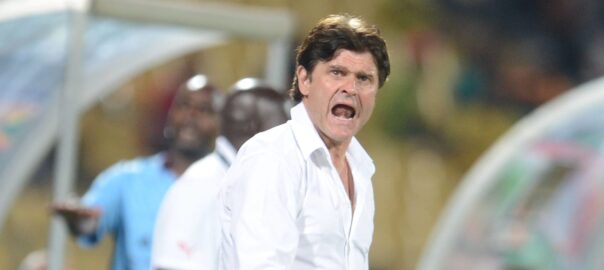
Guinea Head coach Didier Six

  • Guinea have never graced the FIFA World Cup
  • Syli Nationale are in a qualifying group with Morocco, Sudan and Guinea-Bissau
  • Coach Didier Six assesses their chances of making history

Guinea’s youth teams have competed on the world stage on multiple occasions, participating at the FIFA U-20 World Cup twice (Japan 1979 and Korea Republic 2017) and no fewer than four editions of the FIFA U-17 World Cup.

One factor that has contributed to the country’s successful national youth teams is the exceptional football academies located in the capital, Conakry. Even when the country grappled with an Ebola outbreak between 2014 and 2015, their U-17 and U-20 teams made the World Cup.

So why have the senior team never managed to qualify for the global showpiece?

FIFA.com spoke with Guinea’s French coach Didier Six, who enjoyed a notable playing career with French, English, Turkish and German clubs and was part of a wonderful France team that dazzled on the world stage and won UEFA EURO 1984.

After hanging up his boots, Six, like many French coaches, opted to forge a coaching career in Africa rather than staying in Europe. Having guided Togo to the quarter-finals of the 2013 Africa Cup of Nations, progressing from a tough group featuring Algeria, Tunisia and Côte d’Ivoire, he was appointed coach of Mauritius. In charge of Guinea since 2019, his goal – as he explains in this interview – is to lead the country to their maiden appearance at the FIFA World Cup™.

Guinea Head coach Didier Six

FIFA.com: What did you make of the team when you first arrived in Conakry?

Didier Six: I don’t like to criticise those who preceded me, as they may have experienced problems that I could face in the future, but in general the team was suffering because of non-sporting issues, and we had to get things back on track. The standard of football in Guinea is great, and with discipline everything will be up to scratch.

The country’s youth teams have enjoyed considerable successes, but the Guinea senior team have never qualified for the World Cup. Why do you think that is?

These things can happen – there are numerous strong teams that have never made the World Cup. Qualification isn’t inevitable and the competition is really fierce, given that 54 African countries are competing for just five spots, although that number is set to increase in the future.

What’s your goal for Guinea in these World Cup qualifiers? Is it to lead the country to the finals for the first time?

Qualifying for the World Cup is the dream of all Guineans, be it the fans, the players or the president of the football federation. When I accepted the job, he put reaching Qatar 2022 as a clause in my contract. That said, we’ll face strong opposition in our group and our task won’t be easy, especially now that even the continent’s lesser lights have developed and are no longer soft touches.

Preliminary qualifying draw (CAF)

How would you assess Morocco, Sudan and Guinea-Bissau, your opponents in Group I?

On paper, we’re second favourites after Morocco but, as I just said, teams like Sudan and Guinea-Bissau have had some good results. This came as no surprise to be me because Africa’s smaller teams have come a long way and now make things quite difficult for opponents.

How do you envisage your derby games with Guinea-Bissau?

We’ll play them the same as we do the other teams but with even greater focus. Players seeking to represent their national team must have fighting spirit, as that is one of main reasons sides get good results. As coaches, we’re obliged to pick players who possess this mentality. So far, I have Naby Keita, who plays for Liverpool, Amadou Diawara at Roma, and Mady Camara at Olympiacos, but I don’t have players at Real Madrid, Barcelona or Bayern Munich. That said, we need to be able to compete with the squad we have available, but even before that, we have to make sure players have this fighting spirit. That’s very important.

Naby Keita

Although Naby Keita doesn’t play much for Liverpool, he’s still the top Guinean player at present. Have you built the team around him?

It’s not about building the team around a specific player. In my opinion, Keita has magical feet, and I decided to give him the captaincy because he’s a true leader. He’s never abrasive with his team-mates. The way he talks to them is very similar to the way Zidane deals with his players, and he communicates the message in a wonderful way. When he came back from injury, I gave him two full games in four days and he helped us a lot, like scoring against a strong Mali team in Mali. He puts himself at the disposal of the team and his team-mates do all they can to assist him. We always need his magic and battling spirit on the pitch.

You’re currently based in Conakry and doubtless see a lot of local football. What do Guinean players need to do to be more represented in European leagues, like their counterparts from Algeria, Ghana, Côte d’Ivoire, Morocco and elsewhere?

We all know that Guinean players are technically very skilled, and things in Guinea are slowly getting better. When the national team get good results, players get attention from overseas. There are also clubs that have come a long way, such as Hafia and Horoya Conakry. People here play in their neighbourhoods and sometimes I see them playing in the street as I drive by. I’ll often be captivated and wait to see a shot or the end of a move. Guineans are very passionate about football.

Didier Six.

Do you think that an African team can reach the latter stages at Qatar 2022?

Why not? There’s a lot of potential in Africa and there’s been a major transformation in terms of mentality. In addition, there are so many African players based in Europe now. Algeria have an excellent squad, the same goes for Morocco, and we can’t forget about Egypt either. Now, they all must get over the idea that an African team can’t go beyond the quarter-finals, which Ghana most recently reached. There are many good teams such as Cote d’Ivoire, which were previously very strong but are now in the process of rebuilding.

How do you prepare your team during these challenging times caused by the Covid-19 pandemic?

Instead of having a squad of 30, we call up 40-45 players. FIFA have recently passed rules that allow us to have bigger squads. This has helped coaches as they now have greater flexibility during these difficult times.

FIFA.com
FIFA.com News

Stocklasa making his mark with Liechtenstein

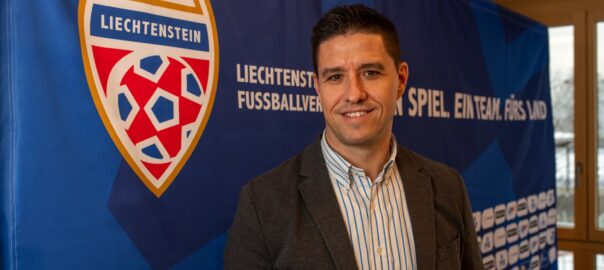
Martin Stocklasa

  • Martin Stocklasa has made history
  • Interview with Liechtenstein’s head coach
  • World Cup qualification starts at the end of March against teams including Germany

On 3 December 2020, the Liechtenstein Football Association made history not on the pitch but off it, as Martin Stocklasa became the first Liechtensteiner to coach the national team.

“Getting the opportunity to coach a national side is always a big deal, but for me it is undoubtedly the greatest challenge of my nascent career and something very special indeed,” the 41-year-old told FIFA.com. “It’s a huge honour and one that comes with lofty ambitions and targets.”

The appointment marks the first major test for the former defender after his spell in charge of the country’s U-21 side. Yet his jump into the deep end has been complicated even further by the coronavirus pandemic, which has made sensible planning almost impossible.

Martin Stocklasa

“From the start there has only really been one direction for me: full steam ahead,” Stocklasa explained. “Coronavirus has been challenging for everyone, but I must admit that I’m currently benefiting from it, because I’ve been able to get our team of mostly amateurs together for a longer period. Of course, coronavirus has changed some things.

“It will probably no longer be possible [for national team coaches] to have a purely sporting influence on a team – and of course we hope that will be the case. Nevertheless, we have been hit hard by the fact that there have been no matches in the amateur leagues, as that is where most of our players come from.”

The benefits of the time the Blues and Reds have spent together will become apparent in a few days time when European qualification for the FIFA World Cup Qatar 2022™ gets underway. Liechtenstein’s opponents in Group J are Romania, Iceland, Armenia, North Macedonia – and Germany. The 41-year-old’s associations with the Germans go back a long way, not just because he faced Bastian Schweinsteiger & Co. (picture below) during his playing days but because he also spent several years plying his trade for Dynamo Dresden.

Martin Stocklasa (R) of Liechtenstein battles for the ball with Bastian Schweinsteiger (L) of Germany

“I was very happy about the draw,” Stocklasa said. “I grew up watching Bundesliga matches and began visiting German stadiums as a small child. I wouldn’t trade my time in Dresden for anything. Despite their mini-crisis, to me Germany are still the ultimate team in Europe and the world. They could not be more different to us,” he added.

“The group is very exciting overall, featuring not just Germany but also Romania, who I was able to watch during the last qualifying campaign. They’re a young side with talented players. Then there are teams like Armenia and North Macedonia, who are difficult to assess, while Iceland have come so far in the last few years.”

David Beckham of England clashes with Martin Stocklasa of Liechtenstein

What does the group have in store?

“Although it will certainly be tough against Germany and Romania, we can create bigger problems for our other opponents on a good day and perhaps get something out of those games. We want to pick up points in this group. Hopefully we’ll be able to play our match against Germany in front of a crowd in September. That would be a reward of sorts for us.”

Stocklasa in numbers

  • His coaching career began almost seven years ago at FC St. Gallen’s youth academy
  • He became Liechtenstein’s head coach after three years with the country’s youth teams
  • As a player he represented clubs including FC Zurich, Dynamo Dresden and Austria’s SV Ried
  • 113 international caps (5 goals)

In what areas does football in Liechtenstein need to improve?

“I want to focus on three things: conditioning, playing tempo and rhythm. We can definitely improve the first of these in training. The leagues have a part to play in the second area; that is, which clubs the players represent and in which leagues. Players must be willing to go the extra mile to get out of their comfort zone. We’re asking a lot here, but in order to improve you need to go somewhere else and compete with the best.

“Luckily the mentality has changed in recent years. More and more young players want to gain experience abroad. If we have three or four players who do that, it helps the entire team. Back when we played Portugal, we were able to spring a surprise because a couple of our team-mates were playing elsewhere. We’ve got to do that again.”

Rheinpark Stadion, Vaduz, Liechtenstein

That match against the Seleção das Quinas marks Liechtenstein’s greatest footballing achievement to date. During qualification for the 2006 World Cup in October 2004, the principality snatched a sensational point with a 2-2 draw – after initially falling two goals behind.

“That’s something that will stay with me,” Stocklasa recalled. “The stadium was full and we were playing against Cristiano Ronaldo, Luis Figo and other international stars. We knew they were favourites for the title, but then we realised they weren’t taking us seriously. Portugal were 2-0 up and then we got the breakthrough we needed: a goal back. Suddenly we thought: we’re onto something here! It’s impossible to describe what happened next. The game finished 2-2, the world was turned on its head and all of Europe knew about Liechtenstein.”

Could the same thing happen against Germany or Romania? “Every point in European or World Cup qualifying is a sensational achievement, and that spurs the players on,” Stocklasa said. “A result like the one against Portugal would still be a huge surprise – even now.”

Rheinpark Stadion, Vaduz, Liechtenstein
FIFA.com
FIFA.com News