Category Archives: 2022 FIFA World Cup

Nsame: Benzema an inspiration in beefing up my game

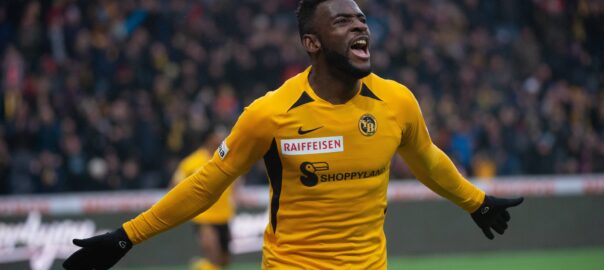
Jean-Pierre Nsame, of BSC Young Boys, celebrates after scoring

  • Jean-Pierre Nsame named Swiss championship Player of the Year for last two seasons
  • The constantly improving Cameroonian has scored 33 goals in 38 matches in 2020
  • He hopes to be judged on his performances and finally get his chance with the Indomitable Lions

Robert Lewandowski, Cristiano Ronaldo, Romelu Lukaku and Ciro Immobile are the only players in the world to have scored more than him in 2020. Suffice to say then that Jean-Pierre Nsame – with 33 goals during the last calendar year – is at the top of his game.

Since arriving in Switzerland in 2016, the Cameroon striker has been steadily improving. A maiden season there with second-division side Servette produced 23 goals in 31 appearances, paving the way for a 2017 move to BSC Young Boys. Nsame took the step-up in his stride, hitting the target 15 times in his first season, 16 in his second, then 41 times in 2019/20.

You could be tempted to rest on your laurels with stats like that, but the player himself is having none of it: “I’ve been progressing ever since I came here, but I still don’t feel like I’m at 100 per cent. I’m only 27 so it would be sad to think I’d already peaked,” he tells FIFA.com.

That does not appear to be the case, with the striker having racked up another 20 goals in 31 games so far this season. “It’s the result of all the work done by the club that developed me, the various loan spells I’ve had, and the different coaches I’ve worked under. They’ve all given me something, and today I’m definitely reaping the fruits of all those years of work. I feel very comfortable at present and also have more experience, which allows me to better envisage my future and to know the aspects of my game I still need to improve to be even better. It’s a motivation.”

Inspiration, progression, motivation

He has certainly been close to his best in Switzerland, where he was named Player of the Year in the Swiss Super League for the last two seasons. Now the complete striker, Nsame knows the qualities that have enabled him to reach this level.

“I’ve improved year on year to become a good finisher inside the box, to have confidence in my technique, as well as to move around effectively,” he says, aware that his imposing physique (1.88m) is also an advantage. “I hold my own pretty well with defenders and am not afraid to go up against them. I’m also capable of making forward runs and producing repeated bursts of high-intensity running. On the mental side, I think I’m good at staying focused for the entirety of matches, continually waiting for the ideal situation, anticipating and intuiting the play,” he explains, adding that he honed these qualities by working with his former team-mate Guillaume Hoarau, a former France international.

And it is another Tricolore striker who is inspiring him to improve even more. “I can progress in every area, like being even more efficient with my finishing in the area and more involved in the build-up play. Moreover, I watch Karim Benzema a lot for the way he participates in games, like being a focal point for breaks or clearances due to his technical precision,” says the Cameroonian. “I want to develop further to beef up my game, something I’m still capable of. That period between the ages of 27 and 31 or 32 is when you feel most comfortable, where you manage things better and know exactly where to push.”

This quest for perfection has made Nsame Cameroon’s top scorer for several seasons now. But despite his effectiveness, the Angers graduate is still waiting to get a real chance with his national team. “I did enough to warrant being in the squad for CAN 2019, as I was Cameroon’s top scorer in Europe at the time,” he recalls, referring to his first full internationals in 2017 and 2019. “However, our former coach Clarence Seedorf preferred someone else. I respect him, but he didn’t give me a convincing explanation. Among the forwards who were there, I was the one who scored the most.”

Jean-Pierre Nsame, of BSC Young Boys

Losing not an option

“That objective is always on my mind, but I’m just faced with a situation that doesn’t satisfy me, in terms of the things being said and stances taken, knowing that everything has been clarified for a long time now,” says the player, who hopes that the appointment of Antonio Conceicao will change the panorama. “As of now, I’m not against going back to the team if things are sorted out. There’s a new coach, so [it’s fine] if the discussion is about on-field performances, but I’m not interested in any of the side issues. I continue to work to create opportunities to establish myself. But the choices, the decisions, the stories – it’s not me who controls them…”

With the CAF qualifiers for the FIFA World Cup Qatar 2022™ on the horizon, the Indomitable Lions could certainly use a confident and in-form goalscorer to emerge from a tough Group D containing Malawi, Mozambique and, above all, Côte d’Ivoire.

“It’s a major rivalry, because of the eras of Didier Drogba and Samuel Eto’o and all the great players of that generation,” admits Nsame, who got to know Ivorian striker Roger Assale well during his time at Young Boys. “If all goes well, our two teams will be battling it out for top spot, although I find it a little sad to think only one of us can qualify [for the next round]. It would be nice to have the best African teams at the World Cup, as it would show that African football is right up there. Still, it’ll be a very interesting match, especially if I’m there and have the opportunity to meet Roger,” he adds with a laugh.

Of course, there will be no laughter if Cameroon do not secure a berth in Qatar. “That’s what the Cameroonian people expect from their team. There’s pressure on all the players,” he admits. “In Cameroon, the national team belongs to the people – fanatical, extreme people in every eventuality. They love you with a passion when you win but can hate you just as much if you lose…

“Sometimes you feel like losing is not even an option, despite football being all about winning and losing. That said, Cameroon always needs to have as their goal qualifying for the World Cup and giving a good account of African football,” he concludes.

FIFA.com
FIFA.com News

Maracana | Brazil 1950 & 2014 | FIFA World Cup

FIFA.com Certain football stadiums have a special aura about them, a magical nature that lends them a legendary status. In Rio De Janeiro lies one such magnificent arena: Maracana.

This Brazilian icon is a renowned name synonymous with footballing greatness. It’s visually distinct and historically significant, being one of only a few stadiums to host two FIFA World Cup finals.

Soteldo: Wearing the Santos No10 shirt has never burdened me

Yeferson Soteldo de Venezuela celebrates after scoring 

  • Venezuela and Santos’ Yeferson Soteldo speaks exclusively with FIFA.com
  • The diminutive midfielder gained global attention at the 2017 U-20 World Cup
  • He talks about his challenging upbringing, Messi’s influence on him and much more

The Venezuelan Yeferson Soteldo is one of the most electrifying players competing in South America today, and while he may be only 1.58m (5’2) tall, it would be a mistake to underestimate him, as plenty of teams can attest.

The 23-year-old attacking midfielder is currently excelling with Brazilian giants Santos and is one of the reasons Venezuela are daring to dream of a maiden FIFA World Cup™ appearance at Qatar 2022.

Curiously, he made his full national team debut (under Noel Sanvicente) before being called up to the U-20 side. Unperturbed, he went on to gain global attention as part of Rafael Dudamel’s historic team that finished runners-up at the FIFA U-20 World Cup in 2017.

Which is not to say his journey to that point had been easy. He endured a tough childhood and challenging upbringing in El Muertico, a disadvantaged neighbourhood, where he managed to escape some bad company, but to which he returns whenever he can.

Soteldo spoke with FIFA.com about those early years, the influence Lionel Messi and Jorge Sampaoli have had on his career, as well as the South American qualifiers – in which he is currently competing for the second time after playing five games in the previous edition.

Yeferson Soteldo of Venezuela waits to take a free kick during the FIFA U-20 World Cup Korea Republic 2017

FIFA.com: How and when did your love affair with football begin?

Yeferson Soteldo: At a very young age. Other sports were fashionable in my neighbourhood, but all I wanted was a football. My dad soon noticed this, and so footballs were what I got for presents. At nine I joined a team that used to compete against older kids, and I quickly realised it was my passion.

Do you remember your first ball?

Yes, it was a futsal ball! We used to play in the street with stones marking the goals. That helped develop my style a little bit, being able to dribble in tight spaces and put my foot on the ball. Until I was 12, I played more five-a-side than anything else. In fact, I still play it whenever I go back to my neighbourhood.

You’ve said on more than one occasion that football saved your life. How so?

I grew up with some friends – well people I called friends at the time – and we’d been hanging out together since I was six. By the age of 11, they were starting to go off the rails and by 12 were already robbing. Suddenly they could afford lots of things while I had nothing. That’s when I began heading in the same direction. However, when I was 13, one of them got killed, and that was when I asked myself: ‘What am I doing here?’

Around that time, I had the chance to play in a game that would be attended by a scout from Caracas FC, but as my football boots were busted, I decided not to go. Then on the day of the game, my team were losing and came looking for me. ‘We’ll lend you a pair of boots,’ they told me, and so off I went. We were losing 2-0 when they sent me on in the No10 role, and we turned it around with two goals and an assist from me. That’s how I got my chance to join Caracas, which was the best thing that ever happened to me.

Wilker Romero, Rolf Feltscher, Yeferson Soteldo, Wuilker Fariñez and Tomas Rincon of Venezuela

How did you feel the first time you were told you wouldn’t succeed because of your size?

A lot of things came from that moment. I’d been let go by Caracas and I was looking to start again from scratch. I was having a trial and doing well, only for one of the staff to tell me that they’d decided against me on account of my physique and that I should forget about a career in football. If you’re an impressionable, submissive kid, then maybe you quit, and I almost did. But I wasn’t weak and understood that I couldn’t let those words get to me. Then I went to a state tournament in Barinas, attended by ‘Chita’ Sanvicente, who’d just been appointed Zamora coach. I was just about to turn 15. He saw me play and the rest is history.

Is it true that Messi was your inspiration back then?

Yes! I looked at him as another small guy and thought, ‘If he can become one of the best in the world, what’s to stop me making it?’ Besides, we had similar styles. I felt that, while maybe I wasn’t going to be the best, at least I could excel like him. I named my first son, who I had at 18, Thiago Mateo after him. [Editor’s note: Messi’s eldest son is called Thiago and his second-born Mateo.]

Lionel Messi of Argentina fights for the ball with Yeferson Soteldo 

Following successful spells at Zamora, Huachipato and Universidad de Chile, you were signed by Santos and given the club’s No10 shirt famously worn by Pele. Did you worry that might be a burden?

Actually, it was me who asked for it! The first thing I did when I arrived was to ask if the No10 shirt was available. I know what it represents, but it never burdened me. What’s more, on the day of my unveiling, I was given a shirt with no number, so I reminded the president I wanted the No10. I think he thought I was joking! Then they printed it, and when I turned my back to show the crowd, the stadium erupted.

Jorge Sampaoli brought you to the club, but then one day he says to you, “You don’t play for me again until you learn to defend.” How did you deal with that situation?

I made my first appearance soon after signing and scored on my debut. But after three or four games, he stopped putting me in the team. Before the classico against Palmeiras, he gave me that ultimatum, which was when I understood what was going on. As I’m someone who heeds my coaches’ advice, I worked hard and changed. Now, I could run 10 or 11 kilometres per game. He’s one of the coaches who has taught me the most thus far.

Your explosive form for Santos also coincided with some of your best performances for the national team. What does La Vinotinto mean to you?

It’s the best thing that ever happened to me, and one of the best things in my life, because it helped teach me not to look back. I also wear the No10 for my country, which is something I dreamed about from the moment I first pulled on a shirt with that number. I will always do my best to be available for the national team.

Ahead of the qualifiers, there were high hopes that this squad could make it to Qatar. How would you assess the start of your campaign, which has yielded just three out of a possible 12 points?

It was hard… difficult and not exactly what we expected. We quickly realised that, performing like that, we weren’t going to qualify, so we talked it out behind closed doors. We have the talent and players needed to qualify, but we had to change quickly and put our egos to one side, among other things. That was noticeable against Brazil, despite losing that game, and against Chile. I can assure you’ll see it again in the upcoming FIFA qualifiers. The goal is to be in Qatar.

What was the key to that first win over Chile in your most recent qualifier?

Understanding that we can’t go out to defend when at home. Nor can we do it on the road either, although it can also depend on the opponent. Respectfully, I’d rather lose while taking on opponents than while defending against them. I want the wingback to spend more time marking me than I do him. Against Chile we kept a higher line, we were better at getting into their box and created more scoring chances.

Salomón Rondón (L) of Venezuela celebrates with teammates Yeferson Soteldo and Jhon Chancellor

Several of your former team-mates that were U-20 World Cup runners-up in 2017 are also in the senior squad. What role have you guys been assigned?

We contribute by doing whatever’s asked of us, although the message should be: “If these youngsters could do it, then so can we.” The fans are also excited now that they’ve experienced the final of a World Cup, and they let you know that. But it’s more of a motivation than a burden.

Ecuador and Peru are next on the horizon for Venezuela. How would you assess those opponents?

Ecuador are very tough, especially when at home, but this time they have to come to Venezuela, which we need to capitalise on. With Chile, our plan to press them and play a high line worked, so I imagine something similar, although Ecuador can be very quick on the break. Peru haven’t had the best of starts, but they qualified for the last World Cup and reached the final of the 2019 Copa America. Thinking they’re now ‘a bad team’ would be a big mistake.

Are you obsessed on seeing Venezuela finally make their World Cup debut at Qatar 2022?

It’s a clear goal and something that’s on my wish list, so I’ll give everything possible to make it happen. But I’ve learned not to get obsessed about things, otherwise I’d go crazy and wouldn’t be able to make a career from football.

Soteldo and…

Experiencing fatherhood at such a young age. “At 18, the prospect of becoming a father scared me, but it helped me mature, and my career progressed. It was God’s blessing.”

Coping with fame. “In Venezuela it’s more low key, but in Brazil it’s intense. If you’re recognised, then you can be suddenly surrounded by people. With my children, Thiago Mateo (5), Rihana (3) and Oliver (2), I explain to them that it happens because Daddy’s playing football well.”

His foray into e-sports. “I like to play Fortnite, and during the pandemic I practiced a lot. That’s when I decided to create my own team. I play for fun, but my players are professionals.”

The future. “Today I can say that I’m ready to take it to the next level, although I feel good here at Santos. We’ll see after the Copa America. I’ve always liked the English league.”

FIFA.com
FIFA.com News

World Cup winner Low to step down

Ukraine v Germany - UEFA Nations League

  • Joachim Low set to stand down following UEFA EURO 2020
  • Low led Germany at three FIFA World Cups, including famous Brazil 2014 win
  • “I am taking this step consciously, full of pride and with huge gratitude”

Joachim Low, architect of Germany’s memorable 2014 FIFA World Cup Brazil™ win, has announced he will end his record-breaking national team tenure after this year’s UEFA EURO.

Low assumed the reins from Jurgen Klinsmann following the FIFA World Cup on home soil in 2006. Low’s World Cup career also included a third place at South Africa 2010, although it ended with disappointment at Russia 2018 with a group-stage exit.

During his national team career, Low also won the FIFA Confederations Cup in 2017 and was runner-up at EURO 2008.

“I am taking this step consciously, full of pride and with huge gratitude, but at the same time with unbroken motivation regarding the upcoming European Championships,” Low said. “Pride, because it is something very special and an honour for me to be engaged for my country, and because I was able to work with the country’s best footballers for almost 17 years, accompanying them in their development. 

“With them I shared great triumphs and painful defeats, but above all many wonderful and magic moments – not only winning the 2014 World Cup in Brazil. I am and will be grateful to DFB, which has always provided me and the team with an optimal working environment.”

German Football Association (DFB) president Fritz Keller said Low has achieved a special place in the nation’s football history. “I have great respect for Joachim Low’s decision,” he said. “DFB knows what it has in Jogi, he is one of the greatest coaches in world football. 

“Jogi Low has shaped German football like almost nobody else over the years and helped it achieve the highest international recognition. Informing us about his decision at an early stage is very decent, and gives us the necessary time to appoint his successor with calm and the right balance.”

FIFA.com
FIFA.com News