Category Archives: 2026 FIFA World Cup

Portugal earn dominant win to book 2026 World Cup place

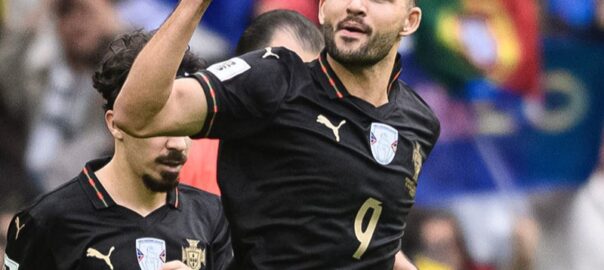
Portugal confirmed their passage to the 2026 World Cup with a commanding display against Armenia, led by hat tricks from Bruno Fernandes and Joao Neves. The team entered the match under pressure after a setback against the Republic of Ireland, a defeat made worse by Cristiano Ronaldo’s dismissal in that encounter.

The tension eased quickly when Renato Veiga met a well-placed free kick from Fernandes and nodded the ball into the net to set Portugal on their way. Armenia briefly stopped the momentum when Eduard Spertsyan reacted quickest inside the area and leveled the score midway through the opening half.

That equalizer did little to unsettle Portugal. Goncalo Ramos restored the advantage soon after by guiding a composed finish beyond the goalkeeper. Neves then produced two strikes in succession, one arriving after a sweeping move and the next produced from a dead-ball effort that curled beyond the defensive wall.

Ruben Dias won a penalty just before the interval, giving Fernandes the chance to calmly send the goalkeeper the wrong way and extend the lead. With that, Portugal went into the break firmly in command of the contest.

Relentless scoring secures overwhelming result

The pattern resumed once the teams returned. Fernandes collected his second of the match with a driven attempt that found the corner of the net. He soon completed his treble from the penalty spot after Carlos Forbs was impeded inside the area, adding further distance between the sides.

Neves was not finished either. The midfielder ensured he matched Fernandes’ tally by guiding in a precise effort from central range, taking Portugal’s total to eight goals and further demonstrating their control of the game.

Francisco Conceicao added the final touch in the closing moments, drilling the ball inside the near post to complete a resounding performance. It capped a night in which Portugal maintained attack-minded pressure from start to finish.

Suspension concerns for Ronaldo ahead of next year

Portugal’s emphatic win also confirmed their place at the tournament without needing help from elsewhere. However, attention now turns to Ronaldo’s disciplinary situation. His red card against the Republic of Ireland has already ruled him out of the next fixture, but a decision from FIFA could increase that punishment.

Should the governing body extend the ban, the forward may miss Portugal’s opening two matches at the 2026 World Cup. That outcome remains possible as officials review the circumstances of his sending off.
FIFA World Cup 26’s official match ball unveiled: TRIONDA

FIFA World Cup 26’s official match ball unveiled: TRIONDA

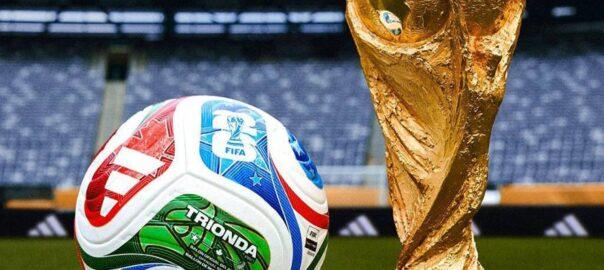
The FIFA World Cup 26™ has reached a major milestone with the introduction of adidas TRIONDA, the tournament’s official match ball. Its name, TRIONDA, translates from Spanish as “three waves” and celebrates the historic collaboration of the three host countries: Canada, Mexico, and the United States.

The ball features a striking palette of red, green, and blue, representing each of the co-hosts. Its innovative four-panel structure with flowing geometry mimics the wave patterns referenced in the name. In the center, these panels form a triangular shape, symbolizing the union of the three nations for the first time in World Cup history.

Adding to its visual appeal, TRIONDA displays icons for each country: a maple leaf for Canada, an eagle for Mexico, and a star for the United States. Gold accents on the ball honor the FIFA World Cup Trophy, highlighting the significance of the competition’s global stage.

Advanced technology and performance features

TRIONDA incorporates several technological upgrades to enhance match performance. The deep seams within the four-panel design improve flight stability by evenly distributing drag as the ball moves through the air. This ensures more predictable trajectories during passes and shots.

Embossed icons, visible only when closely examined, enhance grip for players, especially in wet or humid conditions. The construction focuses on maintaining optimal control, allowing for precise striking, dribbling, and passing.

Connected ball technology also provides detailed tracking of each movement, assisting referees and match officials in monitoring play. This addition reflects the ongoing integration of technology into the sport to support fairness and accuracy.

Build-up to the World Cup and fan engagement

The launch of TRIONDA comes as excitement builds toward the final draw and the start of the tournament. Recent announcements have included the unveiling of the official mascots and confirmation that FIFA will donate USD 1 from each ticket sold to the FIFA Global Citizen Education Fund.

Fan engagement has been strong, with over 4.5 million supporters from 216 countries participating in the Visa Presale Draw, the first phase of ticket distribution for the highly anticipated event.

FIFA President Gianni Infantino expressed his enthusiasm, describing TRIONDA as “another iconic FIFA World Cup ball” and praising adidas for capturing the unity and passion of the host nations. He added that he looks forward to seeing the ball in action on the pitch as the tournament countdown continues.

TRIONDA is now available for purchase through official FIFA and Adidas websites, allowing fans to own a piece of the World Cup ahead of the tournament.

World Cup mascots: Maple, Zayu, and Clutch take center stage

Is a global football celebration complete without a mascot? For the 2026 edition, the answer comes in threes.

With the tournament expanding to 48 nations, the event will also feature three mascots for the three co-hosts. Each one embodies its country’s identity while playing its own special role on the pitch.

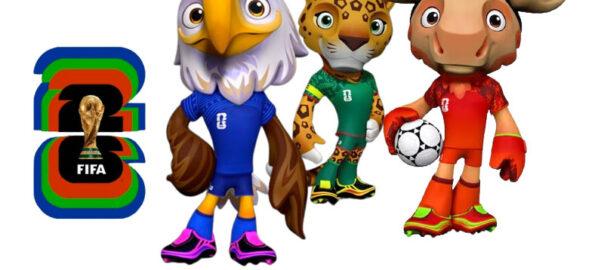
Canada is represented by a moose, Mexico by a jaguar, and the United States by a bald eagle. Together, Maple, Zayu, and Clutch aim to connect culture, tradition, and sport.

Maple the goalkeeper of Canada

Maple, wearing the number 1 shirt, is a moose symbolizing Canadian heritage. His outfit and name highlight some of the country’s most recognizable elements.

According to the description, Maple roams from coast to coast, uniting communities while reflecting the culture of the nation.

While Canada’s men’s team is better known for attack-minded players such as Alphonso Davies and Jonathan David, Maple’s antlers suggest he can cover plenty of space at the back.

Zayu the forward from Mexico

Mexico’s representative is Zayu, a jaguar in the number 9 jersey. Found mainly in the southern regions, the animal carries deep significance for ancient cultures of the country.

Zayu embodies celebration, from cuisine and dance to tradition, creating bonds that stretch beyond borders. His presence mirrors the country’s passion and pride.

Just like legendary strikers such as Javier Hernández, Cuauhtémoc Blanco, and Raúl Jiménez, Zayu leads the line with flair.

Clutch the playmaker of the United States

Clutch, a bald eagle with the number 10, fills the role of midfield organizer. The character is tied to exploration, adventure, and optimism, soaring across the vast United States while embracing different communities and games.

For American supporters, that shirt is strongly linked with Christian Pulisic, who carries the nation’s hopes heading into 2026. Clutch, too, is cast as the creative force in the middle of the field.

Looking back at past mascots

Mascots became a feature of the men’s World Cup in 1966, when England introduced World Cup Willie, a lion in a Union Jack shirt. Each edition since has created a character inspired by its host nation.

Juanito, a sombrero-wearing boy, was unveiled in Mexico in 1970, while West Germany brought Tip and Tap, two children in uniform, for 1974. Argentina presented Gauchito in 1978, a cartoon gaucho, and Spain followed with Naranjito, a cheerful orange, in 1982.

Mexico hosted again in 1986 with Pique, a jalapeño in traditional attire. Italy introduced the abstract figure Ciao in 1990, and the United States revealed Striker the dog in 1994. France continued in 1998 with Footix, a rooster in national colors.

South Korea and Japan, the first co-hosts, created Ato, Kaz, and Nik in 2002, futuristic figures known as Spheriks. Germany introduced Goleo VI and his talking football Pille in 2006. South Africa had Zakumi the leopard in 2010, and Brazil brought Fuleco the armadillo in 2014.

Russia’s choice in 2018 was Zabivaka the wolf, while Qatar presented La’eeb in 2022, a playful character resembling a traditional headpiece.

How the new 48-team 2026 World Cup works

The 2026 edition will be larger than anything the competition has seen before.

Previous tournaments from 1998 to 2022 included 32 nations and 64 fixtures in total. This time, the event expands to 48 participants and 104 matches. Merely trimming the field to 32 sides will already require 72 fixtures, which is eight more than the entire schedule of a 32-team format.

Although three countries are co-hosting, the United States will stage far more than any other nation has ever managed in a single competition. It will host 14 more fixtures than the previous record and 26 more than it did when the event came to its soil in 1994.

The first 27 days of action, from the curtain raiser through the last-32 round, will feature 96 contests without a single rest day. Only one day will stage a solitary clash, and two other days will include two fixtures. All the remaining 24 days will deliver between three and six matches.

By the final week of the group stage, the calendar will be jam-packed. From June 24 to 27, 18 games will be played—more than the entire total of the 1934 edition, which only had 17.

The abandoned plan of three-team groups

Originally, FIFA had considered creating 16 trios instead of 12 groups of four.

That plan would have produced 80 fixtures in total, noticeably fewer than 104. It would also have been simpler to follow, with the two best teams moving straight into the round of 32 to face each other in a clear bracket.

However, every team would only have been assured two matches, not three. More importantly, the structure would have been vulnerable to manipulation. With three-team groups, only three fixtures could be played, and no two at the same time. That meant one team would always complete its games earlier, leaving the final fixture open to scenarios where both sides knew exactly what outcome would secure progress.

The risk of collusion across 16 groups proved too significant, and the plan was eventually dropped despite its more compact design.

The adopted system of 12 groups of four

Instead, the competition will use 12 sections of four, echoing the approach of earlier tournaments such as the 1986, 1990, and 1994 World Cups, or more recent 24-team European Championships.

The formula is straightforward: the top two from each group advance, and they are joined by the eight best third-placed nations to complete the last 32.

It is less tidy than the three-team plan, but it ensures fairness and avoids the controversies that might have arisen otherwise.

The expanded knockout rounds

Once the field has been reduced to 32, the knockout journey follows a familiar path. The difference is simply scale.

Group winners will mostly be paired against third-placed finishers, although four of them will meet runners-up. Meanwhile, the remaining runners-up will be matched against each other.

From there, the tournament progresses in the traditional order: round of 16, quarter-finals, semi-finals, and the final.

For the first time, the eventual champion will need to play eight matches rather than seven, adding one extra step on the road to lifting the trophy.

Guide to the 2026 World Cup host cities & stadiums

The 2026 men’s World Cup will be the largest edition of the event. A total of 48 nations will be involved, 16 more than the tournament held in Qatar in 2022.

It will also be staged across three countries for the very first time. The contest is scheduled to begin on June 11, 2026, and will finish on July 19, 2026.

This will be the 23rd running of the championship.

Final match and entertainment

FIFA president Gianni Infantino confirmed that the deciding game will feature a musical performance during the interval. Coldplay will take part in the show at MetLife Stadium in New Jersey on July 19.

The idea is based on the Super Bowl tradition in the United States.

Host cities and stadiums

The matches will be spread across 16 different locations in the United States, Canada, and Mexico. This will be the first time three nations share organizing duties.

The last World Cup in North America was held in 1994, when the United States was the host.

United states

  • Dallas Stadium, Arlington, Texas (94,000)
  • New York/New Jersey Stadium, East Rutherford, New Jersey (82,500)
  • Atlanta Stadium, Atlanta, Georgia (75,000)
  • Kansas City Stadium, Kansas City, Missouri (73,000)
  • Houston Stadium, Houston, Texas (72,000)
  • San Francisco Bay Area Stadium, Santa Clara, California (71,000)
  • Los Angeles Stadium, Inglewood, California (70,000)
  • Philadelphia Stadium, Philadelphia, Pennsylvania (69,000)
  • Seattle Stadium, Seattle, Washington (69,000)
  • Boston Stadium, Foxborough, Massachusetts (65,000)
  • Miami Stadium, Miami Gardens, Florida (65,000)

Canada

  • Toronto Stadium, Toronto (45,000)
  • BC Place Vancouver, Vancouver (54,000)

Mexico

  • Estadio Azteca, Mexico City (83,000)
  • Estadio Monterrey, Guadalupe (53,500)
  • Estadio Guadalajara, Zapopan (48,000)