Category Archives: 2026 FIFA World Cup

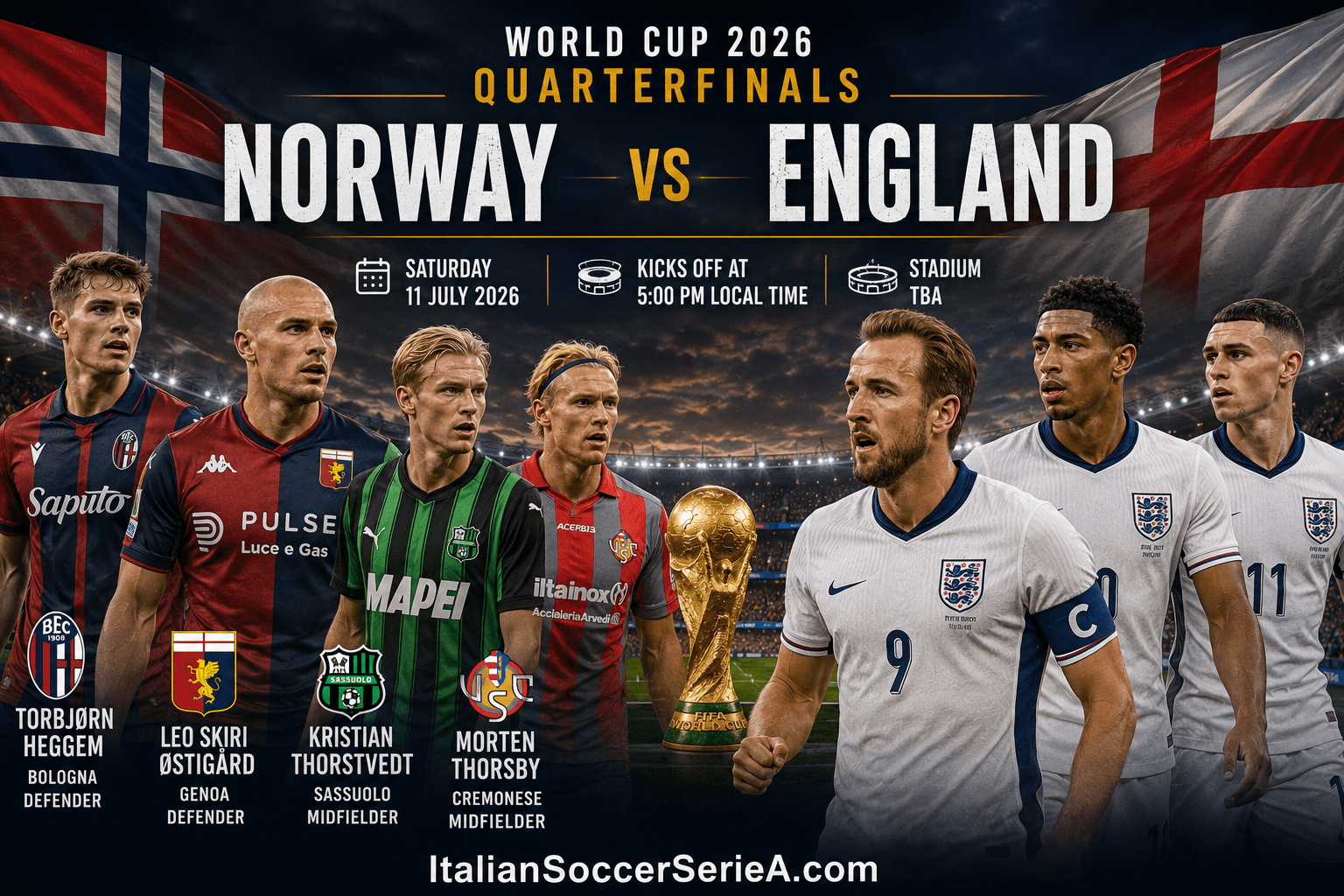
Norway vs England Official Lineups, Saturday, 11 July 2026, World Cup Quarterfinals

Norway vs England Official Lineups, Saturday, 11 July 2026, World Cup Quarterfinals

Here are the official starting lineups for Norway vs England in the FIFA World Cup Quarter-Final on Saturday, July 11, 2026. The match will kick off at 5:00 PM local time (22:00 BST / 23:00 CEST) at the Hard Rock Stadium in Miami, Florida. This is sure to be a thrilling match featuring a clash of superstar strikers, with Erling Haaland leading Norway and Harry Kane leading England’s attack. The winner of this match will advance to the semifinals to face either Argentina or Switzerland at the Atlanta Stadium on Wednesday, July 15.


11-07-2026 21:00
Quarterfinal


FIFA Ranking

England holds the No. 4 spot in the FIFA rankings, while Norway is ranked No. 19.


How did they reach the Quarterfinals?

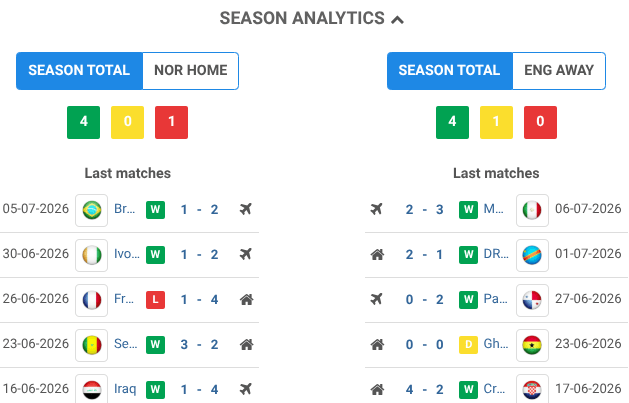
Norway made history by reaching their first-ever World Cup quarterfinal, stunning five-time champions Brazil with a 2-1 victory, thanks to a late brace from Erling Haaland. Earlier in the tournament, Norway finished second in Group I with 6 points, defeating Senegal and Iraq, but losing to France, before eliminating the Ivory Coast 2-1 in the round of 32.

England secured their place in the last eight by defeating co-hosts Mexico 3-2 in a thrilling last-16 match at the Azteca Stadium. The Three Lions reached this stage by topping Group L with seven points, winning against Croatia and Panama, and drawing with Ghana, followed by a 2-1 victory over the Democratic Republic of the Congo in the round of 32.


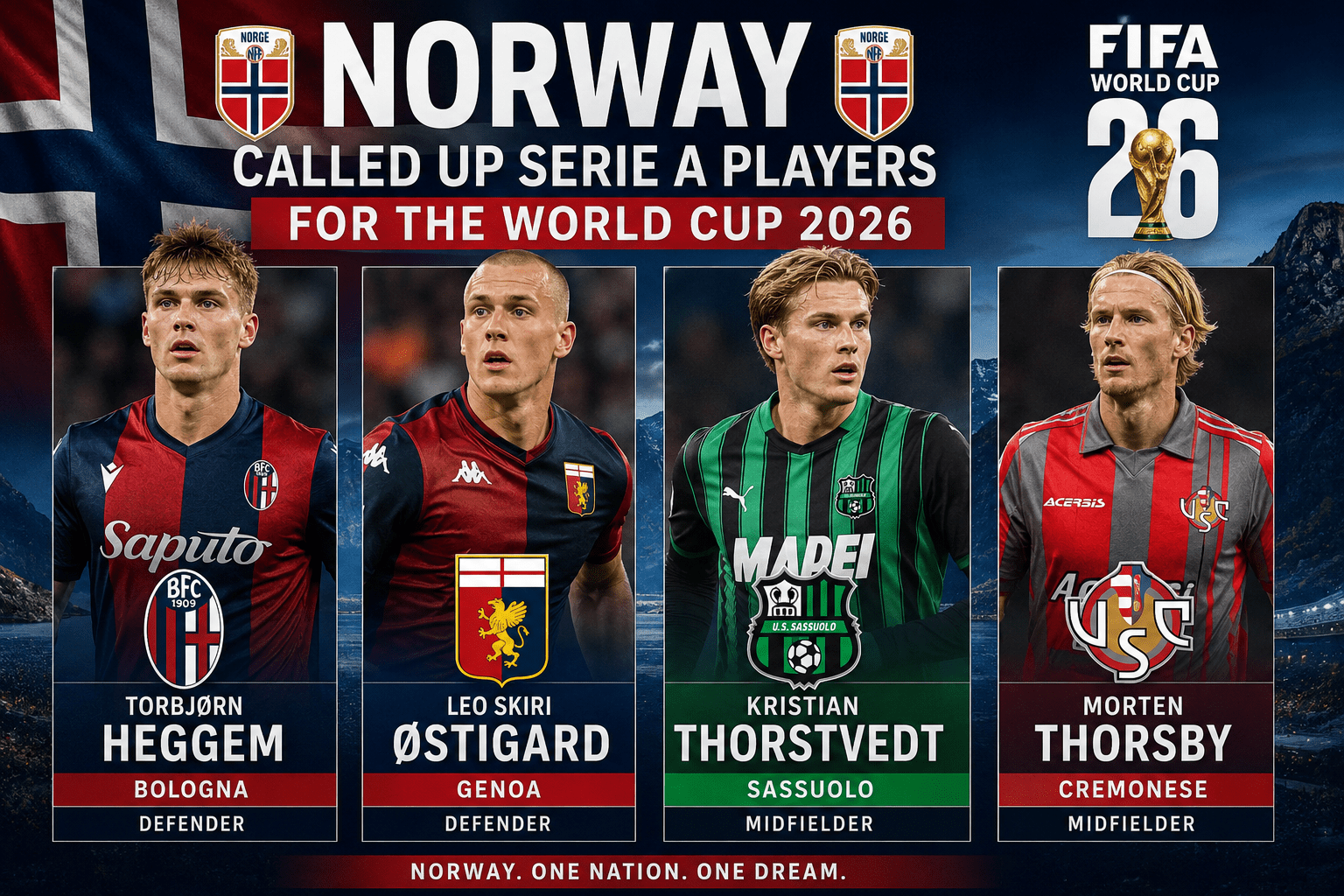
👉   Serie A players called up for    🇳🇴     the Norway National team:
  • Bologna defender Torbjorn Heggem
  • Genoa defender Leo Skiri Ostigard
  • Sassuolo midfielder Kristian Thorstvedt
  • Cremonese midfielder Morten Thorsby


👉   No Serie A players called up for the England National team

👉   Click here for  Full 2026 World Cup Squad Lists – Confirmed rosters for all 48 teams.

👉  Click here for  2026 World Cup Group Stage Standings.

🇳🇴   Norway starting lineup (4-3-3): Ørjan Nyland, Kristoffer Ajer, David Møller Wolfe, Torbjørn Heggem, Julian Ryerson, Patrick Berg, Martin Ødegaard, Sander Berge, Erling Haaland, Alexander Sørloth, Andreas Schjelderup.

Substitutes: Henrik Falchener, Egil Selvik, Jens Petter Hauge, Fredrik Aursnes, Marcus Pedersen, Sondre Langås, Leo Østigård, Oscar Bobb, Morten Thorsby, Jørgen Strand Larsen, Thelo Aasgaard, Fredrik Bjørkan, Sander Tangvik, Kristian Thorstvedt, Antonio Nusa.

🏴󠁧󠁢󠁥󠁮󠁧󠁿   England starting lineup (4-2-3-1):  Jordan Pickford, John Stones, Nico O’Reilly, Marc Guéhi, Ezri Konsa, Elliot Anderson, Anthony Gordon, Declan Rice, Noni Madueke, Jude Bellingham, Harry Kane .

Substitutes: James Trafford, Marcus Rashford, Jordan Henderson, Morgan Rogers, Trevoh Chalobah, Djed Spence, Dean Henderson, Reece James, Bukayo Saka, Ollie Watkins, Eberechi Eze, Dan Burn, Ivan Toney, Kobbie Mainoo.

Norway
England

Starting lineups

1
Ørjan Nyland
Goalkeeper
5
David Möller Wolfe
90'
26
Julian Ryerson
Defender
60'
3
Kristoffer Ajer
Defender
17
Torbjørn Heggem
Defender
91'
21
Andreas Schjelderup
Midfielder
68'
10
Martin Ødegaard
Midfielder
6
Patrick Berg
Midfielder
8
Sander Berge
Midfielder
7
Alexander Sörloth
68'
9
Erling Haaland
Attacker
106'
1
Jordan Pickford
Goalkeeper
2
Ezri Konsa
Defender
89'
5
John Stones
Defender
6
Marc Guehi
Defender
3
Nico O’Reilly
Defender
86'
4
Declan Rice
Midfielder
46'
8
Elliot Anderson
Midfielder
10
Jude Bellingham
Midfielder
111'
18
Anthony Gordon
Attacker
71'
9
Harry Kane
Attacker
20
Noni Madueke
Attacker
46'

Substitutes

2
Morten Thorsby
Midfielder
18
Kristian Thorstvedt
Midfielder
13
Egil Selvik
Goalkeeper
23
Jens Petter Hauge
15
Fredrik Björkan
Defender
19
Thelo Aasgaard
Midfielder
24
Sondre Langås
Defender
12
Sander Tangvik
Goalkeeper
25
Henrik Falchener
Defender
11
Jörgen Strand Larsen
106'
14
Fredrik Aursnes
Midfielder
60'
22
Oscar Bobb
Attacker
68'
20
Antonio Nusa
Attacker
68'
16
Marcus Pedersen
Defender
90'
4
Leo Östigard
Defender
91'
12
Trevoh Chalobah
Defender
16
Kobbie Mainoo
Midfielder
11
Marcus Rashford
Attacker
14
Jordan Henderson
Midfielder
19
Ollie Watkins
Attacker
23
James Trafford
Goalkeeper
13
Dean Henderson
Goalkeeper
22
Ivan Toney
Attacker
15
Dan Burn
Defender
111'
7
Bukayo Saka
Attacker
46'
21
Eberechi Eze
Attacker
46'
24
Reece James
Defender
71'
25
Djed Spence
Defender
86'
17
Morgan Rogers
Attacker
89'


Norway   Norway World Cup 2026 Squad: 
  • Goalkeepers: Orjan Haskjold Nyland (Sevilla), Egil Selvik (Watford), Sander Tangvik (Hamburger SV).
  • Defenders: Julian Ryerson (Borussia Dortmund), Marcus Holmgren Pedersen (Torino), David Moller Wolfe (Wolverhampton), Fredrik Bjorkan (Bodo/Glimt), Kristoffer Ajer (Brentford), Torbjorn Heggem (Bologna), Leo Skiri Ostigard (Genoa), Sondre Langas (Derby County), Henrik Falchener (Viking).
  • Midfielders: Martin Odegaard (Arsenal), Sander Berge (Fulham), Fredrik Aursnes (Benfica), Patrick Berg (Bodo/Glimt), Kristian Thorstvedt (Sassuolo), Morten Thorsby (Cremonese), Thelo Aasgaard (Rangers).
  • Forwards: Erling Haaland (Manchester City), Alexander Sorloth (Atletico Madrid), Jorgen Strand Larsen (Crystal Palace), Antonio Nusa (RB Leipzig), Oscar Bobb (Fulham), Andreas Schjelderup (Benfica), Jens Petter Hauge (Bodo/Glimt).
England   England World Cup 2026 Squad:
  • Goalkeepers: Jordan Pickford (Everton), Dean Henderson (Crystal Palace), James Trafford (Manchester City).
  • Defenders: Reece James (Chelsea), Tino Livramento (Newcastle), Marc Guehi (Manchester City), Ezri Konsa (Aston Villa), John Stones (Manchester City), Jarell Quansah (Bayer Leverkusen), Nico O’Reilly (Manchester City), Dan Burn (Newcastle), Djed Spence (Tottenham Hotspur).
  • Midfielders: Declan Rice (Arsenal), Elliot Anderson (Nottingham Forest), Jude Bellingham (Real Madrid), Jordan Henderson (Brentford), Morgan Rogers (Aston Villa), Kobbie Mainoo (Manchester United), Eberechi Eze (Arsenal).
  • Forwards: Harry Kane (Bayern Munich), Ivan Toney (Al-Ahli), Ollie Watkins (Aston Villa), Bukayo Saka (Arsenal), Noni Madueke (Arsenal), Marcus Rashford (Barcelona), Anthony Gordon (Newcastle).


The Miami Stadium is set for Norway vs England

Three pictures of inside and outside Miami Staidum


Norway’s official starting lineup against England

Image


England’s official starting lineup against Norway
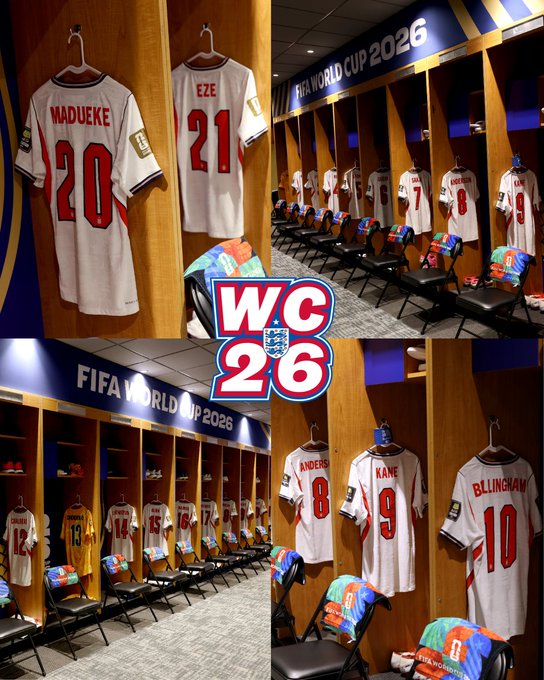
 

Four images of the shirts in the England dressing room

A split image of James Trafford, Nico O'reilly, Elliot Anderson and Harry Kane arriving ahead of England vs Norway.


England: 1 Jordan Pickford, 2 Ezri Konsa, 3 Nico O'Reilly, 4 Declan Rice, 5 John Stones, 6 Marc Guéhi, 8 Elliot Anderson, 9 Harry Kane (c), 10 Jude Bellingham, 18 Anthony Gordon, 20 Noni Madueke Substitutes: 7 Bukayo Saka, 11 Marcus Rashford, 12 Trevoh Chalobah, 13 Dean Henderson, 14 Jordan Henderson, 15 Dan Burn, 16 Kobbie Mainoo, 17 Morgan Rogers, 18 Anthony Gordon, 19 Ollie Watkins, 21 Eberechi Eze, 22 Ivan Toney, 23 James Trafford, 24 Reece James, 25 Djed Spence


Image


Pendant with text; FIFA World Cup 2026 Quarter-final Miami Stadium Saturday 11th July


Credit via x.com/england


Buy FIFA World Cup Tickets
Sports, Football, Soccer, FIFA World Cup Tickets

Sports Events 365World Cup Quarterfinals

🇳🇴   Norway – England 🏴󠁧󠁢󠁥󠁮󠁧󠁿

Date: Saturday, July 11, 2026.
Kicks off at 5:00 PM local time (22:00 BST / 23:00 CEST)
Venue: Hard Rock Stadium
Miami, Florida.

Referee: Clément Turpin FRA
Assistant Referee 1: Nicolas Danos FRA
Assistant Referee 2: Benjamin Pagès FRA
Fourth Official: Alejandro José Hernández Hernández ESP
Reserve AR: José Enrique Naranjo Pérez ESP
Video Assistant Referee: Jerome Brisard FRA
Assistant Video Assistant Referee 1 : Armando Villarreal USA
Assistant Video Assistant Referee 2 : Carlos Del Cerro Grande ESP
Standby Video Assistant Referee: Mohammed Obaid Khadim UAE
Standby Assistant Video Assistant Referee: Abdullah Alshehri KSA

Match preview: Norway vs England

Norway and England will meet in a fiercely contested World Cup quarter-final in the heat and humidity of Miami on Saturday, with the Opta supercomputer predicting one of the closest encounters of the last eight. England were victorious in 62.3% of 25,000 pre-match simulations, while Norway advanced in the remaining 37.7%, highlighting the narrow gap between the two sides.

Before the quarter-finals began, England was not considered the strongest favourite to reach the semi-finals. France had a 73.9% chance of progressing against Morocco, Spain stood at 69.8% against Belgium, and Argentina was given a 69.4% chance of defeating Switzerland, all ahead of the Three Lions in the simulations.

For Norway, this match represents unfamiliar territory as they prepare for their first-ever appearance in a major tournament quarter-final. Their impressive run has included a memorable victory over Brazil, the most successful nation in World Cup history, proving that they have the quality to challenge the biggest teams.

The Norwegians have produced entertaining football throughout the competition, scoring and conceding in all five of their matches so far. They have found the net 12 times while allowing nine goals, with Germany’s 1954 campaign remaining the only previous example of a team reaching the semi-finals after both scoring and conceding at least 10 goals.

Date: Saturday, July 11, 2026
Kick-off Time: 17:00 Miami local time (UTC-4)
Venue: Miami Stadium, Miami Gardens, Florida
Venue Capacity: 65,326
Opponents: Norway vs. England (Quarter-final)
Despite facing each other 12 times in friendlies and qualifiers over the decades, this Miami quarter-final marks the very first time England and Norway have ever played each other in the FIFA World Cup

Norway chasing historic achievement

Ståle Solbakken’s side has won every match except one during this World Cup, with their only defeat arriving on Matchday 3 when they rotated heavily and made 10 changes against France, who are regarded as the tournament favourites.

Norway would have finished top of Group I if they had beaten France, but Solbakken’s choice to rest key players and accept second place has worked in their favour. Since then, they have secured difficult victories against Ivory Coast and Brazil to continue their historic campaign.

The biggest threat in Norway’s attack remains Erling Haaland, who has made an immediate impact on the biggest international stage. The Manchester City striker has scored in each of his first four World Cup appearances, producing seven goals from only 18 shots.

His contribution has been decisive, with four of those goals proving to be match-winners. Only Grzegorz Lato of Poland in 1974 and Italy’s Salvatore Schillaci in 1990 have scored more winning goals during a single World Cup campaign, with both players recording five.

Haaland’s incredible form has strengthened his already outstanding record for Norway. He has scored 62 goals in 54 appearances and has found the net in 14 consecutive competitive matches for his country, scoring 27 times during that run.

Last 5 Norway matches stats

FIFA World Cup

FIFA World Cup

FIFA World Cup

FIFA World Cup

FIFA World Cup

Brazil 1 – 2 Norway

Ivory Coast 1 – 2 Norway

Norway 1 – 4 France

Norway 3 – 2 Senegal

Iraq 1 – 4 Norway

2026/07/05

2026/06/30

2026/06/26

2026/06/23

2026/06/17

England aiming to continue their tournament journey

England have experienced mixed results throughout the tournament, but their victory over Mexico at the Estadio Azteca in the previous round demonstrated the qualities needed for a deep World Cup run. Their performance showed a combination of ability, resilience, and the fortune often required in knockout football.

Unlike Norway, the Three Lions are familiar with this stage of the competition. Only Brazil and Germany, both with 14 appearances, have reached more World Cup quarter-finals than England, who are preparing for their 11th appearance in the last eight.

However, their history at this stage has been difficult. England have progressed from only three of their previous 10 World Cup quarter-finals and have conceded multiple goals in seven of those matches.

A major challenge will be dealing with Haaland, but England possess their own world-class attacking options. Harry Kane remains one of the leading scorers at this tournament with six goals, one fewer than Haaland, matching the total he achieved during the 2018 World Cup.

Kane has consistently delivered in important matches, scoring 11 goals across his 12 knockout-stage appearances at major international tournaments. Meanwhile, Jude Bellingham has also made history, scoring four times in this tournament to become the highest-scoring England midfielder at a single World Cup.

Last 5 England matches stats

FIFA World Cup

FIFA World Cup

FIFA World Cup

FIFA World Cup

FIFA World Cup

Mexico 2 – 3 England

England 2 – 1 DR Congo

Panama 0 – 2 England

England 0 – 0 Ghana

England 4 – 2 Croatia

2026/07/06

2026/07/01

2026/06/28

2026/06/23

2026/06/17

History, records and key battles

The upcoming quarterfinal will be the 13th meeting between Norway and England, with their most recent encounter coming in September 2014 when England won a friendly 1-0. Overall, Norway have claimed victory only twice in their previous 12 meetings and have failed to score in each of the last four clashes.

Jordan Pickford could set a new England World Cup appearance record in this match by making his 18th appearance at the tournament, surpassing Peter Shilton. However, he has struggled against Haaland in the Premier League, conceding seven goals from the 10 shots on target he has faced from the Norwegian forward.

Both teams enter the match with players capable of deciding the outcome. Haaland, Kane, and Bellingham have all produced major moments at this World Cup, but only one of them can become the figure remembered for sending their nation into the semi-finals.

England have been eliminated in five of their last six World Cup knockout matches against European opponents, including a 2-1 quarter-final defeat to France in 2022. Norway, meanwhile, have never won a World Cup match against European opposition, recording two draws and four defeats, with both of their previous knockout losses coming against Italy.

Past H2H Results

International friendlies

International friendlies

England 1 – 0 Norway

Norway 0 – 1 England

2014/09/03

2012/05/26

Prediction and expected outcome

Norway and England are expected to produce one of the most evenly matched quarter-finals of the tournament, with both teams possessing elite attacking talent capable of deciding the contest. England’s greater experience at this stage of the World Cup and the quality of players such as Harry Kane and Jude Bellingham give them a slight advantage, while their defensive focus will be tested by the unstoppable form of Erling Haaland. Norway have already shown they can compete with the world’s best after defeating Brazil, and their attacking approach has made them one of the most entertaining sides in the competition. The match is likely to be intense and open, with England aiming to control possession and Norway looking to use their pace and direct play to exploit spaces. The decisive factor could come down to which defence handles the opposition’s main attacking threat more effectively.

Prediction: England 2-1 Norway

Expected outcome: A narrow England victory in a closely fought quarter-final, with the Three Lions’ tournament experience and depth helping them edge past a dangerous Norway side. However, Norway’s confidence, attacking firepower, and Haaland’s incredible scoring form mean they have every chance of causing another major upset. A high-scoring draw after 90 minutes would not be a surprise, but England are slightly better positioned to secure a place in the semi-finals.

Match preview: Spain vs Belgium

Belgium and Spain will battle for a place in the World Cup semi-finals when they meet in Los Angeles on Friday. Both nations arrive in the last eight after impressive knockout victories, setting up one of the standout ties of the tournament.

Belgium finished first in Group G despite producing performances that were not always convincing. They then recovered from 2-0 down to defeat Senegal 3-2 after extra time in the round of 32 before producing their strongest display yet by crushing co-host United States 4-1 in the last 16.

Spain’s route has also been impressive. Their latest victory came in dramatic fashion, with Mikel Merino striking in the 91st minute to secure a 1-0 success against Portugal and send La Roja into the quarter-finals for the sixth time.

The meeting offers Belgium the chance to continue their growing momentum, while Spain will look to extend a remarkable defensive run that has carried them deep into the competition.

Date: Friday, July 10, 2026
Kick-off Time: 12:00 Los Angeles local time (UTC-7)
Venue: Los Angeles Stadium, Inglewood, California
Venue Capacity: 69,650
Opponents: Spain vs. Belgium (Quarter-final)
Spain reached the quarterfinals of the World Cup without conceding a single goal, racking up a record-breaking streak of six consecutive clean sheets. Their goalkeeper, Unai Simón, has gone more than 10 hours of tournament play without allowing a shot to pass him

Spain relying on defence and rising stars

Breaking through Spain’s back line has proved almost impossible. Their victory over Portugal delivered a sixth successive clean sheet, establishing a new World Cup record, while they have now gone 10 hours and nine minutes without conceding in the competition.

Their defensive dominance is reflected in the numbers. Spain has allowed an average expected goals against figure of just 0.30 per game, the lowest ever recorded by a team across a single World Cup finals.

At the other end, Lamine Yamal continues to make a major impact. The Barcelona winger has completed 17 successful dribbles during the tournament, with only Jamal Musiala in 2022 and Kylian Mbappé in 2018 managing more as teenagers at a World Cup since records began in 1966.

Rodri has also been central to Spain’s control of matches. His 80 line-breaking passes are the highest total by a Spanish player at a World Cup since 2010, when Gerard Piqué, Xavi, and Xabi Alonso all produced even higher numbers during Spain’s title-winning campaign.

Last 5 Spain matches stats

FIFA World Cup

FIFA World Cup

FIFA World Cup

FIFA World Cup

FIFA World Cup

Portugal 0 – 1 Spain

Spain 3 – 0 Austria

Uruguay 0 – 1 Spain

Spain 4 – 0 Saudi Arabia

Spain 0 – 0 Cabo Verde

2026/07/06

2026/07/02

2026/06/27

2026/06/21

2026/06/15

Belgium finding their attacking rhythm

Rudi Garcia’s side have become increasingly dangerous in front of goal as the tournament has progressed. Against the United States, Charles De Ketelaere scored twice before second-half substitutes Hans Vanaken and Romelu Lukaku completed the scoring in a commanding victory.

Although Lukaku has found the net in each of Belgium’s last three World Cup matches, all of those goals have come after he entered from the bench. Only Roger Milla scored more substitute goals at a single World Cup, with four for Cameroon in 1990, meaning Lukaku could once again begin among the replacements.

Belgium’s finishing has been one of their greatest strengths. Their shot conversion rate stands at 12.1%, their second-best return at a World Cup since 1966, surpassed only by the 15.2% recorded during the 2018 tournament in Russia.

The opportunities are also arriving regularly. Garcia’s team has averaged 21.4 attempts per match, producing 107 shots across five games, a figure only bettered by Belgium’s average of 24 attempts per contest at the 1970 World Cup.

Last 5 Belgium matches stats

FIFA World Cup

FIFA World Cup

FIFA World Cup

FIFA World Cup

FIFA World Cup

USA 1 – 4 Belgium

Belgium 3 – 2 Senegal

New Zealand 1 – 5 Belgium

Belgium 0 – 0 Iran

Belgium 1 – 1 Egypt

2026/07/07

2026/07/01

2026/06/27

2026/06/21

2026/06/15

History, records and a familiar rivalry

Luis de la Fuente has guided Spain through each of his six knockout matches at major tournaments. Victory over Belgium would place him alongside only Vittorio Pozzo and Vicente del Bosque as managers to win each of their first seven knockout ties against European opposition.

Belgium, however, has previous experience of denying Spain at this stage. The Red Devils eliminated La Roja on penalties after a 1-1 draw in the quarter-finals of the 1986 World Cup, although Spain won their other World Cup meeting 2-1 during the group stage four years later.

Recent encounters between the nations have largely favoured Spain. They have not lost to Belgium in their last 11 meetings in all competitions, collecting nine victories and two draws since a 2-1 defeat at the 1980 European Championship.

Their most recent clash came in September 2016, when David Silva scored twice in a 2-0 friendly victory in Brussels. Spain have also won each of the last five meetings, outscoring Belgium 13-1 across those matches.

Past H2H Results

International friendlies

FIFA World Cup qualification

FIFA World Cup qualification

Belgium 0 – 2 Spain

Spain 5 – 0 Belgium

Belgium 1 – 2 Spain

2016/09/01

2009/09/05

2008/10/15

Prediction and expected outcome

Spain enters this quarter-final with a slight advantage thanks to their outstanding defensive record, consistent performances throughout the tournament, and impressive balance between defensive stability and attacking creativity. Luis de la Fuente’s side has yet to concede a goal at this World Cup, while players such as Lamine Yamal, Rodri, and Mikel Merino have played key roles in their progress to the last eight. Belgium, however, arrives full of confidence after back-to-back knockout victories, including an emphatic win over the United States, and their attack has become increasingly dangerous with Charles De Ketelaere in fine form and Romelu Lukaku making a major impact from the bench. Rudi Garcia’s team has shown resilience and clinical finishing, meaning they are more than capable of testing Spain’s exceptional defence. The match is likely to be closely contested, with Spain expected to dominate possession while Belgium looks to exploit their efficiency in front of goal and strike on quick transitions.

Prediction: Spain 2-1 Belgium

Expected outcome: A tightly fought encounter in which Spain’s defensive discipline and control of the game ultimately prove decisive, securing a place in the semi-finals. Belgium should create chances and remain competitive throughout, but Spain’s consistency at both ends of the pitch gives them a narrow edge. A draw after 90 minutes would not be an unexpected outcome, although Spain appears slightly more likely to progress.

France continue dominant World Cup run with convincing Morocco victory

France underlined their credentials as the leading contenders for the 2026 World Cup by defeating Morocco 2-0 in Thursday’s quarter-final, becoming the first team to secure a place in the last four.

Already world champions in 1998 and 2018, Les Bleus are now just two victories away from lifting the trophy again. With Didier Deschamps preparing to step down after this tournament, another triumph would strengthen arguments that this squad deserves to be considered among the finest France have produced.

Former France midfielder Patrick Vieira believes the current generation is approaching that level. Speaking after the win, he highlighted the remarkable depth available in attack, describing the number and quality of offensive players as extraordinary.

France’s latest success has only added to the growing belief that this side has all the ingredients needed to complete another title-winning campaign.

Attacking quality continues to set France apart

The breakthrough in Boston arrived during a devastating six-minute spell after the interval. Kylian Mbappe opened the scoring before Ballon d’Or winner Ousmane Dembele quickly doubled the advantage, leaving Morocco with no route back into the contest.

Those strikes increased France’s tournament total to 16 goals, the highest tally of any nation at this stage of the competition. Mbappe also reached eight goals despite seeing an earlier penalty saved, drawing level with Lionel Messi in the race for the Golden Boot while remaining ahead thanks to a superior assist count.

Dembele’s fifth goal of the tournament also placed France in rare company. They became only the second team in the past 50 years to have two players score at least five goals during the same World Cup, following Brazil’s achievement in 2002.

Former Scotland forward Pat Nevin praised France’s attacking strength, describing them as the tournament’s most dangerous side and pointing out that their threat comes from several different players rather than relying on a single star.

Confidence grows ahead of a possible Spain showdown

Deschamps has guided France since 2012 and has already confirmed this World Cup will be his final tournament in charge. During his tenure, the national team lifted the 2018 World Cup, reached the 2022 final, finished runners-up at Euro 2016, and lost to Spain in the Euro 2024 semi-finals.

France entered the tournament ranked third in the world behind Argentina and Spain. Should Spain overcome Belgium in their quarter-final, they will meet France in Dallas for a place in the final.

Vieira believes France holds the advantage if that meeting takes place. While acknowledging Spain’s expected progress through the tournament, he argued that France has improved significantly compared to four years ago, whereas Spain has not reached the same level of development.

The former Arsenal captain even suggested that he cannot currently see any opponent preventing France from advancing to another World Cup final.

Strength throughout the squad and a solid defence

Before the Morocco match, former England striker Ian Wright described France as one of the clearest favourites he had seen entering a World Cup. After watching the quarter-final, he said it was difficult to identify any obvious weakness in the side.

Wright noted that Spain could create problems through their passing ability and the pace of Lamine Yamal, but he still viewed France as the stronger team because of their overall quality and individual talent. Behind the main goalscorers, Deschamps can also call upon Michael Olise, Bradley Barcola, Desire Doue, Rayan Cherki, and Jean-Philippe Mateta.

France’s defensive record has been equally impressive. They have conceded only twice in six matches, with goals allowed against Senegal and Norway, the latter having rested most of its regular starters after already reaching the knockout stage.

Roy Keane added that France still have another level to reach. While insisting they remain beatable, he argued that their combination of goalscoring forwards and players capable of producing moments of individual brilliance makes them especially dangerous, particularly once they take the lead.

Two victories remain between France and history

France’s route to the semi-finals has included wins over Senegal, Iraq, Norway, Sweden, Paraguay, and Morocco, leaving them with a flawless record heading into the final stages of the tournament.

Having already secured their place in the last four, Deschamps’ side can now wait for the remaining quarter-finals to determine their next opponents while enjoying extra preparation time.

Despite the growing confidence surrounding the team, Nevin urged caution. He believes France has occasionally relaxed after establishing comfortable leads and warns that complacency could become their greatest obstacle.

Even so, with their balanced squad, prolific attack, and disciplined defence, France remain only two victories away from securing a third World Cup title.

Are goalkeepers winning the battle over “stuttering” penalties?

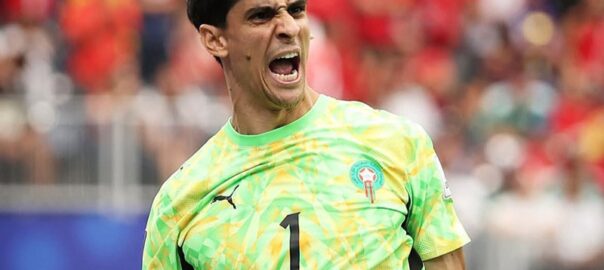
France booked their place in the World Cup semi-finals with a 2-0 victory over Morocco, but one of the game’s biggest talking points came long before the final whistle. Kylian Mbappe failed to convert from the penalty spot after his trademark delayed approach ended with a comfortable save by Yassine Bounou.

The opportunity arrived in a scoreless match after Noussair Mazraoui brought down the France captain. Mbappe slowed his run before striking, hoping to force the goalkeeper into an early decision, but Bounou remained patient and denied the effort with ease.

The miss did not define Mbappe’s evening. Shortly after the hour mark he produced a superb curling finish to finally break Morocco’s resistance, while Ousmane Dembele added a second goal six minutes later to secure France’s passage.

Even so, the failed penalty reignited discussion about whether the increasingly common stuttering run-up is still an effective technique.

A tactic that divides opinion

Many traditional football supporters have never embraced the delayed approach from the penalty spot, placing it alongside other modern aspects of the game they dislike, including VAR, diving, and players wearing gloves despite short-sleeved shirts.

FIFA regulations allow players to pause or feint during their approach provided they do not perform that movement immediately before striking the ball. The method has existed for decades, having previously been used by John Aldridge, Hugo Sánchez, and Pelé.

The approach is designed to persuade goalkeepers to move first, but it becomes far less effective when the goalkeeper holds position and refuses to commit early.

During this World Cup, Mbappe joined Bruno Guimarães, Jorgen Strand Larsen, Lionel Messi, and Harry Kane among players who failed to score after using a stuttering approach. Kane later converted his retaken penalty against Croatia after abandoning that technique.

Numbers suggest a changing balance

Statistics from the tournament indicate that delayed run-ups have not been especially productive. Across 26 penalties using that method, including shootouts, only 15 found the net, producing a conversion rate of 57%.

Players such as Marko Arnautovic, Raul Jimenez, Neymar, Cristiano Ronaldo, Yoane Wissa, and Kai Havertz were among those who successfully used the technique.

By comparison, players taking penalties without a stutter converted 24 of 35 attempts, giving a success rate of 68%.

Overall, penalty takers have endured a difficult World Cup. Thirty percent of penalties taken during normal play have been missed, making it the second-highest miss rate at a World Cup since records began in 1966. When shootout kicks are included, unsuccessful attempts rise to 35%, the highest figure recorded in that period.

Experts point to goalkeepers and preparation

Speaking on ITV, Ian Wright suggested that goalkeepers now appear better equipped to deal with stuttering penalties, saying they have gained the upper hand against the technique.

Pat Nevin argued that modern goalkeepers are taller, quicker, and better prepared, making penalties increasingly difficult to score. He explained that players use delayed run-ups in an attempt to force keepers into diving the wrong way, but detailed analysis means goalkeepers are now familiar with individual preferences, creating an ongoing battle between both sides.

Mbappe’s overall record from the penalty spot remains strong. The miss against Morocco was only his second in a France shirt, leaving him with 14 successful penalties from 16 attempts. At the club level, he has converted 50 of his 62 penalties.

His opponent also deserves significant credit. Bounou has conceded only two of the nine penalties he has faced during the World Cup, including shootouts, recording four saves while three other attempts missed the target.

The delay before the kick becomes another talking point

The penalty was not taken immediately after it was awarded. A VAR review meant three minutes and 12 seconds passed before Mbappe eventually stepped up, creating another debate over whether long interruptions benefit goalkeepers.

French football journalist Julien Laurens felt the lengthy pause disrupted Mbappe’s usual preparation. He described the effort as a poor penalty, adding that the forward normally relies heavily on his established routine when placing the ball before shooting.

Laurens also praised Bounou’s ability from the penalty spot but believed the weak strike made the save straightforward. He suggested Mbappe rush once he was finally given permission to continue.

Roy Keane, speaking on ITV, questioned why players should have to wait so long before taking penalties, arguing that time works against the taker and shifts the balance towards the goalkeeper. Ian Wright agreed, saying prolonged delays give players more opportunity to second-guess their decision before striking the ball.