Category Archives: 2022 FIFA World Cup

Laba: I want to emulate Coubadja for Togo

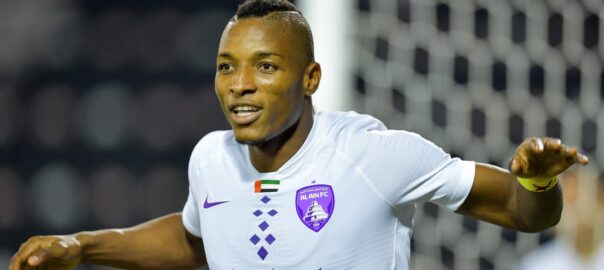
Kodjo Laba of Al Ain FC celebrates

  • Kodjo Laba was just a teen when Togo appeared at the 2006 World Cup
  • Al Ain forward is inspired by compatriot Mohamed Kader Coubadja
  • Player celebrates his goals by performing traditional Togolese dance

By any standard 13 June 2006 was a historic day for Togolese football. That was when Emmanuel Adebayor and Co played the country’s first FIFA World Cup™ game.

And although the Sparrowhawks failed to register a point at the 2006 FIFA World Cup Germany™ after defeats to Korea Republic, Switzerland and France, the events of that summer are still fresh in the memory of present-day Togo striker Kodjo Laba.

The 28-year-old, who now plays for UAE club Al Ain, was a young teenager when Mohamed Kader Coubadja scored Togo’s only goal at that tournament in Germany. Now he hopes to follow in his footsteps and lead Togo to another World Cup appearance in two years’ time.

“The World Cup is not something every team gets to experience, so I thank God for giving my country a chance,” Laba told FIFA.com. “I was young at the time, but I went to all our home qualifying games. I used to walk to the stadium after school despite it being a long way away, and then I watched all our away games on TV.

“Although I was young, I still vividly remember our games at Germany 2006, particularly the one against South Korea in which Coubadja scored a splendid goal.

“I jumped for joy. It was an unforgettable match. And even in the game against France, our players made a huge effort despite the loss. We proved that we were a big team.”

Goal celebration Togo with joyful dance

Dreams can come true

Five years after Togo’s Germany adventure, Laba started his professional football career with OC Agaza. He later joined another Togolese outfit Anges FC before having spells overseas in Gabon and Morocco. His last move, in 2019, took him to UAE giants Al Ain.

After impressing at club level, Laba realised his dream of joining the national team in 2016, going on to become a pillar of the side. He participated with the team at the 2017 CAF Africa Cup of Nations before helping them reach the group stage of the CAF qualifiers for the FIFA World Cup Qatar 2022™ after he scored his country’s first goal in their opening first-round fixture.

“I was lucky to score that away goal against Comoros. I think it was a decisive strike that allowed us to secure an important first-leg draw.

“In Lome we won 2-0, and I believe that my away goal was the one that gave us the edge. Now we’ve qualified for the group stage, for which we’ll prepare in the best possible way.”

Laba and the rest of Claude Le Roy’s side will face Senegal, Congo, and Namibia in Group H of the World Cup qualifiers, a section the free-scoring front man described as “complicated”.

“Our approach to the group stage is to focus on one game at a time. We’re aware of what’s in store for us. I believe the team that poses the biggest threat to us are Senegal, as they have players like Sadio Mane and Kalidou Koulibaly, among many others.

“These days, every team is of a good standard and competes strongly. And while Senegal are a big team, we mustn’t ignore Congo and Namibia. We have to take every game seriously and do the impossible to qualify for the World Cup.”

Great inspiration

Emerging as one of the most prominent Togolese attackers in recent years, with 12 goals in 24 internationals, Laba is seeking to follow the examples of his role model Coubadja and the star of Togolese football Adebayor by playing and scoring at the global showpiece.

“I was inspired by many players when I was young, but if I were to choose one, it’d be Adebayor. He’s a source of inspiration for all Togolese because he was lucky to play with major clubs in Europe.

“There’s also Coubadja, who scored many goals with the team, particularly the wonderful strike at the World Cup. He’s a big name in Togolese football. And because he was an attacker like me, I always try to emulate him. I’m lucky to have met him a few times as he offered me a lot of advice.”

Coubadja’s influence on Laba is such that the latter imitates the dance that Coubadja performed on the Frankfurt pitch after scoring against Korea Republic. The attacker frequently performed this traditional dance during his time with Morocco’s RS Berkane as well as with his current club and the national team.

“It’s called the Agbadja dance and it’s well known where I’m from. It allows me to celebrate in the style of Coubadja, like after I scored in the [2019] CAF Confederation Cup final against Egypt’s Zamalek.”

But is he dreaming of performing this dance at the upcoming World Cup? “First, I’m dreaming of qualifying for the World Cup for the second time in the history of our country. As an attacker, I’ll do everything I can to make my mark on this tournament. If I get the chance to play at the World Cup and to score, I’ll dance the way Coubadja did.”

FIFA.com
FIFA.com News
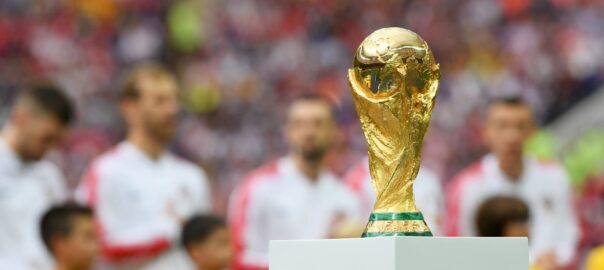
UEFA preliminary draw for FIFA World Cup 2022™ to take centre stage on 7 December

The FIFA World Cup Trophy

  • Preliminary draw to be held in Zurich at 18:00 CET on 7 December
  • Road to Qatar 2022 to be mapped out for 55 European member associations
  • Ceremony to be live-streamed on FIFA.com

With FIFA World Cup 2022™ preliminary-competition action already under way in Africa, Asia and South America, UEFA’s 55 member associations are eagerly looking ahead to the start of their own race to reach Qatar 2022, with 13 berths available. Their anticipation will be heightened on 7 December, when the preliminary draw will take place at 18:00 CET in Zurich.

Due to the COVID-19 pandemic and related restrictions, the ceremony will be held as a virtual event without the presence of member associations’ representatives.

Europe’s road to the FIFA World Cup 2022 will feature a group stage comprising five groups of six teams and five groups of five teams. All teams within a group will play each other twice in a home-and-away format between March and November 2021. The ten group winners will qualify directly for Qatar 2022, with the ten runners-up advancing to the play-offs.

Besides the ten runners-up from the group stage, the play-offs will also include the two best group winners from the UEFA Nations League 2020-2021 overall ranking that did not qualify directly for the FIFA World Cup 2022 and did not enter the play-offs as runners-up. The 12 teams will be split into three play-off paths, which will feature single-leg knockout matches in March 2022 to determine the last three European nations to book a place in Qatar.

Pot allocation

For the sake of the preliminary draw, the 55 participating teams will be allocated to six pots – five containing ten teams and one containing five teams – based on the FIFA/Coca-Cola World Ranking of 26 November 2020.

The ten highest-ranked teams will be allocated to Pot 1, the next ten highest to Pot 2 and so on until the last five remaining teams have been allocated to Pot 6.

The teams drawn will be allocated to a group in alphabetical order, from Group A to Group J (i.e. the first team drawn will be allocated to Group A, the second team to Group B and so forth). When a draw constraint applies or is anticipated to apply, the team drawn will be allocated to the first available group in alphabetical order as indicated by the draw constraint programme.

As Pot 6 will only contain five teams, these teams will be drawn into the sixth position in groups F to J.

The full draw procedures, including details on constraints, are available here.

Live coverage on FIFA.com

Fans around the world will be able to follow the draw live on FIFA.com and through FIFA’s broadcast partners. 

To date, 146 out of 900 FIFA World Cup 2022 preliminary-competition matches have been played and 191 teams remain in the race for one of the 31 berths that are still up for grabs. Hosts Qatar have qualified automatically and will kick off the tournament on Monday 21 November 2022 at 13:00 local time (11:00 CET) at Al Bayt Stadium.

Further details on the FIFA World Cup 2022 preliminary competition are available on FIFA.com.

FIFA.com
FIFA.com News

Cavalli and Niger dreaming of historic World Cup participation

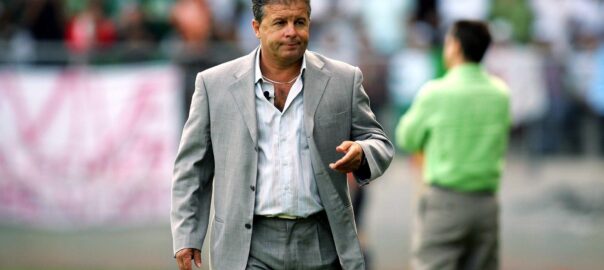
Niger coach Jean-Michel Cavalli 

  • Niger in the same FIFA World Cup™ qualifying group as Algeria
  • Cavalli previously coached Algeria and some of the country’s leading clubs
  • The French coach discusses new mission and prospect of facing The Greens

In March this year, Jean-Michel Cavalli was en route to Paris’s Charles de Gaulle airport to fly to the Niger capital Niamey to sign a contract to coach the country’s national team. As fate would have it, the airport closed immediately due to coronavirus fears, and Cavalli was unable to travel. Football officials in Niger, however, were determined to secure his services, and so both parties agreed to wait a few more months before making the appointment official.

For the Frenchman, that vote of confidence was a positive sign. Niger’s insistence on sticking with him despite the delay, and his own desire to take up the role, boded well for a successful collaboration.

In an exclusive interview with FIFA.com, Cavalli discussed his new mission and the challenges ahead.

“I chose this country because I felt comfortable with the officials I dealt with,” he explained. “For my part, I always gave them priority despite the many offers I got. This mutual respect was a good starting point for me to coach the team.”

As with every other coach in Africa, the first objective when a contract is signed is to reach the CAF Africa Cup of Nations (AFCON).

“Unfortunately, our team lost two crucial AFCON qualifying matches, which has harmed our chances of making the finals. But that doesn’t mean we won’t work hard to make amends. For me, it’s a bit like taking over at the halfway point. If this were still the beginning [of qualifying], the story would probably be different. I believe our chances of reaching the finals depend on the two upcoming matches against Ethiopia. But in addition to reaching the Africa Cup finals, our aim is to build a solid team to compete strongly in the World Cup qualifiers.”

Niger coach Jean-Michel Cavalli 

Successful start

The French coach was surprised with the high standard of football in Niger, where he is working for the first time. “In the months I spent at home before coming here, I had a chance to study the players and line-ups. I was astonished by the abilities I witnessed here, with some players easily capable of playing in Europe.”

Cavalli got off to a good start in the new job, winning his first two friendlies in October. “Although we had two players injured, my team was competitive and at the required level. In the space of three days, we won two friendly matches against Chad and Sierra Leone. Although these aren’t big names in Africa, I can say from experience that there are no small teams. You can see this in what happened to me when I coached Algeria – where the team were when I arrived and how far they went.”

Niger coach Jean-Michel Cavalli with the players

Nostalgic encounter

The draw for FIFA World Cup Qatar 2022™ qualifying pitted Niger in a difficult group with reigning continental champions Algeria, Burkina Faso and Djibouti. Asked what he thought of this quartet, Cavalli replied: “We’re in a group containing three teams at about the same level. The fourth are the African champions. Our match against Algeria will be like a final, and they’ll undoubtedly be firm favourites. However, we have to give ourselves chances in these qualifiers. Even if it’s a one-in-a-thousand shot, we’ll go all out for it.

“My teams always present difficulties for opponents. Everyone remembers when I coached Algeria and we played great football in our friendlies against Brazil and Argentina in 2007,” he added.

Cavalli was in charge of Algeria for about two years, which will make the World Cup qualifying clash between the sides very special for him. “I don’t place that much importance on the fact that I coached Algeria and know their football very well. I’ll aim to do the impossible with my team because I love to compete. At any rate, we have nothing to lose in this group. Algerian football has developed a great deal in recent times, particularly at senior-team level and in terms of sporting infrastructure, and their players are at some of the world’s biggest clubs.”

Niger coach Jean-Michel Cavalli 

Final wish

Because his tenure in charge of Algeria only lasted from 2006 to 2007, Cavalli feels he missed a chance to take a side to the World Cup. Understandably, it’s something he would love to do with Niger now.

“Reaching the World Cup finals is the dream of every coach. If we manage to do this with Niger, it would be an historic achievement. I personally lost out on the chance to participate in the 2010 World Cup. I worked with Algeria for 22 months but left before the qualifiers kicked off. But my work there during that time still paid off.

“Before I left Algeria, I remember telling Hamid Haddadj, the president of the country’s football federation at the time, that the team were well prepared for the World Cup qualifiers, and that I’d be their number one supporter. I was almost certain that they’d qualify given the good work we’d done in the previous months. The proof was that we ended the first half of our friendly against Argentina leading 2-0 and the first half of the Brazil one drawing 0-0. These South American sides were ranked one and two respectively by FIFA at the time. So, I certainly dream of leading a team to the World Cup before I call time on my coaching career.”

But who are the favourites to represent Africa at Qatar 2022 in his opinion? “Algeria and Senegal are in the best shape to qualify, as well as Morocco, but I believe we’re in for a surprise or two in the upcoming qualifiers.”

FIFA.com
FIFA.com News

FIFA World Cup 2022™ First Sustainability Progress Report published

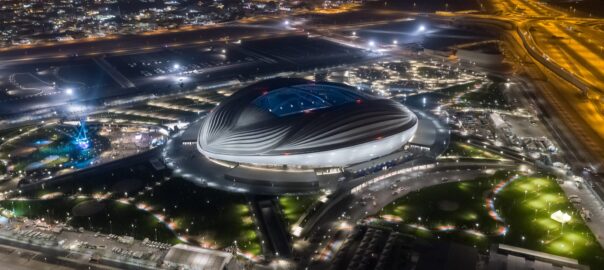
Al Janoub Stadium2 - Al Wakrah

The FIFA World Cup 2022™ First Sustainability Progress Report provides an update on the progress made by FIFA, the Supreme Committee for Delivery & Legacy (SC) and the FIFA World Cup Qatar 2022 LLC in 2019 regarding their five sustainability commitments, including human rights, diversity and environmental protection.

“We are very glad to provide our stakeholders and the public with an overview of how much we advanced last year with the delivery of the Sustainability Strategy for the next edition of our flagship event. The report reflects our joint commitment to accountability and our drive to contribute to the evolution of best practices in the field of sustainability management in sporting events,” said FIFA’s Head of Sustainability & Environment, Federico Addiechi.

“It’s fantastic to be able to share the progress that Qatar and FIFA have made across the many critical sustainability projects connected to the delivery of the FIFA World Cup. Sustainability remains at the core of our infrastructure and tournament operational planning, and by delivering a fully carbon neutral FIFA World Cup through these various initiatives, we hope to set new standards for sustainable mega event hosting and cement one of Qatar 2022’s most profound legacies,” added the engineer Bodour Al-Meer, SC Sustainability & Environment Senior Manager.

Mahmoud Qutub, the SC’s Workers’ Welfare Executive Director, said: “We are driven by a commitment to ensure the people building our stadiums and venues are treated with the utmost dignity and respect. The health, safety and protection of our workforce have always been at the forefront of our efforts. These workers play an important role in preparing Qatar to welcome the world in 2022 and their welfare is at the heart of the legacy this tournament will leave behind. Tangible changes in worker standards on our projects now serve as benchmarks across Qatar and the region.”

Key achievements:

  • Al Janoub Stadium became fully operational, achieved its targeted sustainable building certification for design and build, and exceeded its targeted sustainable construction management certification.
  • The FIFA World Cup Qatar 2022™ headquarters in Doha became the first office tower in the country to receive sustainable building certification for operations.
  • The majority of the Doha Metro network became fully operational, reducing road congestion, vehicle air and noise pollution.
  • Continued implementation of the SC programme to monitor compliance with its Workers’ Welfare Standards across all sites and expansion of the SC’s recruitment fees reimbursement scheme benefitted 16,500 workers on FIFA World Cup 2022 projects and 18,000 workers on other sites.
  • The first voluntary carbon-offsetting programme was established in the region.
  • Human rights and safety training was provided to over 2,000 police officers by Qatar’s Ministry of Interior in coordination with the SC’s security team.
  • Over 900 people participated in the tailor-made online open course on Sustainability & Major Sport Events.
  • An assessment was carried out of the tournament experience for disabled people and people with limited mobility at the FIFA Club World Cup Qatar 2019™ and improvements were implemented accordingly.
  • FIFA’s Anti-Discrimination Monitoring System was implemented at all 168 FIFA World Cup Qatar 2022 qualifying matches played in 2019.

Earlier this year, FIFA, Q22 and the SC also published the development process for the FIFA World Cup 2022 Sustainability Strategy. More recently, the Supreme Committee for Delivery & Legacy (SC) also released the FIFA World Cup 2022 Sustainable Stadiums report.

The organisers will continue reporting on their progress and publish a full Sustainability Report of the tournament in 2023.

FIFA.com
FIFA.com News

Mabil and Sisto: Out of adversity comes opportunity

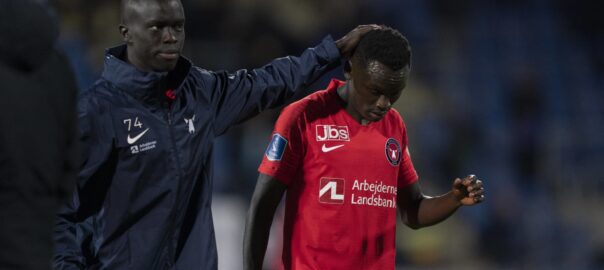
FC Midtjyllands players Awer Mabil and Pione Sisto

  • Mabil and Sisto lived in refugee camps as children
  • Their families emigrated to Australia and Denmark
  • Mabil plays for the Socceroos and Sisto the Danes, with both eying Qatar 2022

‘Out of adversity comes opportunity.’

This famous saying certainly applies to Pione Sisto and Awer Mabil. Hailing from South Sudan, the pair suffered the horrors of a civil war that forced their parents to live in refugee camps in Kenya and Uganda. But after years of adversity, a humanitarian programme helped Mabil and his family to relocate to Australia, and Sisto to settle in Denmark.

Asked about his experience in the refugee camps where it all began, Mabil, who currently plays for Midtjyllands, told the BBC’s World Football show: “We built a hut out of mud, probably the size of one bedroom in a normal house in the Western world, as you would call it. But you know it’s not your home. There were four of us living in it – me, my mum, my brother and sister. We would get food from the UN once a month.”

“Each person would get 1kg of rice, so we had 4kg in our family, and 3kg of beans. It was very difficult. We would have one meal a day, which was dinner. There was no such thing as breakfast or lunch. You just had to survive with the little dinner you had and you really had to appreciate it.”

FC Midtjyllands player Awer Mabil

Mabil started to play football with other children at the refugee camp when he was five. “Playing football was the only thing I could do,” said the Manchester United fanatic, who had difficulties watching games. “Ever since I was a kid, I’ve loved playing football. I followed Manchester United, but there was only one TV that was two hours away by car, and you had to pay $1 to go there. If you couldn’t go, you just had to make sure that one of your friends who went told you the result.”

Mabil has never forgotten his roots and now has his own foundation, Barefoot to Boots, and regularly visits Kakuma: “I take boots, football equipment and hospital equipment and donate them to the refugees there. If I have two weeks’ holiday, I’ll spend one week there and a week with my family.”

Sisto, difficult childhood and survival

Due to the prolonged civil war (1985-2005), Pione Sisto’s parents fled with their two children to Uganda in 1994. A few months later, Pione was born and then the whole family embarked on a long journey to northern Europe, seeking a better future for their children.

Asked about their experience, Pione’s brother Angelo said: “Back in South Sudan, our parents lived on a small farm, but when they fled to Denmark the change was immense. In South Sudan and Uganda, you feel you’re alone. That’s why our parents always protect us and guide us to do better.”

In 2002, Sisto started out in youth football as a seven-year-old with Tjorring before switching to Midtjylland, where he eventually broke into the senior team and went on to play in the UEFA Europa League. He then signed for Spanish side Celta Vigo, where he had a four-year stint before returning to Midtjylland.

FC Midtjyllands player Pione Sisto

Eyes on Qatar 2022

Having acquired Danish citizenship and represented Denmark regularly since 2015, Sisto is now looking forward to participating in the qualifiers for the FIFA World Cup Qatar 2022™. And after the sadness and trauma of his early life, what better way to complete his story that with an appearance at football’s flagship event?

Mabil has similar goals. After accruing professional experience with several Australian teams and subsequently Midtjylland, he received a call-up to the Australian national team months after Russia 2018. He is now looking forward to playing in the Qatar 2022 qualifiers and dreaming of a World Cup appearance. Were that to happen, his journey would be one of the most remarkable in footballing history, given the obstacles he had to surmount to become a successful player.

Asked about playing for Australia, Mabil said: “I represent Australia because it’s given me and my family a second chance in life. It’s part of me because I’ve lived half of my life there. I call it home, so I’m proud to represent it.”

FIFA.com
FIFA.com News