Category Archives: 2022 FIFA World Cup

FIFA and Qatar invite MAs to discuss human rights with international experts ahead of FIFA World Cup

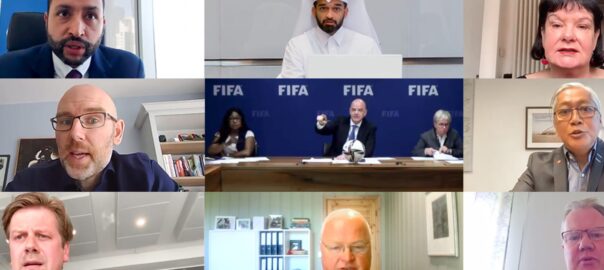
Qatar 2022 human rights virtual meeting

On Monday 10 May, FIFA held a virtual meeting with several member associations and confederations to discuss workers’ welfare reforms and broader human rights in Qatar in connection to the country’s hosting of the FIFA World Cup 2022™.

The virtual event was organised in collaboration with the Supreme Committee for Delivery & Legacy (SC), FIFA’s local partner in Qatar. Member associations that had expressed an interest in the matter heard from the SC’s Secretary General, H.E. Hassan Al Thawadi, as well as presentations from industry experts from independent international organisations, human rights organisations and workers unions (Amnesty International, BWI, ILO, ITUC1) with direct knowledge of the situation on the ground.

The meeting provided an opportunity to clarify a number of facts related to the country’s labour reforms programme, look at the important progress achieved since Qatar was awarded the tournament in 2010 and discuss the challenges that still remain, while stressing the role that FIFA and football can continue to play in promoting a lasting legacy of the FIFA World Cup 2022™ in the field of workers’ welfare and human rights in the host country.

“I very much welcome the constructive engagement with our member associations on this important topic,” said FIFA President Gianni Infantino. “We all want to ensure the protection of everyone engaged in the delivery of the FIFA World Cup, and we are confident the event can serve as a catalyst for broader positive social change.”

“We know there is still work to be done, but we need to recognise the significant progress achieved in a very short time, thanks to the commitment of the highest authorities in the country, and to ensure that any debate on this complex matter should be based on verified facts,” he added. “It is important for our member associations to hear directly from independent international experts that the conditions on the FIFA World Cup construction sites have reached the highest global safety standards, and that the recent landmark legislative reforms have already benefitted tens of thousands of workers across Qatar.”

The exchanges with member associations focused on the concrete steps towards full implementation of the changes introduced, and the expansion of the measures put in place within Qatar’s construction sites to the service sector that will become more involved as the competition approaches.

The international organisations, human rights organisations and workers unions that have been directly involved in Qatar’s labour reform programmes since 2010 welcomed the national reforms and the work specifically being conducted by the SC and FIFA on the country’s World Cup projects. The same organisations also outlined the need for strict implementation of the new and existing legislation and pointed to some additional reforms that are expected later this year.

The meeting followed a series of previous exchanges with individual member associations on the same topic, and FIFA and the SC committed to continue to engage with the global football community to keep its stakeholders regularly informed on preparations for the FIFA World Cup, and to address any concerns that may arise.

FIFA.com
FIFA.com News

Alioski: World Cup the next step for North Macedonia

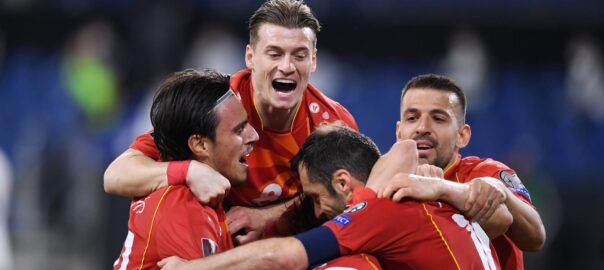
North Macedonia's national team celebrates.

  • Ezgjan Alioski is a key player for North Macedonia and Leeds United
  • His national team reached the EURO and beat Germany in World Cup qualifying
  • Alioski reflects on those achievements and explains why Leeds “changed his life”

When he swapped Lugano for Leeds United in 2017, there was little to hint at the adventures that have ensued for Ezgjan Alioski.

The club he had joined were preparing for an eighth successive season in England’s second tier, and ended that campaign mired in mid-table mediocrity. His national team was faring worse still, having sunk to an all-time low 162nd in the FIFA/Coca-Cola Men’s World Ranking after a run of 14 losses in 18 matches.

Alioski himself was 25. Though clearly talented, he remained little-known outside Switzerland and his North Macedonian homeland – and no-one seemed to know his best position. Having started out as a left-back, he had been converted to a right winger at Lugano, then reshaped again into a centre-forward.

His subsequent rise reflects that of his teams. As Marcelo Bielsa’s Leeds became an impressive, much-lauded addition to England’s Premier League, and North Macedonia made history by qualifying for the UEFA EURO and inflicting Germany’s first FIFA World Cup™ qualifying defeat in two decades, Alioski emerged as a key man.

Maintaining that skywards trajectory is now the target of a player who has thrived since returning to his original role on the left. But before tackling future challenges, it was time to reflect on events and people that, over the past few years, have utterly transformed his life and career.

North Macedonia's national team.

FIFA.com: Ezgjan, it’s been an incredible year for North Macedonia. How do you reflect on qualifying for the EURO and that win over Germany?

It’s been amazing. The biggest thing for us, as a team and a country, was the EURO. It was such a big step for North Macedonia as we had never done it before, but all the way through we really believed. With the team we’ve built over the past five or six years, we know we are strong, that the quality is high. There is good talent and a nice mix of young players and experienced guys, and we’ve become a close group over the past few years because the team hasn’t changed much in that time. Now we’ve achieved our dream together.

It was a bit of a fairy tale that the winning goal in the EURO play-off should come from Goran Pandev. What’s he like, both as a player and a personality?

I look at him sometimes and think, ‘This guy is 38. It’s incredible. Imagine if he was ten years younger – he could win the Ballon d’Or.’ He’s an amazing player. And it’s not just his quality and his experience – he’s also a very good person. You wouldn’t know from the way he behaves around us that he’s won the Champions League and done all these other amazing things in his career. He doesn’t behave like a star at all and, if you have any issue or problem, he’s always there for you. A new generation has come through, but there won’t be a legend like Pandev in this generation. He’s given so much to the country and the team and is someone we all look up to. It’s great that he’s getting to a big tournament after all those years of trying so hard.

Goran Pandev celebrates scoring for North Macedonia.

The EURO is of course the next big challenge. But how much would it mean to you to play at a World Cup?

Like every kid who loves football, I grew up dreaming of playing in all these big competitions: the Champions League, the EURO and the World Cup. And those other two – the World Cup and the Champions League – are now my big targets. When we beat Germany, we have to believe we can get there because, in my opinion, we are better than Romania, Iceland and the other teams in our group. So why not? Getting to a World Cup is definitely the next step that Macedonia needs to take.

That qualifying win in Germany caught the rest of us by surprise. But did you see it coming?

We really did. We went there with full respect, knowing we were up against a four-time world champion with players in all the top clubs. But my opinion is that football has changed a lot and we also have players at top clubs, playing at a high level. Teams like ourselves can cause surprises and we’d already played well against other big teams – drawing 1-1 with Italy, for example – so we thought, ‘Why not Germany too?’ We saw they’d had problems in previous matches and we really felt confident we could at least get a draw. And although they had a lot of possession, they didn’t manage many shots on goal. We played really well tactically, fought like a real team, and played with a lot of character and heart. I felt we deserved the win. The fact I can say that shows how far we’ve come in the last few years. Our federation deserves credit too for developing young players and so does our coach, who has managed us well and always believed in us.

What’s Igor Angelovski like as a coach? Are there any similarities to Bielsa?

It’s tough to compare the two because they have their own philosophies and personalities, and the job of coaching a national team is quite different to coaching a club. Plus, Bielsa is special – you cannot compare him to anyone else because he’s a one-off! (laughs) What they have in common is that they both do their jobs very well. Angelovski is a guy who really believes in himself and his players, and he puts a lot of importance on having a good relationship with us, creating a good feeling in the team and giving us confidence in ourselves. When you go out in the field with a coach like that, it gives you a lot of security on the field. You feel really calm. And you can see in the results – we’ve gone from being above 100 in the FIFA Rankings to now being at 65 – that what he’s doing is working.

Even with that ranking rise, you’re still the lowest-ranked team at the EURO. All the same, do you think that Germany result will create a bit of fear among your opponents?

I hope not because it’s nice for us, and it works for us, to be in the position of underdogs. We enjoy showing people what North Macedonia is all about. I’ve always said that there’s a lot of talent in our region; all we have lacked is the money and the infrastructure that exists in countries like England. But now we have qualified, we have a great chance to build for the future.

Stuart Dallas of Leeds United celebrates with Ezgjan Alioski after scoring their team's first goal during the Premier League match between Manchester City and Leeds United at Etihad Stadium on April 10, 2021 in Manchester, England. 

Finally, we have to ask you about Leeds. How enjoyable has it been to be part of that journey with Bielsa, taking a big club back to the Premier League and making such a major impact?

I always tell people: Leeds United changed my life. As a football player, yes, but also as a person. I’m calmer, more experienced and more mature now, and that’s thanks to what I’ve learned here. I can also say that about Bielsa as a coach after three years together. He’s changed my whole outlook on life and improved me so much as a player. I feel I’ve improved every day working with a coach like him and I’m so grateful. I know I need to enjoy it too because those three years have been so good, but they have gone so quickly. The Premier League has been a great experience for us so far, and I want to finish as high as possible because I really believe we’ve built a strong and very special team here.

FIFA.com
FIFA.com News

Update on African qualifiers for FIFA World Cup Qatar 2022™️

FIFA World Cup Trophy

FIFA can confirm that in conjunction with CAF and taking into consideration the current disruption caused by the COVID-19 pandemic and the need to ensure optimal playing conditions for all teams, it has been decided to postpone the African qualifiers for the FIFA World Cup Qatar 2022™️ that were due to be played in June 2021.

The qualifiers are now scheduled to take place in the existing windows of September, October and November 2021, and March 2022.

FIFA.com
FIFA.com News

Benatia speaks on Qatar 2022 Magazine Show

Welcome to the fourth episode of the FIFA World Cup Qatar 2022™ Magazine Show, coming to YouTube and FIFA.com every month.

In this month’s show we catch up with former Morocco captain Medhi Benatia, who reflects on the Atlas Lions’ Russia 2018 campaign and talks life at Qatar Star League side Al Duhail.

We also spend a day at the races watching the fastest camels on earth, as well as running through the Qatari desert following one of the world’s toughest extreme treks.

FIFA.com
FIFA.com News

Wieghorst: Denmark want to make people stop and watch

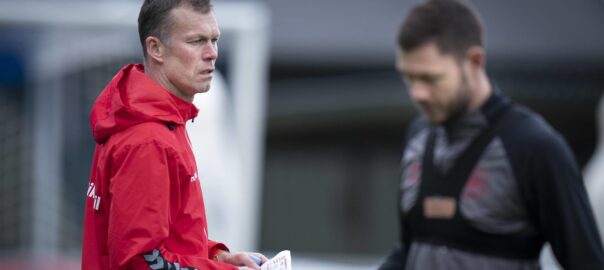
Morten Wieghorst coaching Denmark's national team.

  • World Cup veteran Morten Wieghorst is now Denmark’s assistant coach
  • The Danes have made a flawless, free-scoring start to Qatar 2022 qualifying
  • Wieghorst discusses their new-look team and reflects on his career highlights

Morten Wieghorst was 15 when Danish Dynamite exploded on the global stage. He watched, starry-eyed, as the stylish, fluid football of Laudrup, Lerby, Elkjaer and the Olsens illuminated the 1986 FIFA World Cup Mexico™, winning the hearts of neutrals everywhere.

A dream formed as he saw that team plant Denmark’s flag on the football map, and was realised 12 years later when Wieghorst lined up alongside Laudrup, his evergreen idol, at the country’s second World Cup. The Danes’ Class of ’98 were a fine team in their own right, had enjoyed major-tournament successes, and ultimately outperformed their beloved predecessors by reaching the quarter-finals.

But Wieghorst knows now, as he did then, that results alone do not determine a team’s standing and legacy. That’s why the former midfielder has no hesitation in declaring those heroes of ’86 superior to his generation and the country’s 1992 EURO winners, and is reflected in the ethos he has brought to his current job.

That job is No2 to Kasper Hjulmand, the coach who has led Denmark to three wins from three in Qatar 2022 qualifying – each more impressive than the last. An aggregate score of 14-0 in those matches reflects that style has been now allied to solidity and, as Wieghorst told FIFA.com, this dynamic Danish team heads to the EURO aiming not just to compete, but entertain.

Denmark celebrate scoring against Moldova in the 2022 World Cup qualifiers.

FIFA.com: Morten, three wins from three in World Cup qualifying, 14 goals scored and none conceded. Surely that’s that exceeded even your expectations?

It has. We’d decided on rotating, changing the team almost completely from game to game, before the group met up – just because of the time of the season, the number of games and the unique circumstances of the past year. But although we felt it was the right thing to do, you know there’s a risk in changing ten players from one game to another. If we’d slipped up against Moldova, that would have been the first thing thrown at us. In the end though, it couldn’t really have gone any better because we got a fantastic performance, eight goals, and came away from that game with even more competition for places. The players who’d played against Israel saw, ‘Ok, we really need to keep on our toes’ because the others in the squad had come in and done an exceptionally good job. It created a great feeling too because everyone went away proud of having played their part in that fantastic start we’ve had. And it wasn’t just the 14 goals scored and zero conceded – Kasper [Schmeichel] only had two saves to make across all three games. That definitely exceeded our expectations.

The third match in particular, winning 4-0 in Austria against a team expected to be one of your closest challengers, raised a lot of eyebrows.

It was impressive to us too because we thought that game in Vienna might well be our toughest in the entire campaign. And the first half was tight. But we thought at that stage that, even without playing our best, we had been comfortable defensively. That’s always a good base to build from, and that structure and solidity we’ve taken over from Age Hareide and his staff, who did a great job in making Denmark very difficult to break down. But we had a good half-time chat and almost from the start of the second half we were much better on the ball. We looked like we could score every time we went forward.

How have you and Kasper Hjulmand approached the job given that there wasn’t a lot wrong under Hareide, who had enjoyed a good record and qualified Denmark for Russia 2018 and the upcoming EURO?

You’re absolutely right to say that, and we were very fortunate that Age and Jon Dahl Tomasson had put in place a really great foundation for us to work on. The team was well organised, hard to beat and had been on a long unbeaten run. All the same, whenever there’s a change of staff, you can’t just keep everything as it was. It hasn’t been a revolution – far from it – but there were three or four points that we wanted to change in the playing style. Nothing massive; just tweaking details about the defensive side of the game and about the positions we held in possession and how we wanted to build up the game. The squad have embraced those changes very well.

Is it too simplistic to say that those changes add up to Denmark playing more on the front foot, in a more attractive, attacking style?

We try to press a little bit higher than was previously the case but we can’t do that for 90 minutes and it’s about finding the balance and deciding when you do it, and for how long. It’s been good to see, even against the best teams – we played Belgium in the Nations League, for example – that we can press high like that and feel comfortable doing it. That makes us look like we’re on the front foot, and it’s a great feeling for a team to have. But it’s easier said than done and you need to pick your moments because if you press at the wrong time, or in the wrong way, against the likes of Belgium, they will kill you. It’s a great challenge to get that balance right though, and I think Kasper is doing a fantastic job in making the most of the precious time he has with the players on the training ground.

We’ve seen in the past how crucial Christian Eriksen has been to Denmark. Is he still as central to the team you’re building, or are you trying to move away from being so reliant on him?

Christian is just a great player, and what’s been so important to us from day one has been to get him into the best positions on the pitch to help the team. You have to get the best out of your top players and, with Christian – who is definitely one of ours – we can see we’re moving in the right direction.

Roles were reversed when you and Kasper worked together at Nordsjaelland, as he was your assistant back then. How does the dynamic between the two of you work now?

First and foremost, we get on very well. There’s big respect between us and we know each other’s personalities and strengths extremely well. When I brought Kasper in as my assistant, he already had head-coach experience by then. And although there’s a difference between the two roles – I’m experiencing that now too – if you feel you’re part of something that makes sense, and a great coaching team, it can be a real pleasure too. That’s definitely the way it’s been for me.

Kasper Hjulmand and Morten Wieghorst.

How do your personalities mesh? You’re quite a calm guy; is he similar or is there a contrast there?

We’re not that different. You still hear sometimes that it’s important to have one calm guy and another who screams and shouts – the old good cop, bad cop routine. But I think times have changed. Kasper doesn’t come in shouting and bawling at the players at half-time, and he doesn’t want me doing that either. It’s all about motivating the group and, with this team, I really like and respect the fact that the players have been the first to recognise in matches when things aren’t going well. We’re there to help them along the path but, at half-time in Austria for example, it was the players who saw that things weren’t going to plan in an attacking sense and needed to be improved.

Having been to major tournaments with Denmark before, how excited are you by the prospect of doing that again?

Oh, very much so. We’re really excited about the EURO coming up, and all the more so now as we’ve been told that we’ll be able to have at least 12,000 fans inside the Parken Stadium – and we have three home games in the group stage. I’m very excited about the World Cup too. I think it’s going to be a special one having the competition concentrated in such a small area – it will create such a fantastic feeling. When it’s a big country, everything – and everyone – is spread out more. But having all the matches, all the teams, all the fans, gathered in a small area will make this really unique and special – the feeling will be intensified. The World Cup, for me, is still the biggest thing in football.

Morten Wieghorst in action at the 1998 World Cup.

Given your love for the World Cup, was playing at France 98 the highlight of your playing career?

It’s up there, definitely. There were so many at club level with Celtic too, and other special moments with the national team, like winning the Intercontinental Championship (later renamed the FIFA Confederations Cup) in 1995. I also remember in EURO 2000 qualifying, we had to win away to Italy to get through, went 2-0 down and came back to win 3-2. That was amazing. But the World Cup is always very special.

You watched the great Denmark team at Mexico 86, and later you’d go on to play with the likes of Michael Laudrup. What was that experience like?

That was such a big thing for me because that team, in my opinion at least, was Denmark’s best ever. That whole period was so significant because the 1980s was the first time that we’d shown that Denmark could compete against the best in the world. As for Michael, he was my hero growing up, so to get the chance to play alongside him – and then later under him in his first coaching job, and working on his coaching team at Swansea – was so special for me. It was something I couldn’t have dreamt of growing up and I feel very privileged. For me, he’s still Denmark’s greatest-ever player.

You mention the Intercontinental Cup win you had, and Denmark had won the EURO just a few years before. Is it your ambition to have the team challenging for trophies again?

It’s certainly what we dream about. To expect it is a different matter because we’re a nation of 5.5 million people, so we’re never going to start any tournament as favourites. Winning is what we work for and what we play for. But the most important thing is to go as far as we possibly can and also, I feel, to make people stop and watch. The ’86 team is a great example of that because, even though they didn’t win the tournament, they’re loved and respected as Denmark’s greatest because they entertained and had the world watching.

Morten Wieghorst.
FIFA.com
FIFA.com News