The approach of next year’s tournament is finally becoming tangible, yet the path to discovering the group pairings became an unexpected marathon. Supporters who tuned in at 17:00 GMT were treated to an extended prelude of musical numbers, speeches, and montages long before a single ball was drawn. Performances by Robbie Williams and Nicole Scherzinger, along with addresses from US President Donald Trump, FIFA President Gianni Infantino, and others, stretched the anticipation to the limit.
Co-host representatives Claudia Sheinbaum and Mark Carney joined Trump on stage to reveal their own teams, though this brought no fresh information. More interviews and cutaways followed, adding to the delay. At last, the main event started at 18:27 GMT, nearly ninety minutes after the scheduled time.
The draw itself lasted nearly an hour, prompting BBC commentator Jonathan Pearce to joke that the contest could begin before the ceremony reached its conclusion.
A broader field and new dynamics on the pitch
The coming edition will feature a record 48 nations, marking the largest lineup yet and introducing a new round of 32. With 12 groups of four, the early fixtures appear thinner in terms of clashes between the highest-ranked sides. England’s meeting with Croatia stands out as the only group match involving two top-10 teams. Brazil against Morocco provides the next most notable contest.
The Netherlands landed in what appears to be the toughest quartet based on rankings, while Germany’s collection of opponents offers the lowest difficulty on paper.
Nonetheless, compelling encounters remain scattered throughout the schedule, promising intriguing storylines even without frequent elite duels.
Two dominant forwards prepare for a rare showdown
Erling Haaland will finally enter a major international competition after carrying Norway through qualification with 16 goals in eight outings — the highest tally achieved by any player worldwide during the campaign. His prolific output continues to fuel discussion over his place in his country’s footballing history.
Norway’s final group fixture places Haaland opposite Kylian Mbappé, who is edging toward France’s all-time scoring record and has been in formidable form for Real Madrid. This will be the first time the pair face each other in national colors.
With both attackers entering the tournament in exceptional league-scoring rhythm, France coach Didier Deschamps highlighted the encounter as one of the standout individual contests of the group stage.
Familiar pairings and fresh memories revisited
Mexico and South Africa will reprise their 2010 opening-day meeting when they launch next summer’s competition at Estadio Azteca. Their previous curtain-raiser is etched into World Cup lore thanks to Siphiwe Tshabalala’s thunderous strike.
France will also cross paths with Senegal once more, a fixture that evokes memories of Senegal’s stunning upset in 2002, sealed by Papa Bouba Diop’s decisive effort.
Across the groups, several matches carry echoes of past tournaments, reinforcing the sense of historical threads interwoven with modern narratives.
The full picture of the groups
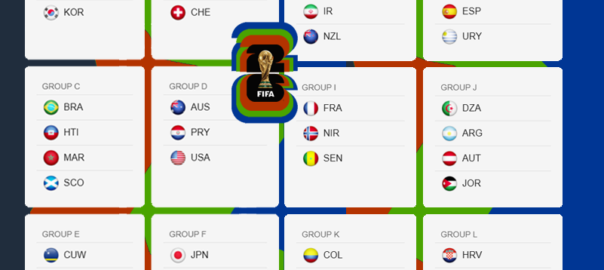
Group A: Mexico, South Africa, South Korea, UEFA Play-Off D
Group B: Canada, UEFA Play-Off A, Qatar, Switzerland
Group C: Brazil, Morocco, Haiti, Scotland
Group D: United States, Paraguay, Australia, UEFA Play-Off C
Group E: Germany, Curaçao, Ivory Coast, Ecuador
Group F: Netherlands, Japan, UEFA Play-Off B, Tunisia
Group G: Belgium, Egypt, Iran, New Zealand
Group H: Spain, Cape Verde, Saudi Arabia, Uruguay
Group I: France, Senegal, FIFA Play-Off 2, Norway
Group J: Argentina, Algeria, Austria, Jordan
Group K: Portugal, FIFA Play-Off 1, Uzbekistan, Colombia
Group L: England, Croatia, Ghana, Panama
Debut nations handed imposing challenges
Four teams — Uzbekistan, Cape Verde, Jordan, and Curaçao — have reached the tournament for the first time, but each will face a powerhouse in their opening contests.
Curaçao will meet Germany in their maiden match, becoming the smallest participating nation in the event’s history. Cape Verde are set to begin against Spain, offering an extraordinary test against former European and world champions.
Jordan’s reward for four decades of pursuit is a meeting with defending champions Argentina and Lionel Messi. Uzbekistan, guided by Fabio Cannavaro, will encounter Portugal and Cristiano Ronaldo as they make their finals debut.
These newcomers enter the competition with historic opponents awaiting them from the outset.
Early predictions for the elimination rounds
If the most highly regarded teams prevail in their groups, the first knockout stage could quickly produce heavyweight pairings. One highlight would be a possible meeting between Germany and France in the last 16, a fixture last seen in the 2014 quarter-finals. Germany would then potentially navigate past the Netherlands and Spain to progress further.
On the opposite side of the bracket, a prospective quarter-final involving Messi’s Argentina and Ronaldo’s Portugal draws immediate attention. This would depend on both sides topping their groups and surviving through the early elimination rounds, setting up a dramatic meeting in what may be the final World Cup for each legend.
England, should they begin well against Croatia and win Group L, would find themselves against a third-placed team in the round of 32, though determining the exact opponent remains tricky.