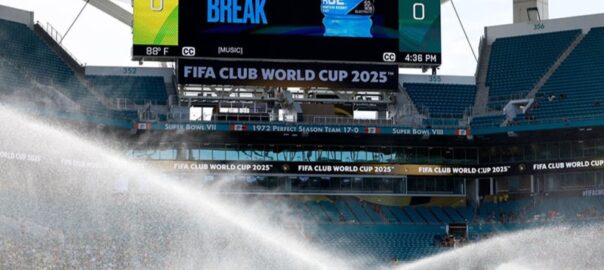
The 2026 World Cup will see a three-minute hydration pause in each half of every match. FIFA announced the initiative, emphasizing that it is designed to protect players’ well-being. These pauses will take place regardless of the weather to maintain consistent conditions for all teams.
Referees will pause play 22 minutes into each half to allow players time to rehydrate. This decision comes ahead of a summer tournament across the United States, Canada, and Mexico, where high temperatures and extreme weather events such as wildfires or hurricanes could affect participants and spectators.
Previous tournaments have implemented similar breaks only under extreme heat. However, this time, FIFA plans to standardize them for all matches, ensuring all teams benefit equally from the opportunity to recover.
Addressing extreme heat risks
A recent Pitches in Peril report, prepared by Football for the Future and Common Goal, highlighted that ten of the 16 World Cup stadiums face a very high risk of extreme heat stress. Concerns over player safety have intensified after complaints during the last Club World Cup, held in similarly hot conditions in June and July.
Chelsea midfielder Enzo Fernandez described experiencing dizziness while playing in “very dangerous” heat. Meanwhile, England manager Thomas Tuchel suggested that some substitutes might remain in the dressing room during matches to reduce exposure to the high temperatures.
FIFA’s hydration breaks are based on a simplified version of the cooling pauses used in past tournaments, and they will now be mandatory regardless of temperature or stadium conditions. Cooling breaks were previously only enforced when temperatures exceeded 32°C.
Implementation and scheduling considerations
The new breaks have also influenced match scheduling, contributing to the 13 different kickoff times planned for the tournament. Chief tournament officer Manolo Zubiria explained that each pause would last three minutes from whistle to whistle in both halves.
He also noted that if an injury stoppage occurs around the 20th or 21st minute, referees will handle it on the spot, ensuring that the hydration break is not interrupted.
This structured approach aims to prioritize player safety while maintaining the flow of the game, reflecting FIFA’s broader commitment to adapting to challenging summer conditions in North America.