The Italian National Team Italy is back to action. Italy Head Coach has called up 37 players for their first two games in the UEFA Nations League. The first game Italy vs Bosnia Herzegovina is scheduled Friday 4 September at the Artemio Franchi Stadium in Florence at 20:45. The second game Netherlands vs Italy is on Monday 7 September at the Johan Cruijff ArenA in Amsterdam at 20:45.
As reported by the Italian Football Federation (FIGC) the team will meet at the Coverciano Federal Training Centre on Saturday 29 August evening.
The last game of the Italian team was ten months after Italy’s 9-1 win over Armenia on 18 November at the Renzo Barbera Stadium in Palermo. Italy having eleven consecutive wins.
Head Coach Roberto Mancini called up 37 players (having now called up a total of 67 different players in his time in charge). This date marks the first milestone in a season full of international action, with eight games scheduled over the course of the next two months, all ahead of the European Championship next summer, postponed by a year due to the COVID-19 pandemic.
Forwards: Andrea Belotti (Torino), Federico Bernardeschi (Juventus), Francesco Caputo (Sassuolo), Federico Chiesa (Fiorentina), Stephan El Shaarawy (Shanghai Shenua), Ciro Immobile (Lazio), Lorenzo Insigne (Napoli), Moise Kean (Everton), Kevin Lasagna (Udinese), Riccardo Orsolini (Bologna).
*Suspended call-ups awaiting the outcome of medical tests once the players’ respective isolation requirements are complete.
Among the news is the first senior call-up for Alessandro Bastoni, Manuel Locatelli and Francesco Caputo, with the Inter defender having already taken part in a training camp with the senior side in February 2019. Another marked presence is that of Azzurri captain Giorgio Chiellini, who returns to the squad after a year out through injury.
ITALY VS. BOSNIA & HERZEGOVINA. These two nations have met on three occasions in the past: after a 2-1 friendly defeat in November 1996, a match which marked an end to the Sacchi era, Italy won both of their subsequent encounters in EURO 2020 qualifiers (2-1 in Turin and 3-0 in Zenica). Italy are unbeaten in Florence, having played 26 games in the city and come away with 20 wins and six draws. Their last trip to the Franchi ended in a 1-0 win for the Azzurri, Graziano Pellé’s goal gifting Italy three points against Malta in EURO 2016 qualifiers.
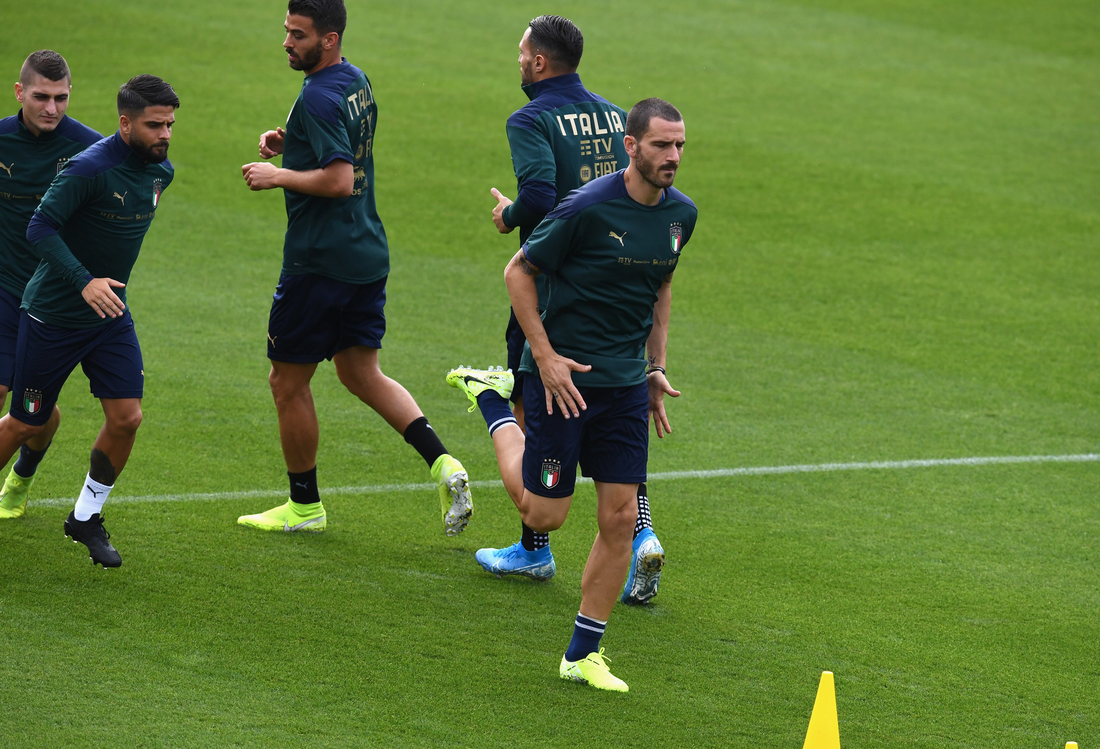
Photo: via figc.it
NETHERLANDS VS. ITALY. Italy hold a positive record against Dutch opposition: nine wins, nine draws and just three defeats from their 21 meetings. The last of these came in a friendly on 4 June 2018 in Turin (a 1-1 draw with goals from Zaza and Akè), an occasion which also marked Roberto Mancini’s first game in charge on home soil. This will be the Azzurri’s eleventh outing in Amsterdam, their five games against the Netherlands (two wins, three draws) being added to by five games in the 1928 Olympic Games as Italy finished with a bronze medal.
UEFA NATIONS LEAGUE 2020/21. This will be the second edition of the new-born international competition, a league divided into four groups from A to D with a promotion and relegation system and won by Portugal in the inaugural edition in 2019. The 2020/21 edition of the tournament has seen League A extended from twelve to 16 nations, with four groups of four teams and a total of six matchdays between September and November 2020.
The 55 federations have been divided into four leagues based on their UEFA national ranking (positions 1-16 in League A, 17-32 in League B, 33-48 in League C and 49-55 in League D). Italy have been inserted into Group 1 of League A, up against the Netherlands, Bosnia & Herzegovina and Poland, who they already faced in the previous edition of the tournament (a 0-0 draw in Bologna and a 1-0 win in Chorzow).
The four group winners from League A will then compete in the final phase of the UEFA Nations League, which will take place at a date still to be determined. The knockout tournament will be hosted by Group 1’s winner, with the host cities set to be Milan and Turin should Italy top their group. The group winners in Leagues B, C and D will be promoted, while the last-placed teams in Leagues A and B will be relegated. Seeing as League C has four groups and League D has just two, the two teams to be relegated from League C will be decided through play-offs over two legs. One novelty from the Nations League comes in the availability of two play-off places for the 2022 FIFA World Cup in Qatar: along with the ten group winners from qualification which begins in March 2021, there will also be play-offs for the ten runners-up from the World Cup qualifiers, along with the top two group winners from the UEFA Nations League who haven’t already qualified or made the play-offs.
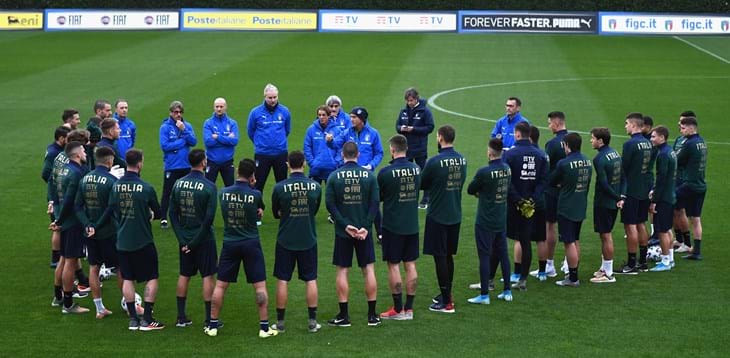
<> at Centro Tecnico Federale di Coverciano on November 11, 2019 in Florence, Italy.
Photo: via figc.it
👉 The schedule (all times CEST):
Saturday 29 August
The group to meet at the Coverciano Federal Training Centre by 23:30
Sunday 30 August
13:45 – Press conference with the Coach at the Coverciano Auditorium
17:30 – Training (behind closed doors)
Monday 31 August
13:45 – Press conference with a player at the Coverciano Auditorium
17:30 – Training (behind closed doors)
Tuesday 1 September
13:45 – Press conference with a player at the Coverciano Auditorium
17:30 – Training (behind closed doors)
Wednesday 2 September
13:45 – Press conference with a player at the Coverciano Auditorium
17:30 – Training (behind closed doors)
Thursday 3 September
17:00 – Italy’s press conference (Coach and one player) at the Stadio Franchi in Florence (location TBC)
17:30 – Italy’s training at the Stadio Franchi in Florence (open to the press for the first 15 minutes – location TBC)
18:30 – Bosnia & Herzegovina’s press conference (Coach and one player) at the Stadio Franchi in Florence
19:00 – Bosnia & Herzegovina’s training at the Stadio Franchi in Florence (open to the press for the first 15 minutes)
Friday 4 September
20:45 – Italy vs. Bosnia & Herzegovina (Stadio Franchi in Florence)
Followed by a press conference with the Coach
Saturday 5 September
10:00 – Training (behind closed doors)
17:30 – Transfer Florence to Venice
Sunday 6 September
10:45 – Transfer Venice to Amsterdam
11:00 – The Netherlands’ training at the KNVB Campus (open to the press for the first 15 minutes)
13:15 – The Netherlands’ press conference (Coach and one player) at the KNVB Campus
17:30 – Italy’s press conference (Coach and one player) at the Johan Cruijff ArenA
18:00 – Italy’s training at the Johan Cruijff ArenA (open to the press for the first 15 minutes)
Monday 7 September
20:45 – Netherlands vs. Italy (Johan Cruijff ArenA)
Followed by a press conference with the Coach and the squad’s return to Italy
Genoa Coach Rolando Maran visits for the first time Villa Rostan on Thursday 27 August 2020. A 360 ° contact with the work environment, starting from the assigned position on the first floor. The welcome of managers and employees.
Maran has the chance to inspect the headquarters, offices, changing rooms, fields and gym of the renovated Centro Signorini. Time for a greeting to everyone and to Ivan Radovanovic, also a former Chievo player. Then the operational meetings with the interlude of the tests for the Ben Sherman uniform, adorned with the rossoblù shield. The new technical course has turned on the picture. As soon as the results of the second round of health tests are unmarked, the activity on the green rectangle can start. A large group of players, at the Syn-Lab Il Baluardo, has just finished the exams to which it was subjected.
Genoa Cricket and Football Club announces on Wednesday 26 August 2020 that it has entrusted the technical management of the first team to Mister Rolando Maran. The President Enrico Preziosi and the Company wish the coach a good job. Maran is replacing coach Davide Nicola.
The contractual agreement is on the basis of a two-year period. His installation is expected on the occasion of the players’ return to activity, at the end of the second cycle of functional medical examinations at the beginning of the preparation.
Rolando Maran was born in Trento on 14 July 1963. After the end of his career as a football player, he embarked on the path of coach. Initially as assistant coach in Chievo Verona, then he moved on to the youth teams before Brescia and later on to the Cittadella. In 2002 he became the coach of the first team of the Cittadella. He then sits on the benches of Brescia, Bari, Triestina and Vicenza, before landing in Varese, an experience that ended with the play-off final. From the following year he assumed the technical management in Serie A first of Catania, then of Chievo Verona and subsequently of Cagliari.

 By Anna Italia